Photonic Quantum Computing Explained
Photonic quantum computing uses quantum states of light to encode, manipulate, entangle, measure, and process quantum information. Instead of relying on electrons moving through transistors, photonic approaches use photons traveling through waveguides, interferometers, beam splitters, phase shifters, sources, detectors, and integrated photonic circuits.
Photonic Quantum Computing at a Glance
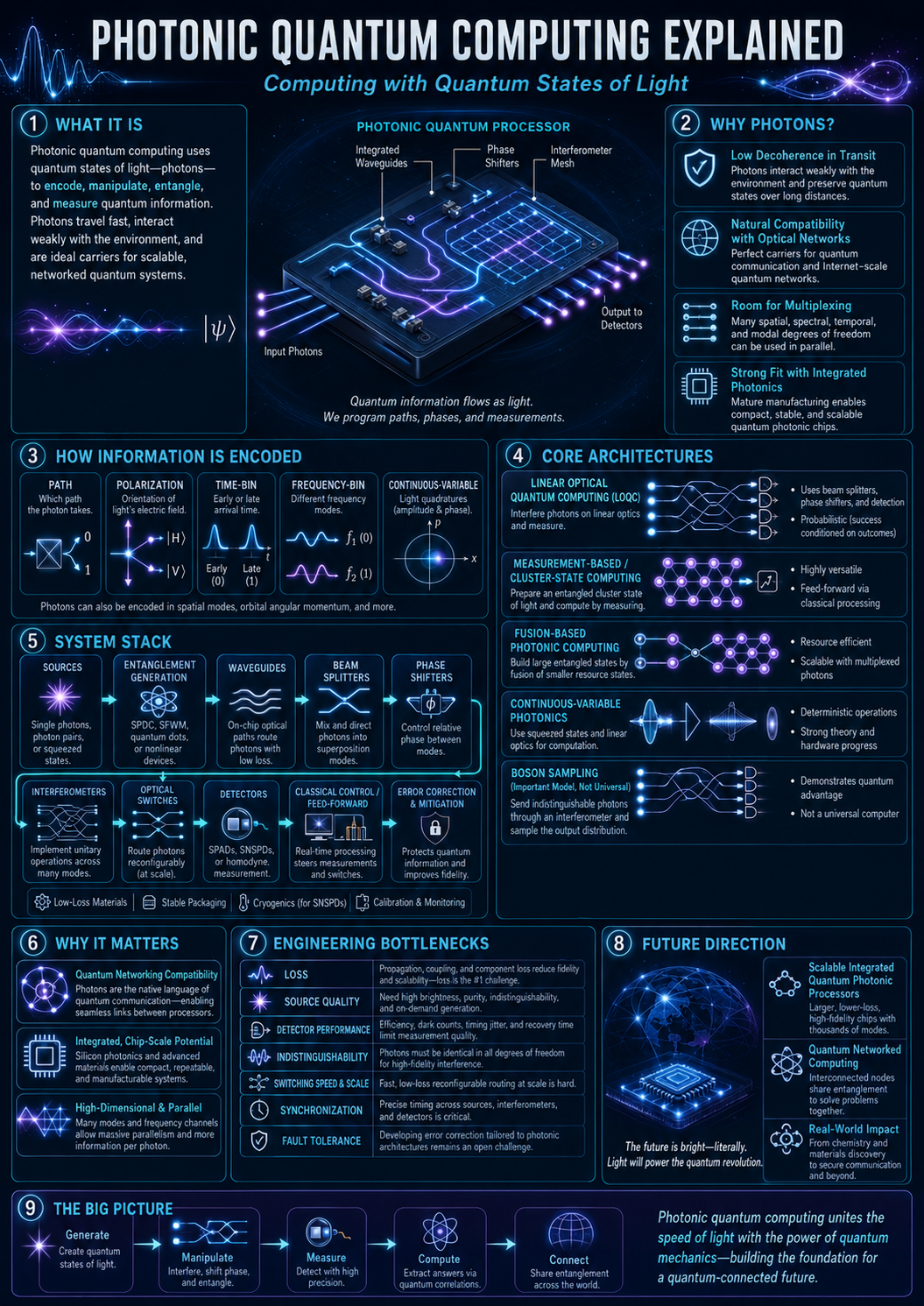
This study graphic summarizes the core photonic-quantum-computing lesson: what photonic quantum computing is, why photons are useful for quantum information, how different encodings and architectures work, how the full system stack fits together, and why loss, sources, detectors, and scalability remain the defining engineering constraints.
Offer this as a downloadable photonic-quantum-computing study reference.
Connect this form to your email platform and send visitors the full-size Photonic Quantum Computing infographic. This keeps the page educational while turning the visual reference into a useful lead magnet.
Photonic quantum computing processes information with quantum light.
A photonic quantum computer uses photons as carriers of quantum information. The photons may encode qubits in path, polarization, time-bin, frequency-bin, spatial mode, or phase states. They may also use continuous-variable states of light such as squeezed optical modes.
Photonic quantum computing is powerful because photons move quickly, resist many forms of environmental decoherence during transmission, and naturally connect with optical networks. It is difficult because photons do not easily interact with each other, and photon loss is extremely damaging.
Photonic quantum computing is attractive because photons are excellent carriers of quantum information. It is hard because computation requires creating, entangling, routing, and measuring photons with extremely low loss.
It is quantum computation built from light, optical circuits, and measurement.
In classical optical communication, light carries ordinary bits through fiber. In photonic quantum computing, quantum states of light carry quantum information and are processed through optical transformations and measurements.
A photonic quantum computer may use single photons, entangled photon states, squeezed light, cluster states, interferometers, photon-number-resolving detectors, feed-forward electronics, and integrated photonic chips.
quantum light + optical circuits + entanglement + measurement + feed-forward + error correction
Photons are natural flying qubits.
Photons can travel through fiber, waveguides, and free space while carrying quantum states. That makes them useful for distributed quantum systems, quantum networks, and chip-to-chip quantum interconnects.
Good carriers
Photons interact weakly with many environments, which helps them carry quantum states through optical links.
Quantum communication fit
Photons are already the natural information carrier for fiber-optic and free-space optical networks.
Transmission can be practical
Photon paths can operate outside cryogenic environments, even when sources or detectors require special conditions.
The challenge is that photons are not naturally strong interacting particles. They pass through each other easily, which is excellent for communication but difficult for deterministic quantum gates.
Quantum information can be encoded into multiple optical degrees of freedom.
Photonic quantum computers can use different encodings depending on the architecture. Some approaches use discrete qubits. Others use continuous variables.
| Encoding | Physical Meaning | Why It Matters |
|---|---|---|
| Path / Dual-Rail | A photon in one optical path or another | Common in integrated photonic circuits and linear optical quantum computing. |
| Polarization | Horizontal/vertical or diagonal polarization states | Useful in free-space and some bulk-optics experiments. |
| Time-Bin | A photon in an early or late time slot | Strong fit for fiber networks and temporal-mode processing. |
| Frequency-Bin | Quantum information in different spectral modes | Connects naturally to WDM, spectral processing, and integrated photonics. |
| Spatial Mode | Different transverse optical modes | Can support high-dimensional quantum information. |
| Continuous Variable | Optical field quadratures rather than discrete photon modes | Important for squeezed-light and measurement-based continuous-variable architectures. |
Linear optics uses beam splitters, phase shifters, interferometers, and measurement.
Linear optical quantum computing attempts to process photonic qubits using optical elements that guide and interfere light. Beam splitters and phase shifters can implement unitary transformations on optical modes.
The difficult part is two-qubit logic. Photons do not naturally interact strongly, so many schemes use measurement, ancillary photons, entanglement, and feed-forward to create effective nonlinear behavior.
Measurement can drive the computation.
Measurement-based quantum computing prepares a large entangled resource state, often called a cluster state, then performs computation by measuring parts of that resource in chosen bases.
This approach fits photonics because photons are easier to move and measure than to make interact directly. The challenge is generating large, high-quality entangled resource states with low loss and enough feed-forward control.
In measurement-based photonic computing, the entangled state is the hardware resource, and measurement patterns become the program.
Fusion architectures build larger resource states from smaller entangled pieces.
Fusion-based approaches generate small entangled photonic states and attempt to fuse them together using measurements. Successful fusion events grow larger entangled structures that can support fault-tolerant quantum computation.
The appeal is modularity: instead of trying to create a huge entangled state all at once, the system repeatedly creates, routes, fuses, and measures smaller photonic resources. The hard part is scaling this with enough source quality, detector performance, switching, low loss, and error correction.
Create small entangled states
Photon sources and circuits prepare small resource states.
Attempt entangling measurements
Measurements probabilistically connect smaller resources into larger structures.
Build fault-tolerant resources
Error correction and multiplexing are needed to overcome failure and loss.
Continuous-variable systems use quantum states of optical fields.
Not all photonic quantum computing uses discrete single-photon qubits. Continuous-variable photonics encodes quantum information in field quadratures, often using squeezed states of light.
Continuous-variable architectures can naturally create large optical cluster states and use homodyne or photon-number-resolving measurements. They also face challenges around squeezing quality, loss, noise, non-Gaussian resources, and fault-tolerant encoding.
Continuous-variable view: quantum field quadratures and squeezed optical modes
Boson sampling shows how hard multi-photon interference can become.
Boson sampling is a specialized photonic computation task where multiple photons pass through a complex optical network, and the output photon distribution is sampled. It is not a universal quantum computer by itself, but it demonstrates how quantum interference among many photons can generate classically difficult sampling problems.
Boson sampling helped make photonic quantum computing visible because it uses strengths of photons: multi-mode interference, low-loss optics, and measurement. But general-purpose quantum computing requires broader programmability, error correction, and fault tolerance.
A useful system needs sources, circuits, detectors, feed-forward, and error correction.
Photonic quantum computing is not just one chip. It is a full system stack.
| Layer | Role | Why It Matters |
|---|---|---|
| Quantum Light Sources | Generate single photons, entangled pairs, or squeezed states | Source purity, brightness, and indistinguishability affect everything downstream. |
| Photonic Circuits | Route, interfere, filter, delay, and phase-shift optical modes | Low loss and stable interferometry are essential. |
| Entanglement Resources | Create cluster states, Bell pairs, or fused resource states | Entanglement is the computational resource in many architectures. |
| Detectors | Measure photons and output electrical events | Efficiency, dark counts, timing jitter, and photon-number resolution shape performance. |
| Feed-Forward Electronics | Use measurement outcomes to control future operations | Fast control is needed for adaptive protocols and scalable architectures. |
| Error Correction | Protect logical information from loss and noise | Fault tolerance is required for large-scale useful quantum computing. |
Photonic quantum computers need manufacturable optical hardware.
Integrated photonics can move sources, waveguides, splitters, phase shifters, filters, switches, interferometers, and detectors onto compact chips. This is important because scalable photonic quantum computing cannot rely only on fragile tabletop optical setups.
The best long-term systems may combine silicon photonics, III-V sources, nonlinear materials, superconducting detectors, electronic control, advanced packaging, and cryogenic or temperature-controlled subsystems.
The future of photonic quantum computing is not just “more photons.” It is better integrated systems that can generate, route, entangle, measure, and correct quantum light at scale.
Photonics has a beautiful advantage and a brutal bottleneck: loss.
Photons are excellent carriers, but if a photon is lost, the quantum information can be lost with it. Loss affects sources, coupling, waveguides, switches, filters, fiber links, detectors, and packaging. This makes low-loss engineering central to photonic quantum computing.
The central enemy
Every lost photon can reduce computation fidelity or destroy an encoded state.
Photons must be clean
Sources need purity, brightness, synchronization, and indistinguishability.
Measurement must be reliable
Efficient, low-noise, fast, and scalable detectors are essential.
Classical control matters
Measurement-driven architectures require rapid electronic decisions and optical routing.
Logical qubits need protection
Fault-tolerant operation requires large overhead and robust encoding strategies.
Systems must be manufacturable
Photonic quantum processors need fiber attach, thermal control, readout, electronics, and testability.
Photonic quantum computing is a full-stack engineering race.
The most important progress will come from improving the whole system: brighter and cleaner sources, lower-loss integrated circuits, better detectors, faster feed-forward, optical switching, multiplexing, error correction, and scalable manufacturing.
This page completes the first QCLS Quantum Photonics cluster. The next expansion could move into deeper subpages on linear optical quantum computing, continuous-variable quantum photonics, boson sampling, quantum repeaters, or quantum memories.
Photonic quantum computing, explained clearly.
What is photonic quantum computing?
Photonic quantum computing uses quantum states of light to encode, process, entangle, and measure quantum information.
Why use photons for quantum computing?
Photons travel well through optical systems, resist many forms of environmental decoherence during transmission, and naturally connect with quantum networks.
What makes photonic quantum computing difficult?
Photons do not naturally interact strongly with each other, and photon loss is extremely damaging to quantum information.
What is linear optical quantum computing?
It is an approach that uses beam splitters, phase shifters, interferometers, single photons, measurement, ancillary states, and feed-forward to process quantum information.
What is measurement-based photonic computing?
It prepares a large entangled resource state and performs computation through a sequence of measurements.
Is boson sampling a full quantum computer?
No. Boson sampling is a specialized photonic sampling task. It can demonstrate hard multi-photon interference but is not, by itself, a universal fault-tolerant quantum computer.