Photonic Qubits Explained
A photonic qubit is a quantum bit encoded in a photon — a particle of light. Photonic qubits can carry quantum information through polarization, path, time-bin, frequency-bin, phase, or continuous-variable states, making photons powerful carriers for quantum communication, quantum networks, and photonic quantum computing.
Photonic Qubits at a Glance
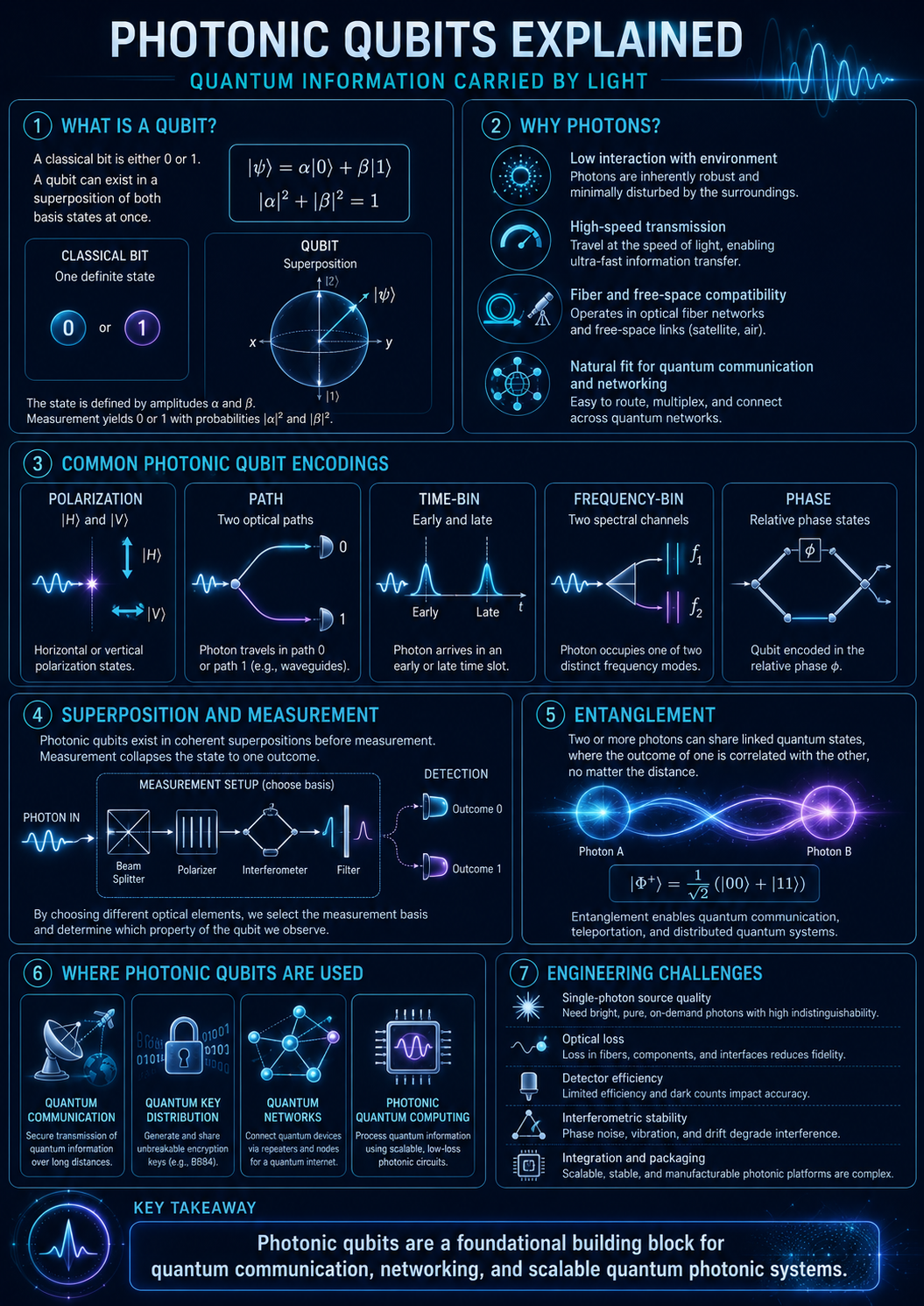
This study graphic summarizes the core photonic-qubit lesson: what a qubit is, why photons are effective quantum carriers, how photonic qubits are encoded, how superposition and measurement work, and how photonic qubits support quantum communication, networking, and photonic quantum computing.
Offer this as a downloadable photonic-qubits study reference.
Connect this form to your email platform and send visitors the full-size Photonic Qubits infographic. This keeps the page educational while turning the visual reference into a useful lead magnet.
Photonic qubits are quantum information carried by light.
A qubit is the basic unit of quantum information. A photonic qubit is a qubit encoded into one or more properties of a photon. Instead of using electrical charge, superconducting circuits, trapped ions, or atomic states, photonic systems use light itself as the quantum carrier.
Photonic qubits are especially valuable because photons travel well through optical fiber, interact weakly with the environment, and are natural carriers for long-distance quantum communication. They are also central to quantum key distribution, quantum networks, quantum teleportation experiments, photonic quantum computing, and integrated quantum photonic chips.
The simplest way to think about it: a photonic qubit is not a classical light pulse. It is a quantum state of light used to carry quantum information.
A qubit is a quantum two-state information system.
A classical bit is either 0 or 1. A qubit can be described as a quantum state that combines two basis states before measurement. Those basis states are often written as |0⟩ and |1⟩.
Qubit before measurement: α|0⟩ + β|1⟩
|α|² + |β|² = 1
The symbols α and β are probability amplitudes. When the qubit is measured in a chosen basis, the result becomes one of the allowed outcomes with probabilities determined by those amplitudes.
Photons are strong quantum carriers because they move well.
Photons are excellent carriers of quantum information because they can travel at high speed through optical fiber or free space and can preserve quantum states over useful distances when the system is well engineered.
Photons are hard to disturb
Photons do not easily interact with each other or many environmental degrees of freedom, which helps transmission.
They use optical infrastructure
Quantum states of light can travel through fiber links, making photons useful for quantum communication.
Transmission can avoid cryogenic channels
Photon transmission often works outside cryogenic hardware, even when sources or detectors may need special conditions.
The same weak interaction that makes photons good for communication also makes some forms of photonic quantum computing difficult. Photons are easy to move but hard to make interact deterministically.
A photon can encode a qubit in several physical degrees of freedom.
Photonic qubits are flexible because quantum information can be encoded in different properties of light. Each encoding has advantages and trade-offs.
| Encoding | What |0⟩ and |1⟩ Can Mean | Why It Matters |
|---|---|---|
| Polarization | Horizontal vs vertical, or other polarization bases | Conceptually simple and widely used in free-space and lab experiments. |
| Path | Photon in one waveguide/path vs another | Useful for integrated quantum photonic circuits and interferometers. |
| Time-bin | Photon arriving in an early time slot vs a late time slot | Strong fit for fiber communication because it can be robust to polarization drift. |
| Frequency-bin | Photon occupying one optical frequency mode vs another | Useful for dense spectral processing and compatibility with wavelength-domain photonics. |
| Phase | Relative phase between optical modes | Central to interferometric processing and many quantum communication protocols. |
| Continuous-variable | Quadratures of the optical field rather than discrete modes | Important for squeezed light, homodyne detection, and continuous-variable quantum information. |
A photonic qubit can exist in a quantum combination of modes.
Superposition means the photonic qubit is not simply “this path” or “that path,” “early” or “late,” “horizontal” or “vertical” before measurement. It can be in a coherent combination of basis states.
|ψ⟩ = α|path A⟩ + β|path B⟩
Time-bin qubit example:
|ψ⟩ = α|early⟩ + β|late⟩
The usefulness of the qubit depends on preserving coherence. If the environment leaks information about the state, interference can be lost and the quantum behavior degrades.
Measurement converts quantum amplitudes into an observed outcome.
A photonic qubit is measured by sending it through optical components and detectors arranged for a chosen measurement basis. Depending on the encoding, the measurement system may use polarizers, beam splitters, interferometers, filters, delay lines, phase shifters, or single-photon detectors.
Polarizers and waveplates
Measurement projects the photon onto selected polarization bases.
Interferometers and detectors
Measurement determines which path or coherent path combination is detected.
Delay interferometers
Measurement compares early and late time modes through controlled interference.
Detection does not reveal a hidden classical value that was simply sitting there. It produces an outcome according to the quantum state and the measurement basis.
Photonic qubits become most powerful when they are entangled.
Entanglement links quantum states across multiple photons or across light and matter systems. Entangled photonic qubits are central to quantum communication, quantum teleportation, entanglement distribution, quantum repeaters, and photonic quantum computing.
For example, two photons can be entangled in polarization, time-bin, frequency, or path. Measuring one photon then reveals correlations with the other that cannot be explained as ordinary classical correlation.
Entanglement is what turns photonic qubits from isolated quantum carriers into the foundation of quantum networks and distributed quantum systems.
Photonic qubits connect quantum communication, networking, sensing, and computing.
Photonic qubits appear across multiple quantum technology categories. The exact encoding and hardware depend on the application.
Sending quantum states
Photons can carry qubits through fiber or free-space links.
Quantum key distribution
Photonic states can help distribute cryptographic keys using quantum measurement principles.
Entanglement distribution
Photonic qubits can connect remote quantum processors, memories, and sensors.
Qubits on chips
Waveguides, interferometers, filters, resonators, and detectors can process photonic qubits on PICs.
Linear optics and measurement
Photons can support computation through interference, entanglement, measurement, and feed-forward.
Using quantum states of light
Nonclassical light can improve measurement sensitivity in carefully designed systems.
Photonic qubits are powerful, but building reliable systems is difficult.
The physics is elegant, but practical quantum photonics requires precise sources, low-loss circuits, stable interferometers, efficient detectors, and careful system integration.
Generating the right photons
Many systems need photons that are pure, indistinguishable, synchronized, and generated on demand.
Lost photons destroy information
Propagation loss, coupling loss, detector inefficiency, and imperfect components reduce performance.
Photons must match
Many interference-based protocols require photons that are nearly identical in all relevant degrees of freedom.
Seeing single photons is hard
Single-photon detectors must be efficient, low-noise, fast, and compatible with the system.
Interference needs control
Many encodings and operations depend on stable optical phases and path-length matching.
Systems must grow
Large-scale quantum photonics needs manufacturable chips, packaging, control electronics, and testing.
Photonic qubits are the entry point into quantum networks and photonic quantum computing.
As integrated photonics advances, more photonic qubit functions can move onto chips: sources, waveguides, interferometers, switches, filters, multiplexers, detectors, and control electronics. This is the pathway from fragile tabletop quantum optics toward manufacturable quantum photonic systems.
The next QCLS quantum pages should build from here: entanglement, QKD, single-photon sources, single-photon detectors, and photonic quantum computing.
Photonic qubits, explained clearly.
What is a photonic qubit?
A photonic qubit is a quantum bit encoded in a photon or optical mode. It can use properties such as polarization, path, time-bin, frequency-bin, phase, or optical quadratures.
Why are photons useful as qubits?
Photons travel well through fiber and free space, interact weakly with the environment, and are natural carriers for quantum communication and quantum networks.
What is time-bin encoding?
Time-bin encoding represents quantum information using different arrival-time modes, such as an early time bin and a late time bin.
Can photonic qubits be used for quantum computing?
Yes. Photonic quantum computing uses interference, entanglement, measurement, and feed-forward, although deterministic photon-photon interactions are difficult.
What makes photonic qubits hard to scale?
Major challenges include photon loss, source quality, indistinguishability, detector efficiency, phase stability, packaging, and system control.
How are photonic qubits related to quantum networks?
Photonic qubits can carry quantum information between remote nodes, making them central to entanglement distribution, QKD, teleportation, and future quantum networks.