
Photonics vs Copper Interconnects
Copper and photonics are both essential to modern computing systems. Copper is still excellent for short, cheap, local electrical connections. Photonics becomes powerful when bandwidth, reach, signal integrity, energy per bit, and physical density become the limiting factors.
Copper
Best for short, local, low-cost electrical paths where reach and loss remain manageable.
Photonics
Best when data must travel farther, faster, denser, and with less electrical loss.
Photonics vs Copper Interconnects at a Glance
This study graphic summarizes the core comparison: where copper remains strong, where photonics becomes superior, how they differ in bandwidth, reach, power, density, and AI scalability, and why the future of high-performance systems is a hybrid architecture using the right technology at the right distance.
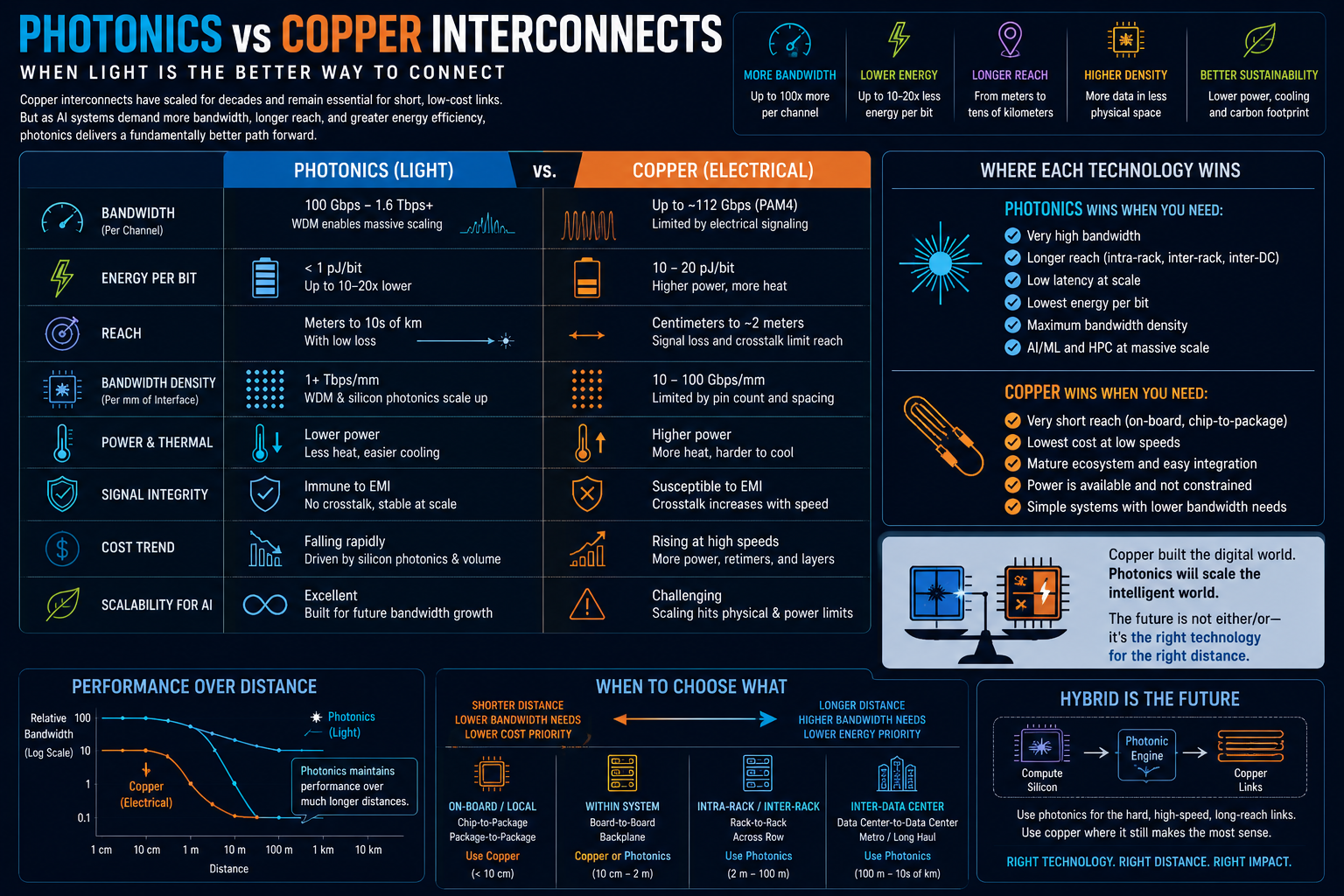
Offer this as a downloadable photonics-versus-copper study reference.
Connect this form to your email platform and send visitors the full-size Photonics vs Copper Interconnects infographic. This keeps the page educational while turning the visual reference into a useful lead magnet.
The question is not copper or photonics. The question is where each physical layer belongs.
Copper interconnects use electrical signals through conductive paths. Photonic interconnects use optical signals through fiber, waveguides, or optical engines. Each is strong in different parts of the system.
Copper is simple, mature, low-cost, and excellent for short-distance electrical communication. It is deeply integrated with chips, packages, boards, connectors, and power delivery. But high-speed copper links become harder as data rates rise and distance increases.
Photonics is strongest where data must move with high bandwidth, longer reach, better signal integrity, higher bandwidth density, or lower data-movement energy in the right architecture.
The future of AI infrastructure is hybrid: copper for local electrical communication, photonics for high-bandwidth data movement where copper becomes too lossy, hot, dense, or power-hungry.
Copper wins when links are short, cheap, local, and simple.
Copper is the default language of electronics. Chips, packages, boards, connectors, memory, power delivery, and control systems all rely on electrical paths. Copper remains extremely important because most computation, logic, memory access, and control are electronic.
Mature and economical
Copper links are widely manufactured, familiar, and cost-effective for short electrical paths.
Native to electronics
Copper works naturally with CMOS, packages, boards, connectors, and power systems.
Excellent for local links
Short electrical paths can be extremely fast, direct, and efficient for nearby components.
Copper should not be dismissed. In many places, it is the right answer. The problem appears when copper is forced to carry extremely high-speed signals across distances or densities where electrical loss becomes expensive.
Photonics wins when reach, bandwidth, and density matter more.
Photonics uses light to move data. Optical links can travel through fiber or on-chip waveguides and can carry multiple wavelengths at once. This gives photonics advantages in reach, bandwidth density, signal isolation, and scaling.
Longer high-speed links
Optical fiber can carry high-speed data across longer distances with lower loss than high-speed copper.
Many wavelengths, one path
Multiple optical wavelengths can share one fiber or waveguide, increasing bandwidth density.
Less electrical interference
Optical fiber is not affected by electromagnetic interference in the same way as copper.
Photonics vs copper depends on bandwidth, reach, energy, cost, and serviceability.
There is no universal winner. A good architecture uses copper and photonics together.
| Factor | Copper Interconnects | Photonic Interconnects |
|---|---|---|
| Best use case | Short, local, low-cost electrical links | High-bandwidth, longer-reach data movement |
| Physical carrier | Electrons through conductive paths | Photons through fiber or waveguides |
| Distance scaling | Harder as data rate and distance increase | Strong over longer reaches and optical fabrics |
| Bandwidth density | More lanes, traces, pins, and equalization | Fiber, waveguides, WDM, optical I/O, CPO |
| Power pressure | Drivers, equalization, retiming, and loss can rise with speed and reach | Lasers, modulators, detectors, coupling, and thermal tuning must be managed |
| Serviceability | Mature and familiar | Depends on pluggables, CPO strategy, fiber attach, lasers, and package design |
| Future role | Local electrical communication, control, memory, power, short reach | Optical interconnects, AI fabrics, CPO, optical I/O, photonic chiplets |
Copper becomes harder as signals get faster and travel farther.
High-speed electrical signals lose quality as they move through traces, connectors, cables, and packages. The system may need equalization, retiming, stronger drivers, better materials, shorter paths, or more power.
Photonics changes the channel. Light can move through fiber with far lower distance-related loss for high-bandwidth communication, which is why optical links dominate longer data-center and telecom connections.
Data movement power is where the trade-off becomes serious.
Copper links consume energy through drivers, receivers, loss, equalization, retiming, clocking, and signal conditioning. At higher speeds and longer distances, that energy can grow quickly.
Photonic links can reduce data-movement energy in the right regimes, but the full optical link must be counted: lasers, modulators, detectors, receivers, coupling, packaging, thermal tuning, and DSP.
Photonics does not mean “free energy.” It means optical data movement can become more efficient when copper links are spending too much energy fighting the channel.
Photonics helps when there is not enough physical room for more copper.
AI systems need more bandwidth through limited package edge, board space, cable count, rack faceplates, and power budgets. Copper can scale by adding lanes, increasing data rates, and improving materials, but those approaches create congestion and power pressure.
Photonics adds new scaling tools: fiber, waveguides, WDM, CPO, optical I/O, and photonic chiplets.
Photonic scaling: more wavelengths + optical paths + denser optical I/O
AI forces the copper-versus-photonics decision earlier.
AI workloads move enormous amounts of data between accelerators, memory, storage, switches, and racks. As clusters scale, the system becomes constrained by interconnect bandwidth, energy per bit, reach, and density.
Light between systems
Optical links connect switches, racks, servers, and data-center fabrics.
Optics near switch ASICs
Co-packaged optics shortens high-speed electrical paths before data becomes light.
Light near compute
Optical I/O moves photonic connectivity closer to accelerators and advanced packages.
The future is copper plus photonics, not copper versus photonics everywhere.
Modern systems will use copper where electrical links are best and photonics where optical links are best. That means copper inside chips, packages, short board paths, memory interfaces, control systems, and power delivery — with photonics increasingly used for high-bandwidth communication across longer or denser boundaries.
Local electronic communication
Short-reach electrical I/O, memory interfaces, control, logic, management, and power delivery remain copper-heavy.
High-bandwidth optical movement
Fiber links, optical engines, CPO, optical I/O, WDM, and photonic chiplets grow where bandwidth density and reach dominate.
Photonics solves some copper problems but introduces optical ones.
Replacing a copper link with an optical link only helps if the full system works. Photonics introduces its own challenges around lasers, coupling, packaging, thermal control, testing, standards, and serviceability.
Light source power matters
Laser efficiency, placement, wavelength stability, and reliability affect system economics.
Getting light in and out is hard
Fiber-to-chip or package-to-fiber coupling can erase efficiency gains if loss is high.
Photonic devices drift
Temperature changes can shift resonators, filters, and optical alignment.
Data centers need repairable systems
Pluggables are easy to replace; CPO and optical I/O require new service models.
Optics must justify complexity
The optical solution must beat copper at the system level, not only in a lab metric.
Validation crosses domains
Optical systems require electrical, optical, thermal, mechanical, and firmware validation.
As AI scales, the optical boundary moves closer to compute.
Optics already dominates long-haul and data-center interconnects. The next shift is moving optical conversion closer to the sources of data: switches, accelerators, chip packages, and eventually chiplet ecosystems.
Copper will remain essential, but the boundary between copper and photonics is moving inward as bandwidth density and energy per bit become more important.
Photonics vs copper, explained clearly.
Is photonics better than copper?
Photonics is better for certain high-bandwidth, longer-reach, high-density links. Copper is still better for many short, local, low-cost electrical connections.
Will optical links replace copper everywhere?
No. Copper remains essential for local electrical communication, memory interfaces, control, power delivery, and short-reach links.
Why does copper struggle at high speed?
High-speed copper links face loss, crosstalk, reflections, equalization, retiming, heat, and reach limitations.
Why does photonics help AI data centers?
Photonics can improve bandwidth density, reach, and energy efficiency for large-scale data movement between accelerators, switches, racks, and facilities.
What is the role of WDM?
WDM allows multiple wavelengths to carry separate data channels through the same fiber or waveguide, increasing bandwidth density.
What are the drawbacks of photonics?
Photonics adds challenges in lasers, coupling, packaging, thermal stability, testing, standards, serviceability, and cost.