
Wavelength-Division Multiplexing Explained
Wavelength-division multiplexing, or WDM, is one of the most important ideas in optical communications: multiple colors of light can carry separate data channels through the same fiber or waveguide at the same time.
WDM at a Glance
This study graphic summarizes the core WDM lesson: what wavelength-division multiplexing is, how multiple wavelengths travel through one fiber or waveguide, how multiplexers and demultiplexers work, why WDM increases bandwidth density, and why it matters for silicon photonics, optical communications, and AI data-center scaling.
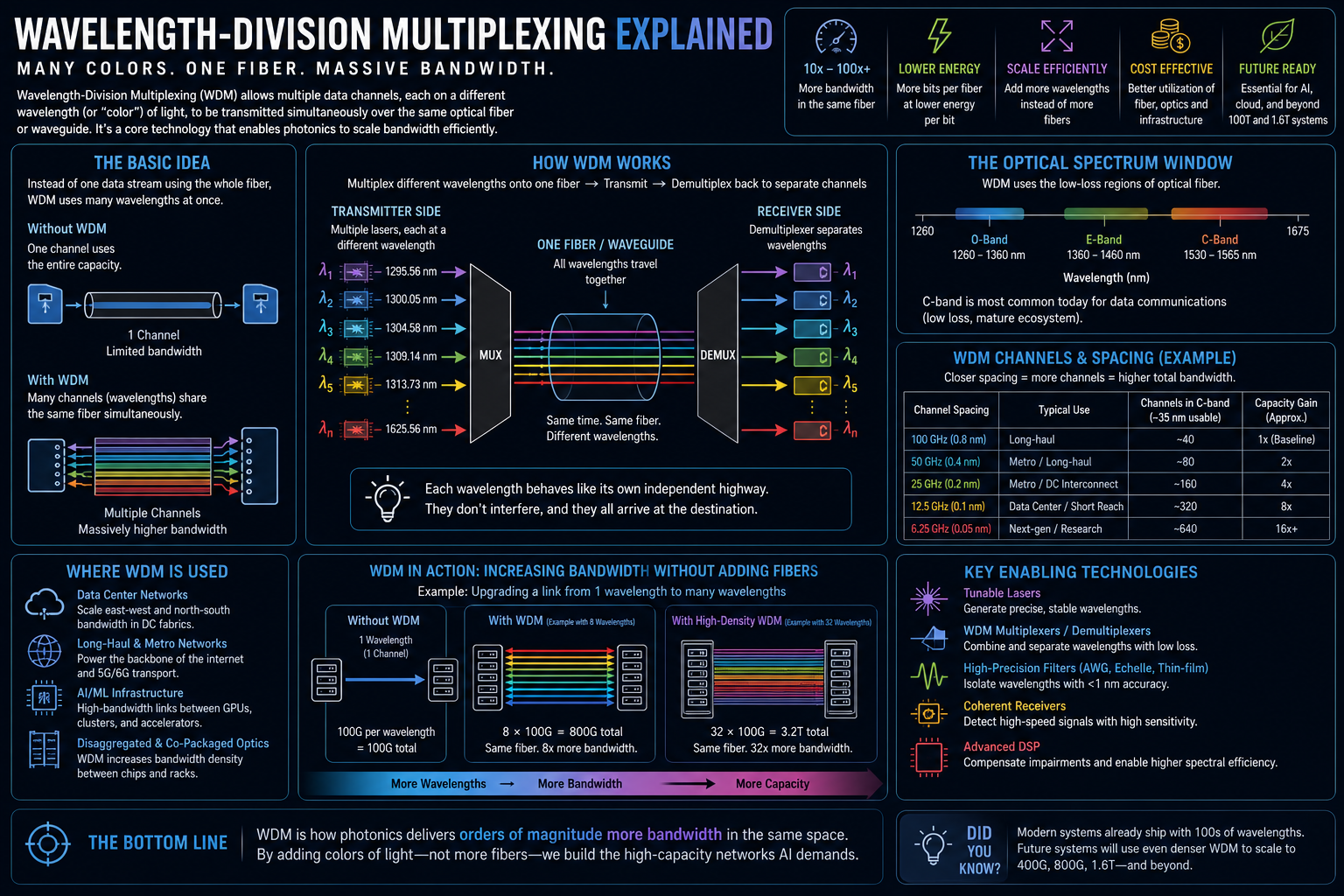
Offer this as a downloadable WDM study reference.
Connect this form to your email platform and send visitors the full-size WDM infographic. This keeps the page educational while turning the visual reference into a useful lead magnet.
WDM lets many optical channels share one fiber or waveguide.
Wavelength-division multiplexing is a technique that sends multiple optical signals through the same physical optical path by assigning each data stream to a different wavelength of light.
Instead of using one fiber for one signal, WDM uses many optical wavelengths as separate channels. Each wavelength can carry its own data stream. A multiplexer combines the wavelengths at the transmitter side, and a demultiplexer separates them at the receiver side.
WDM is one of the reasons photonics scales bandwidth differently than copper: it adds a wavelength dimension to data movement.
WDM is optical channel stacking.
In electronics, adding more data channels often means adding more physical lanes, pins, traces, or cables. In photonics, multiple wavelengths of light can travel together through the same fiber or waveguide while remaining separable.
λ2 → data channel 2
λ3 → data channel 3
λ4 → data channel 4
All wavelengths share the same optical medium.
This is why WDM is fundamental to optical networks, data-center interconnects, silicon photonics, co-packaged optics, optical I/O, and future AI-scale fabrics.
Each wavelength behaves like a separate optical lane.
A WDM system starts with multiple optical carriers, each at a different wavelength or frequency. Data is encoded onto each carrier using modulation. The carriers are combined into a shared optical path, transported together, then separated by wavelength at the receiver side.
Multiple optical carriers
Each wavelength acts like a separate optical channel.
Information rides on light
Electrical data is encoded onto each optical wavelength.
Combine into one path
A mux combines channels into the same fiber or waveguide.
Shared optical medium
The combined wavelengths travel together through the optical link.
Separate by wavelength
A demux splits the wavelengths back into individual channels.
Recover the data
Photodetectors and receivers convert optical signals back to electrical data.
Coarse WDM and dense WDM use different channel spacing strategies.
WDM is a broad category. CWDM uses wider wavelength spacing and is generally simpler. DWDM uses tighter spacing and can support more channels, higher capacity, and longer-reach optical network designs.
| Type | Main Idea | Typical Strength |
|---|---|---|
| CWDM | Coarser wavelength spacing | Simpler optics, fewer channels, often useful for shorter or lower-cost links. |
| DWDM | Denser wavelength spacing | More channels, higher aggregate capacity, strong fit for scalable optical networks. |
| Integrated WDM | WDM functions on photonic chips | Compact multiplexers, demultiplexers, filters, and resonators for optical I/O and PICs. |
A WDM system depends on wavelength control and filtering.
WDM requires more than a single fiber. It needs optical sources, modulators, multiplexers, demultiplexers, filters, detectors, and control systems that keep channels separated and stable.
Provide optical carriers
Each channel needs a stable optical wavelength or frequency.
Encode data
Modulators imprint electrical data onto optical carriers.
Combine wavelengths
A mux merges many wavelengths into one optical path.
Separate wavelengths
A demux splits combined channels back apart at the receiver side.
Select channels
Filters isolate target wavelengths and reject unwanted ones.
Recover electrical data
Photodetectors convert received optical signals into electrical current.
WDM helps AI systems move more data without endless cables.
AI data centers need massive bandwidth between accelerators, switches, racks, storage, and facilities. WDM can increase aggregate bandwidth without requiring a separate fiber or copper lane for every data channel.
Integrated photonics can bring WDM onto chips.
WDM does not only live in long-haul optical networks. Silicon photonics can build compact WDM functions such as arrayed waveguide gratings, ring resonators, filters, splitters, couplers, multiplexers, and demultiplexers.
This matters because future optical I/O and photonic chiplets need compact ways to move many channels through limited package and fiber interfaces.
Compact wavelength filters
Can select or modulate specific wavelengths, but may need thermal control.
Multi-channel routing
Arrayed waveguide gratings can separate or combine wavelength channels.
Density for optical I/O
Integrated WDM helps increase data throughput from compact photonic systems.
WDM increases bandwidth density by using wavelength as a scaling dimension.
Bandwidth density is not just how fast one channel runs. It is how much total throughput fits into a physical boundary. WDM helps because one optical path can carry multiple wavelength channels.
WDM gives photonics a scaling dimension copper does not have in the same way: many colors of light can share the same physical path.
The practical result is higher aggregate bandwidth per fiber, per waveguide, per package edge, or per optical interface — assuming the system can manage power, filtering, wavelength stability, and coupling loss.
WDM is powerful, but wavelength systems must be controlled carefully.
WDM increases capacity, but it also adds engineering constraints around channel spacing, drift, filtering, nonlinear effects, dispersion, laser stability, thermal tuning, and receiver design.
Channels must stay aligned
Temperature and device variation can shift optical wavelengths and filters.
Channels can interfere
Filters and spacing must prevent one wavelength from leaking into another channel.
Control costs power
On-chip filters and resonators may require active tuning and monitoring.
Many channels need light
Systems need stable sources, combs, arrays, or external lasers depending on architecture.
Every optical component costs margin
Muxes, demuxes, filters, couplers, and waveguides all contribute loss.
More channels means more control
High-channel-count WDM systems require calibration, monitoring, testing, and reliability planning.
WDM is a foundation for scalable optical infrastructure.
As AI infrastructure demands more data movement, WDM becomes increasingly important. It helps optical links carry more total bandwidth without simply adding more fibers, modules, or copper lanes.
The future includes integrated WDM in silicon photonics, optical engines, CPO modules, optical I/O chiplets, data-center fabrics, and AI-scale interconnect systems.
WDM, explained clearly.
What is wavelength-division multiplexing?
WDM is an optical communication technique that sends multiple data channels through the same fiber or waveguide by assigning each channel a different wavelength of light.
Why does WDM increase bandwidth?
WDM increases aggregate bandwidth because multiple wavelengths can carry separate data streams through the same physical optical path.
What is the difference between CWDM and DWDM?
CWDM uses wider channel spacing and is generally simpler. DWDM uses denser spacing, enabling more channels and higher aggregate capacity.
How does WDM help AI data centers?
WDM can increase bandwidth per fiber, reduce cable complexity, improve bandwidth density, and support scalable optical interconnect fabrics.
Can WDM be integrated onto photonic chips?
Yes. Silicon photonics can integrate WDM functions using waveguides, filters, ring resonators, arrayed waveguide gratings, muxes, and demuxes.
What limits WDM systems?
Limits include laser stability, channel spacing, crosstalk, filtering, thermal drift, insertion loss, dispersion, nonlinear effects, and control complexity.