
Quantum Sensing with Photonics Explained
Quantum sensing with photonics uses quantum states of light, optical interference, single photons, squeezed light, entanglement, atomic references, and photonic integrated circuits to measure the physical world with extreme precision. It connects quantum physics to real measurements: fields, time, motion, chemistry, pressure, temperature, biology, and navigation.
Quantum Sensing with Photonics at a Glance
This study graphic summarizes the core quantum-sensing lesson: what quantum sensing with photonics is, why it matters, which quantum principles and photonic tools are involved, what sensor families exist, how integrated photonic quantum sensors work, where the applications are strongest, and which noise, packaging, and deployment challenges shape real-world quantum sensing systems.
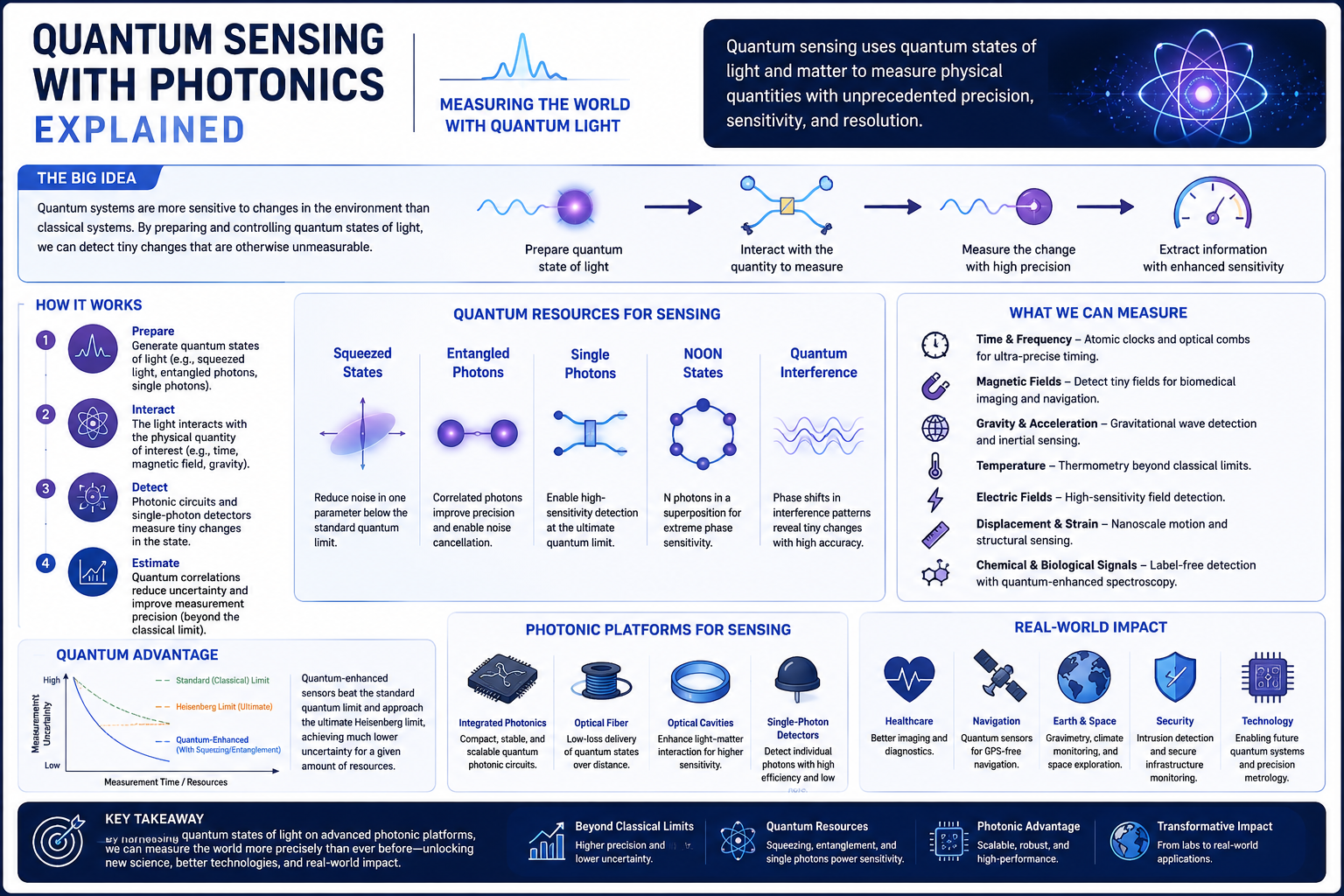
Offer this as a downloadable quantum-sensing study reference.
Connect this form to your email platform and send visitors the full-size Quantum Sensing with Photonics infographic. This keeps the page educational while turning the visual reference into a useful lead magnet.
Quantum sensing uses quantum behavior to measure physical quantities more precisely.
A quantum sensor uses quantum properties such as superposition, coherence, spin, entanglement, squeezing, photon statistics, or interference to measure something about the world. Photonics matters because light can prepare, carry, probe, and read out quantum states with extraordinary precision.
Quantum sensing with photonics can involve laser interferometry, squeezed light, single-photon detection, atomic clocks, quantum-enhanced spectroscopy, optomechanical sensors, integrated resonators, color-center sensors, and chip-scale atomic or molecular references.
Quantum sensing is not just “a more sensitive sensor.” It is a measurement system that uses quantum effects as part of the sensing mechanism.
It is precision measurement using quantum light, quantum matter, or both.
Photonics is already one of the most powerful tools for sensing. Light can measure distance, velocity, vibration, absorption, refractive index, temperature, pressure, magnetic fields, and chemical composition. Quantum sensing pushes this further by using quantum states or quantum-limited measurement techniques.
Some photonic quantum sensors use light as the quantum probe. Others use light to read out a quantum system, such as an atom, ion, defect center, vapor, molecule, or superconducting detector. Many practical systems use both quantum matter and photonic readout.
Quantum sensing connects deep physics to useful measurement.
Many industries depend on measurement: navigation, communications, semiconductor manufacturing, medical imaging, environmental monitoring, defense, geophysics, timing, energy, and scientific instrumentation. Quantum sensing aims to improve sensitivity, stability, resolution, or calibration in regimes where classical sensors face limits.
Measure smaller signals
Quantum systems can respond to tiny changes in phase, frequency, field strength, time, or motion.
Reference physics itself
Atomic and quantum references can provide stable measurement standards.
See what classical sensors miss
Quantum sensors can open measurement regimes that are difficult with traditional devices.
Bring sensors onto chips
Integrated photonics can shrink optical measurement systems into deployable packages.
Distributed sensing
Quantum networks may eventually coordinate sensors using entanglement or shared quantum references.
Improve measurement standards
Quantum-based references can improve standards for time, frequency, pressure, vacuum, and optical power.
Quantum sensing depends on coherence, phase, noise, and measurement statistics.
Quantum sensors often convert a physical signal into a measurable shift in a quantum state. That shift may appear as a phase change, frequency shift, spin precession, photon correlation, squeezed-noise signature, resonance shift, or timing difference.
| Principle | Meaning | Why It Matters |
|---|---|---|
| Superposition | A quantum system can exist in a combination of states | Small perturbations can change relative phase and become measurable. |
| Coherence | Quantum phase relationships are preserved | Longer coherence can improve sensing time and precision. |
| Interference | Quantum amplitudes combine constructively or destructively | Phase shifts can be read out with high sensitivity. |
| Squeezing | Noise is reduced in one measurement quadrature at the cost of another | Can improve measurements below ordinary shot-noise limits in certain regimes. |
| Entanglement | Quantum systems share correlations stronger than classical correlations | Can improve networked or multi-particle sensing under the right conditions. |
| Single-Photon Detection | Individual photons are measured | Enables extremely weak-signal, time-resolved, and correlation-based sensing. |
Photonics gives quantum sensing its probes, circuits, and readout systems.
Quantum sensing with photonics is powered by optical tools that prepare, guide, shape, and measure quantum states.
Stable optical probes
Lasers prepare and interrogate atoms, molecules, resonators, interferometers, and defects.
Phase-sensitive measurement
Interferometers convert tiny path, index, motion, or field changes into measurable intensity changes.
Noise redistribution
Squeezed optical states can reduce uncertainty in the measurement quadrature of interest.
Count weak signals
SPADs, SNSPDs, and photon counters enable low-light and correlation measurements.
Enhance light-matter interaction
Resonators increase interaction time and sensitivity in compact photonic systems.
Stabilize and shrink systems
Chips can integrate waveguides, couplers, resonators, modulators, and detectors.
Quantum photonic sensing appears across multiple hardware families.
The term covers many systems, from atomic clocks to chip-scale photonic resonators to defect-based magnetometers. The unifying theme is that quantum behavior improves or enables the measurement.
| Sensor Family | What It Measures | Photonic Role |
|---|---|---|
| Atomic Clocks | Time and frequency | Lasers interrogate atomic transitions and stabilize timing references. |
| Atom Interferometers | Acceleration, gravity, rotation | Optical pulses split, manipulate, and read matter-wave states. |
| Color-Center Sensors | Magnetic fields, temperature, strain | Light initializes and reads spin states in crystal defects. |
| Squeezed-Light Sensors | Phase, displacement, weak optical signals | Quantum noise is engineered to improve the measured quantity. |
| Single-Photon Sensors | Weak light, timing, imaging, correlations | Individual photon events reveal low-signal phenomena. |
| Integrated Resonator Sensors | Refractive index, temperature, pressure, chemical changes | On-chip resonances shift when the environment changes. |
Integrated photonics can turn quantum sensing into deployable hardware.
Many precision optical systems are too large, delicate, or alignment-sensitive for broad deployment. Integrated photonics can shrink optical paths, stabilize interferometers, route light on chip, integrate resonators, and connect detectors and electronics.
Chip-scale quantum sensors may combine photonic waveguides, atomic vapor cells, microresonators, MEMS structures, detectors, modulators, heaters, and electronics. This is where the QCLS integrated photonics pillar connects directly to quantum sensing.
The future of quantum sensing is not only better physics. It is better packaging, better photonic integration, and better system engineering.
Quantum photonic sensors can measure time, fields, motion, chemistry, and more.
The most important application areas depend on the sensor platform, but the potential reach is broad.
Atomic clocks and references
Quantum transitions provide stable timing and frequency standards.
Spin-based magnetometry
Quantum defects, atomic vapors, and superconducting systems can detect weak magnetic fields.
Inertial sensing
Atom interferometers and optical systems may support GPS-independent navigation concepts.
Low-light and magnetic readout
Quantum optical techniques can support sensitive imaging and biomagnetic measurement research.
Spectroscopy and refractive sensing
Photonic resonators and quantum-enhanced spectroscopy can detect molecular signatures.
Gravity and subsurface mapping
Quantum inertial and magnetic sensors may support mineral exploration, infrastructure, and Earth science.
Quantum sensing is about managing noise, not pretending noise disappears.
All sensors face noise. Quantum sensing often works by controlling which noise sources dominate, engineering measurement statistics, or using quantum references that respond predictably to physical signals.
Important limits include shot noise, thermal noise, technical laser noise, detector noise, vibration, decoherence, environmental drift, material noise, and calibration error. Quantum-enhanced methods help only when the full system is engineered to preserve the advantage.
Quantum sensors must leave the lab without losing their advantage.
A quantum sensor is only useful if the quantum advantage survives the real operating environment.
The quantum state degrades
Environmental interactions can destroy the quantum behavior that enables the measurement.
Optical loss reduces signal quality
Loss can erase quantum states, reduce sensitivity, and add uncertainty.
Real systems are messy
Laser noise, vibration, temperature drift, electronics, and packaging can dominate.
Precision requires trust
Quantum sensors need careful calibration, traceability, and uncertainty analysis.
Miniaturization is difficult
Chip-scale packaging must preserve optical quality, thermal stability, and readout performance.
Performance must justify complexity
Quantum sensors must compete with mature classical sensors that are cheaper and simpler.
Quantum sensing may be the first quantum technology many industries actually use.
Quantum computing gets much of the attention, but sensing may produce practical value earlier in many fields because it targets measurement problems directly. Photonics is central because light is already the language of precision metrology, spectroscopy, imaging, and timing.
For QCLS, this page expands the quantum cluster into measurement science. The next natural page would be Squeezed Light Explained, because squeezed states are one of the most important photonic quantum resources for sensing and precision measurement.
Quantum sensing with photonics, explained clearly.
What is quantum sensing?
Quantum sensing uses quantum properties such as coherence, superposition, spin, squeezing, entanglement, or photon statistics to measure physical quantities.
Why is photonics important for quantum sensing?
Light can prepare, carry, interact with, and read out quantum states with high precision, making photonics central to many sensing systems.
What does squeezed light do?
Squeezed light reduces uncertainty in one measurement quadrature, which can improve sensitivity in certain optical measurements.
Are quantum sensors always better than classical sensors?
No. A quantum sensor is useful only when its quantum advantage survives noise, loss, calibration limits, and real-world operating conditions.
What can quantum photonic sensors measure?
They may measure time, frequency, magnetic fields, motion, pressure, temperature, refractive index, chemical signatures, weak light, and biological signals.
How does integrated photonics help?
Integrated photonics can shrink, stabilize, package, and scale optical sensing systems that would otherwise require larger tabletop setups.