
Single-Photon Sources Explained
A single-photon source is a device or system designed to emit one photon at a time, or to produce a photon whose presence can be reliably identified. Single-photon sources are core building blocks for quantum key distribution, entanglement generation, quantum networks, quantum sensing, and photonic quantum computing.
Single-Photon Sources at a Glance
This study graphic summarizes the core single-photon-source lesson: what a single-photon source is, why quantum light matters, why weak lasers are not ideal single-photon sources, how heralded and on-demand sources differ, how quantum emitters and nonlinear optical sources work, and which performance metrics define source quality.
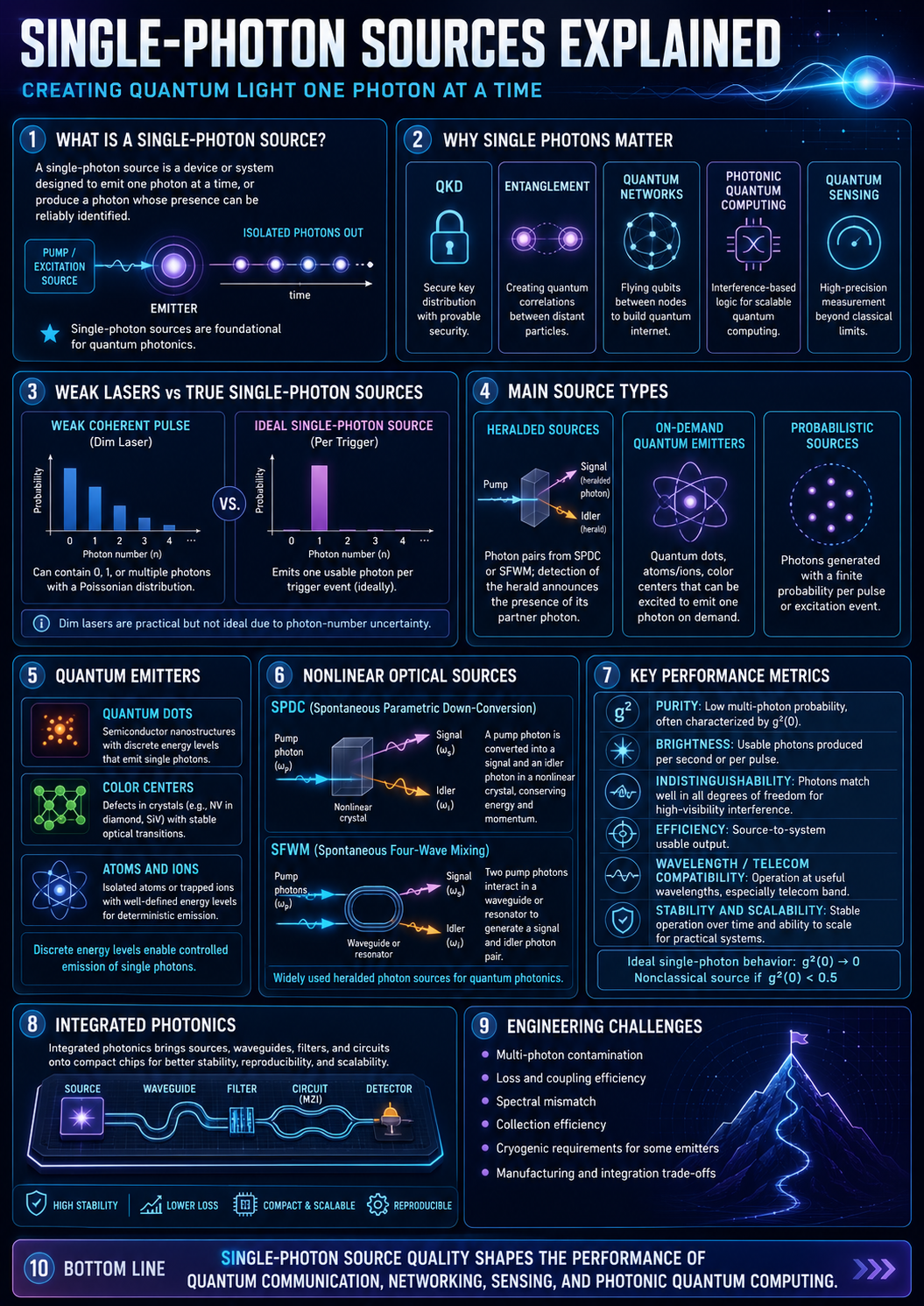
Offer this as a downloadable single-photon-sources study reference.
Connect this form to your email platform and send visitors the full-size Single-Photon Sources infographic. This keeps the page educational while turning the visual reference into a useful lead magnet.
Single-photon sources create the quantum light that quantum photonics needs.
A single-photon source is designed to produce individual photons rather than ordinary classical light pulses. In quantum photonics, the source determines whether a system has clean quantum inputs for communication, computation, sensing, or networking.
There are two broad families: probabilistic or heralded sources, often based on nonlinear optical processes such as SPDC or SFWM; and on-demand sources, often based on quantum emitters such as atoms, ions, quantum dots, molecules, or color centers.
The quality of a quantum photonic system is often limited by the quality of the photons it can generate.
A single-photon source emits quantum light one photon at a time.
Classical light can be described as an electromagnetic field with many photons. A true single-photon source aims to produce isolated photon states that can be used as quantum information carriers.
In an ideal system, each trigger event would produce exactly one photon in the desired optical mode, at the desired time, wavelength, polarization, and spatial profile, with no chance of producing zero photons or two photons.
trigger pulse → exactly one photon → useful optical mode
Real source:
trigger pulse → probability of zero, one, or multiple photons depending on source physics and efficiency
Quantum photonics needs light that behaves quantum mechanically.
Many quantum photonic protocols assume that photons arrive as individual quanta. If the source sometimes emits more than one photon or emits photons that do not match, the protocol may lose security, fidelity, interference quality, or computational usefulness.
Security depends on photon statistics
Multi-photon pulses can create vulnerabilities in some protocols if not handled correctly.
Photon pairs need clean correlations
Entangled photon experiments require high-quality photon generation and low noise.
Interference requires matching photons
Photonic quantum computing often depends on photons that are indistinguishable.
A dim laser is not the same thing as an ideal single-photon source.
Many practical quantum communication systems use heavily attenuated laser pulses because they are convenient, stable, and compatible with telecom equipment. But a weak coherent pulse has photon-number uncertainty. Sometimes it contains zero photons. Sometimes one. Sometimes more than one.
That does not make weak lasers useless. Protocols can use decoy states and security analysis to manage the risk. But weak lasers are not true deterministic single-photon sources.
| Source | Photon Number Behavior | Common Use |
|---|---|---|
| Weak coherent pulse | Probabilistic distribution of 0, 1, 2, or more photons | Practical QKD systems and telecom-compatible experiments. |
| Heralded source | One photon is announced by detecting its partner photon | Quantum optics experiments, entanglement generation, and photonic protocols. |
| On-demand emitter | Designed to emit one photon when triggered | Quantum networks, repeaters, photonic quantum computing, and scalable quantum systems. |
Single-photon sources can be probabilistic, heralded, or on demand.
The best source depends on the application. Some systems need high brightness. Others need high indistinguishability. Others need telecom wavelength, room-temperature operation, chip integration, or entanglement with a matter qubit.
Photons appear randomly
Nonlinear processes may create photon pairs with a probability per pump pulse.
One photon announces another
Detecting one photon of a pair can signal the presence of the partner photon.
Triggered emission
A quantum emitter is excited and designed to emit one useful photon per trigger.
Quantum emitters behave like artificial atoms that release single photons.
Quantum emitters have discrete energy states. When excited, they can relax by emitting one photon. This makes them promising for on-demand single-photon sources.
Semiconductor artificial atoms
Quantum dots can emit highly pure and potentially highly indistinguishable photons, especially when integrated with cavities or photonic structures.
Defects in crystals
Defect centers in diamond, silicon carbide, silicon, and other materials can emit photons and sometimes provide spin-photon interfaces.
Highly controlled quantum systems
Atoms and ions can provide excellent quantum properties but may require complex trapping and control systems.
Organic quantum emitters
Some molecules can emit single photons with narrow linewidths under suitable conditions.
Atomically thin emitters
Defects in materials such as hexagonal boron nitride or transition metal dichalcogenides are being explored for integrated quantum light.
Matter qubits plus photons
Some emitters can link stationary quantum memory states with flying photonic qubits.
Nonlinear sources generate photons in pairs.
Nonlinear optical processes are widely used in quantum photonics. A pump field interacts with a material and can produce pairs of photons with correlated energy, momentum, polarization, time, or frequency properties.
| Process | How It Works | Why It Matters |
|---|---|---|
| SPDC | A pump photon in a nonlinear crystal can split into two lower-energy photons | Common source for entangled photon pairs and heralded photons. |
| SFWM | Two pump photons interact in a nonlinear medium to produce signal and idler photons | Useful in integrated waveguides, fibers, and resonators. |
| Microresonator Pair Sources | Resonators enhance nonlinear interaction and channel generation | Can support compact, chip-scale photon-pair sources. |
| Multiplexed Sources | Multiple probabilistic sources are combined to improve success probability | Can make probabilistic sources behave more like useful near-deterministic systems. |
A good single-photon source must be pure, bright, and indistinguishable.
Single-photon sources are judged by more than whether they emit photons. The photons must be useful for the quantum protocol.
Low multi-photon probability
Often characterized by the second-order correlation value g²(0). Lower values indicate stronger single-photon behavior.
Useful photons delivered
A source must deliver photons into the desired mode, fiber, waveguide, or optical circuit efficiently.
Photons must match
Interference-based protocols require photons that are nearly identical in spectrum, time, polarization, and spatial mode.
Photons must arrive predictably
Precise timing is essential for synchronization, interference, and high-rate systems.
System compatibility matters
Telecom wavelengths are useful for fiber networks; visible or near-infrared wavelengths may fit other platforms.
One source is not enough
Large systems need many sources that can be manufactured, packaged, and controlled reliably.
Integrated photonics is turning single-photon sources into chip-scale systems.
Tabletop quantum optics is powerful but difficult to scale. Integrated photonics aims to combine sources, waveguides, couplers, filters, resonators, interferometers, switches, and detectors into compact photonic circuits.
For single-photon sources, integrated photonics can improve stability, alignment, footprint, and manufacturability. But it also introduces challenges around coupling loss, fabrication variation, thermal drift, and material compatibility.
The future is not just better emitters. It is better emitters integrated into complete quantum photonic systems.
The ideal single-photon source is still difficult to build.
The perfect source would be on demand, bright, pure, indistinguishable, telecom-compatible, room-temperature, low-noise, electrically triggered, chip-integrated, manufacturable, and inexpensive. Real sources involve trade-offs.
Single-photon sources are a bottleneck and a breakthrough point.
The future of quantum photonics depends heavily on better sources. QKD, quantum repeaters, entanglement distribution, photonic quantum computing, and quantum sensing all improve when photon generation becomes cleaner, brighter, more deterministic, and more scalable.
The next QCLS quantum page should be **Single-Photon Detectors Explained**, because sources and detectors are the two ends of nearly every quantum photonic system.
Single-photon sources, explained clearly.
What is a single-photon source?
A single-photon source is a device or system designed to emit individual photons for quantum communication, computing, sensing, or networking.
Is a dim laser a single-photon source?
Not ideally. A dim laser can produce weak pulses with a probability of zero, one, or multiple photons. It is useful in some protocols but is not a deterministic single-photon source.
What is a heralded single-photon source?
A heralded source creates photon pairs. Detecting one photon signals that the partner photon is likely present.
What is an on-demand single-photon source?
An on-demand source is triggered to emit one photon when needed, often using a quantum emitter such as a quantum dot, atom, ion, molecule, or color center.
Why does indistinguishability matter?
Many quantum photonic protocols rely on photons interfering with each other. That requires photons to be nearly identical in relevant optical properties.
What makes single-photon sources hard to scale?
Challenges include loss, multi-photon contamination, wavelength control, source variation, cryogenic requirements, packaging, and integration with photonic circuits.