
What Is Photonics?
Photonics is the engineering of light — using photons to transmit information, measure the world, reduce data-movement bottlenecks, support quantum communication, and extend what electronic systems can do alone.
At the engineering level, photonics is not simply “the study of light.” It is the use of photons as functional carriers of information, energy, timing, sensing, and quantum states. Electronics controls electrons. Photonics controls the propagation and interaction of photons through fiber, free space, waveguides, lasers, resonators, modulators, detectors, and photonic integrated circuits.
Electronics uses electrons. Photonics uses photons. The future uses both.
Photonics is the physical-layer technology of light-based information.
Photonics includes optical communication, lasers, integrated photonics, silicon photonics, photonic integrated circuits, advanced sensing, LiDAR, spectroscopy, optical interconnects, quantum photonics, and emerging light-based computing architectures.
Speed & Bandwidth
Optical carrier frequencies and wavelength-division multiplexing allow enormous information-carrying capacity across fiber, waveguides, and interconnect systems.
Efficiency & Cooling
Photonic links can reduce electrical transmission losses in high-bandwidth interconnects, helping address data-center power and cooling constraints.
Signal Integrity
Optical fiber supports long-distance, high-capacity communication with low attenuation and reduced electromagnetic interference compared with many electrical links.
Security & Quantum
Photonics enables fiber-based secure communication, physical-layer sensing, quantum key distribution research, and quantum network concepts.
Integration & Scale
Integrated photonics and silicon photonics are moving optical systems from bulky bench equipment into compact chip-scale platforms.
Measurement & Sensing
Because light interacts precisely with matter, photonic systems can detect distance, strain, vibration, temperature, chemicals, biological markers, and quantum states.
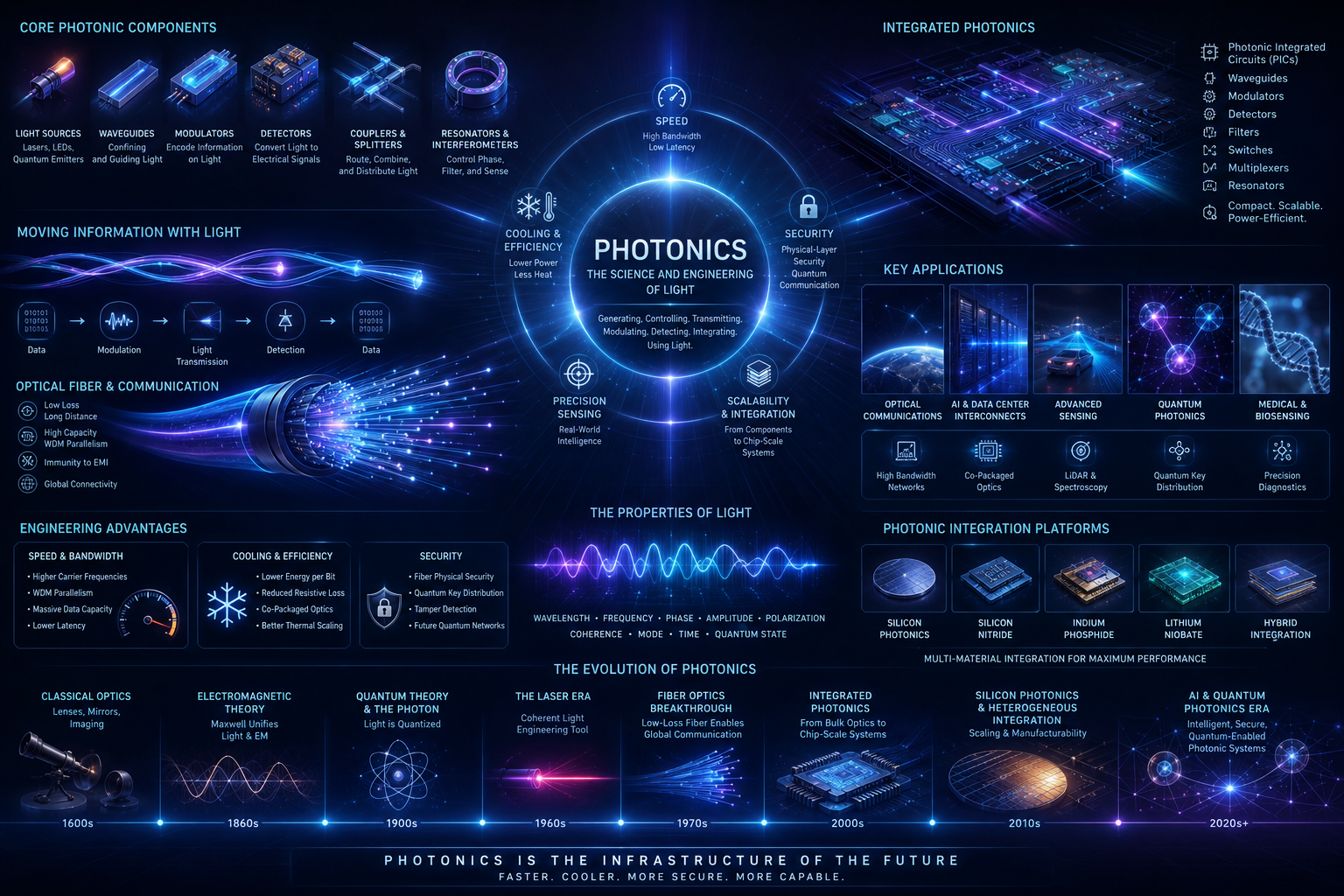
Photonics at a glance
This infographic gives visitors a fast visual foundation before they move deeper into the technical page. For the QCLS site standard, keep the visual available on-page, then use the full-resolution download as an email-list builder.
Download the full-size technical reference
Use this as a lead magnet: “Get the full-resolution QCLS Photonics Technical Reference delivered to your inbox.”
Photonics starts with electromagnetic radiation and quantum carriers.
At the physical layer, photonics deals with electromagnetic radiation, most commonly in the infrared, visible, and ultraviolet regions of the spectrum. In engineering systems, the most commercially important wavelengths are often in the near-infrared, especially around 850 nm, 1310 nm, and 1550 nm, because these wavelength regions are useful for optical communication, fiber transmission, and semiconductor photonic devices.
A photon is the quantum excitation of the electromagnetic field. Photons have no rest mass and no electric charge. They travel at the speed of light in vacuum and propagate more slowly through materials according to the refractive index of the medium.
v = phase velocity in the material
c = speed of light in vacuum
n = refractive index of the material
Wavelength
Determines color or spectral position and enables wavelength-division multiplexing.
Phase
Enables coherent communication, interferometry, modulation, and precision measurement.
Polarization
Provides another degree of freedom for communication, sensing, and quantum encoding.
Quantum State
Allows photons to carry qubits, entanglement, squeezed states, and other quantum information.
Optics studies light. Photonics engineers light into systems.
Optics asks
How does light behave?
Optics focuses on reflection, refraction, diffraction, interference, imaging, lenses, mirrors, and propagation.
Photonics asks
How can light be generated, controlled, modulated, routed, detected, integrated, and used to solve technical problems?
A lens is optics. A laser-based fiber network, silicon photonic biosensor, or photonic integrated circuit is photonics.
The hardware building blocks of light-based systems
A photonic system is usually built from light sources, waveguides, modulators, detectors, couplers, splitters, resonators, interferometers, filters, and optical interfaces.
Light Sources
Lasers, laser diodes, VCSELs, LEDs, quantum emitters, frequency combs, and supercontinuum sources generate controlled light.
Optical Fibers
Fiber guides light through glass using total internal reflection and forms the backbone of high-capacity global communication.
Waveguides
Waveguides confine and direct light on chips, functioning as the optical equivalent of wires in integrated photonics.
Modulators
Modulators encode information onto light by changing intensity, phase, frequency, polarization, wavelength, or timing.
Photodetectors
Photodetectors convert optical signals into electrical signals. Performance depends on responsivity, bandwidth, dark current, and noise.
Resonators & Interferometers
These components filter, switch, sense, modulate, and measure light using resonance and phase interference.
Data becomes light, travels, then becomes data again.
Photonics moves information by encoding data onto light, transmitting that light through a medium, and detecting it at the receiving end.
Modulation methods
Intensity modulation is the simplest data format, while phase modulation, coherent communication, polarization encoding, and advanced modulation formats increase spectral efficiency.
Wavelength-division multiplexing
WDM allows multiple wavelengths of light to travel through the same fiber or waveguide simultaneously. Each wavelength acts as a separate data channel.
How photonics became infrastructure
| Era | Technical shift | Why it mattered |
|---|---|---|
| Classical optics | Lenses, mirrors, reflection, refraction, imaging | Gave humanity the ability to shape and measure light. |
| Electromagnetic theory | Maxwell unified electricity, magnetism, and light | Light became part of a mathematically described electromagnetic spectrum. |
| Quantum theory | Einstein’s photoelectric effect helped establish quantized light | The photon became the conceptual foundation of modern photonics. |
| Laser era | Coherent, directional, narrow-band light became controllable | Lasers enabled precision measurement, telecom, medicine, manufacturing, and spectroscopy. |
| Fiber optics | Low-loss fiber transformed long-distance communication | The internet became fundamentally photonic at the backbone layer. |
| Integrated photonics | Optical systems moved from benches to chips | Waveguides, modulators, detectors, and filters became chip-scale. |
| AI infrastructure era | Data movement became a limiting factor in compute scale | Photonics became a compute-infrastructure technology, not only a telecom technology. |
Photonics vs electronics
Photonics and electronics are not simple competitors. They solve different parts of the system problem.
Electronics is strongest for
Digital logic, memory, switching, control, computation, power regulation, dense transistor integration, and low-cost short-reach electrical systems.
Photonics is strongest for
High-bandwidth transmission, long-distance communication, wavelength parallelism, low-loss interconnects, electromagnetic isolation, precision sensing, quantum channels, and optical timing.
The future is not photons replacing electrons everywhere. The future is electronic-photonic integration.
Why photonics is faster in the right regimes
Light propagates extremely fast, but system speed depends on the full architecture: source, modulator, waveguide, detector, electronics, packaging, latency, thermal tuning, and signal processing. The advantage of photonics is not a slogan; it comes from carrier frequency, wavelength parallelism, loss behavior, and bandwidth density.
Higher carrier frequencies
Optical carriers are far higher in frequency than RF or microwave carriers, supporting large modulation bandwidths.
WDM parallelism
Photonics can add wavelengths, not merely push one electrical channel faster.
Lower loss over distance
Optical fiber supports high-speed signals across long distances with low attenuation.
Bandwidth density
Photonic systems can move large amounts of information through compact physical channels.
Photonics helps because data movement creates heat.
Modern computing faces a thermal wall. Much of the energy in large-scale computing is not spent only on arithmetic; it is spent moving data. Electrical interconnects experience resistive losses, equalization overhead, retiming power, and signal-conditioning cost. Photonic links can reduce some of those losses in high-bandwidth data movement.
Resistive heating
When electrons move through conductors, energy is dissipated as heat. Photons do not experience electrical resistance in the same way.
Energy per bit
Photonics can reduce energy per bit in certain high-bandwidth links, especially as distance and bandwidth density increase.
Co-packaged optics
Moving optical conversion closer to processors and switch ASICs can reduce electrical path length and improve bandwidth density.
Photonics does not mean “no heat.” It means high-bandwidth data movement can become more thermally scalable.
Photonics creates new security primitives, but system design still matters.
Fiber physical security
Fiber can be monitored for bending, vibration, disturbance, or intrusion. Tapping optical fiber generally requires physical access and specialized methods.
Quantum key distribution
QKD uses quantum states of light to distribute cryptographic keys, where eavesdropping can introduce detectable errors under the right conditions.
Quantum-safe infrastructure
Photonics may support future quantum communication channels, entanglement distribution, repeaters, single-photon detectors, and integrated quantum photonic circuits.
Important limitation: fiber is not automatically secure, and QKD is not plug-and-play encryption. Real-world security still depends on authentication, endpoint protection, implementation quality, hardware trust, and network architecture.
Where photonics is already changing systems
Integrated photonics
Chip-scale waveguides, modulators, detectors, resonators, and interferometers shrink optical systems into manufacturable platforms.
AI infrastructure
Optical transceivers, co-packaged optics, optical I/O, and photonic chiplets help AI clusters move more data with better efficiency.
Quantum photonics
Photons can carry qubits, entangle states, support quantum communication, and enable advanced quantum sensing and photonic quantum computing.
Advanced sensing
LiDAR, spectroscopy, interferometry, OCT, and fiber sensors measure the physical world with high precision.
Optical communications
Fiber optics, coherent networks, WDM, and optical interconnects move global data as light.
Security and monitoring
Photonics supports fiber intrusion sensing, quantum communication research, secure timing, and high-resolution detection systems.
The future is hybrid electronic-photonic infrastructure.
Photonics is moving closer to processors, deeper into AI data centers, further into quantum systems, and across advanced sensing networks.
Optical I/O
Optical communication moves closer to CPUs, GPUs, accelerators, and switch ASICs.
Photonic chiplets
Photonic dies may sit beside electronic chiplets in advanced packages.
AI-scale optical fabrics
Large AI clusters increasingly require optical links across more layers of the system hierarchy.
Integrated quantum photonics
Quantum photonic systems move from lab benches to chips with sources, circuits, detectors, and control electronics.
Light is becoming an infrastructure layer: it moves information, measures the world, supports quantum communication, and extends the limits of electronics alone.
Photonics frequently asked questions
What is photonics?
Photonics is the science and engineering of generating, controlling, transmitting, modulating, detecting, and using light. It uses photons as carriers of information, energy, sensing, timing, and quantum states.
How is photonics different from electronics?
Electronics uses electrons for logic, memory, switching, and control. Photonics uses photons for high-bandwidth data movement, optical communication, sensing, quantum communication, and specialized light-based systems.
Why is photonics important for AI infrastructure?
AI systems require enormous data movement between processors, accelerators, memory, switches, and data centers. Photonics helps address bandwidth density, power, cooling, and signal-integrity limits in large-scale interconnects.
Does photonics eliminate heat?
No. Lasers, modulators, drivers, detectors, thermal tuners, and electronics still generate heat. Photonics can reduce certain data-movement losses, but practical systems still require thermal management and electronic-photonic co-design.
What is integrated photonics?
Integrated photonics brings optical components onto chips using waveguides, modulators, detectors, resonators, filters, couplers, and photonic integrated circuits.
Will photonics replace electronics?
No. The likely future is hybrid. Electronics will remain dominant for dense logic, memory, and control, while photonics increasingly handles communication, sensing, optical I/O, quantum channels, and high-bandwidth data movement.
Full-size view of the QCLS photonics technical infographic. For production, upload the highest-resolution version and replace this image URL if needed.