Quantum Key Distribution Explained
Quantum key distribution, or QKD, uses quantum states of light to help two parties create a shared secret key while detecting attempts to observe the quantum channel. QKD does not encrypt the data itself — it distributes key material that can later be used with classical encryption.
Quantum Key Distribution at a Glance
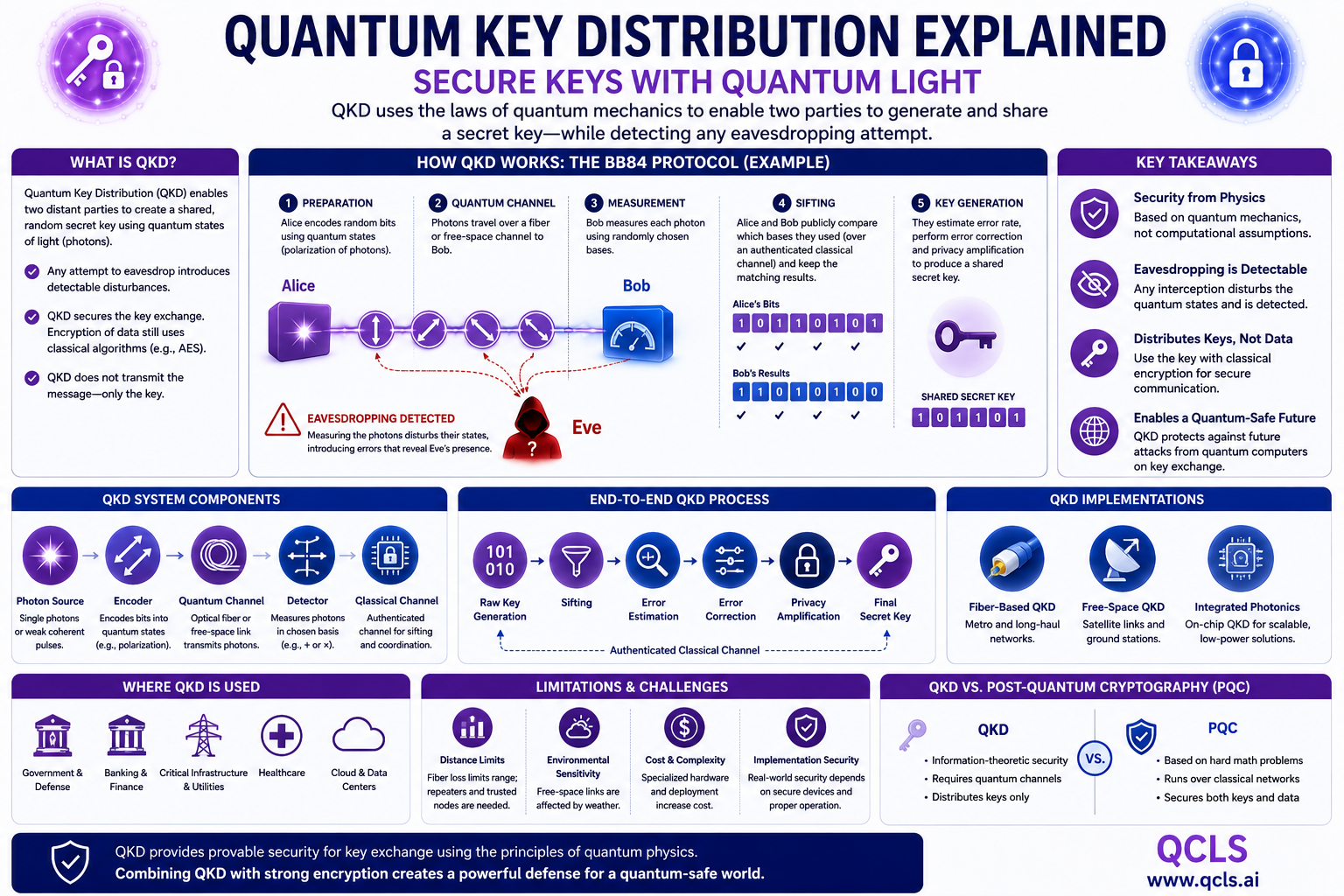
This study graphic summarizes the core QKD lesson: what quantum key distribution is, how BB84 and entanglement-based QKD work, how the key pipeline turns quantum measurements into usable shared keys, and why QKD matters for quantum-safe communication while still carrying real-world implementation limits.
Offer this as a downloadable QKD study reference.
Connect this form to your email platform and send visitors the full-size Quantum Key Distribution infographic. This keeps the page educational while turning the visual reference into a useful lead magnet.
QKD uses quantum physics to distribute secret keys.
Quantum key distribution is a method for creating and sharing cryptographic key material using quantum states, usually photons transmitted through fiber or free space. The security idea is that an unknown quantum state cannot be measured or copied perfectly without disturbing it.
In a typical QKD system, Alice sends quantum states to Bob over a quantum channel, while Alice and Bob also communicate over an authenticated classical channel. After measurement, sifting, error estimation, error correction, and privacy amplification, they can produce a shared secret key if the observed error rate is low enough.
QKD is best understood as a key-distribution technology — not a replacement for all cryptography, not a magic internet shield, and not automatically secure if the hardware implementation is flawed.
Quantum key distribution helps two parties agree on a shared secret key.
QKD is designed to create key material between two endpoints. That key material can then be used with classical cryptographic systems, such as symmetric encryption or one-time-pad-style applications under strict conditions.
The photonics part is central: QKD often uses single photons, weak coherent optical pulses, entangled photon pairs, or other quantum optical states. These states carry random key information in properties such as polarization, phase, path, time-bin, or frequency.
Photons carry quantum states
Alice sends optical quantum states to Bob through fiber or free-space optical links.
Public discussion is still needed
Alice and Bob compare basis choices, estimate errors, and process the key over an authenticated classical channel.
The output is key material
QKD produces a shared secret key if the quantum channel appears secure enough.
QKD is powerful, but it is often misunderstood.
QKD is sometimes described as unbreakable encryption. That is too loose. QKD is not the message encryption algorithm itself. It is a method for distributing keys using quantum measurement principles.
QKD turns quantum measurement disturbance into a security signal.
The core principle is that measuring an unknown quantum state generally disturbs it, and unknown quantum states cannot be copied perfectly. If an eavesdropper tries to intercept and measure the quantum channel, that action can introduce errors that Alice and Bob can detect statistically.
The system does not know every detail of an attack. Instead, it estimates whether the observed statistics are compatible with secure key generation under the protocol assumptions.
BB84 is the classic prepare-and-measure QKD protocol.
BB84 uses quantum states prepared in different bases. Alice randomly chooses a bit value and a basis, then sends the corresponding quantum state. Bob randomly chooses a measurement basis. Later, Alice and Bob publicly compare basis choices but not the key values.
Alice encodes random bits
She prepares photons in randomly selected bases.
Bob chooses random bases
Some measurements use the same basis as Alice; others do not.
Keep matching bases
Alice and Bob discard results from incompatible basis choices.
Check for disturbance
A high quantum bit error rate can indicate eavesdropping, noise, or implementation problems.
Reconcile differences
Error correction helps Alice and Bob align their raw keys.
Compress into a secure key
Privacy amplification reduces any partial information an attacker may have.
Some QKD protocols use entangled photon pairs.
Entanglement-based QKD uses entangled states shared between Alice and Bob. Instead of Alice simply preparing states and Bob measuring them, an entangled source distributes correlated quantum states. The correlations can be tested to estimate security.
Entanglement-based methods are closely connected to the broader quantum network vision because entanglement distribution, entanglement swapping, and quantum repeaters all build on shared quantum states between nodes.
Prepare-and-measure QKD teaches how quantum states reveal interception. Entanglement-based QKD points toward quantum networks where entanglement itself becomes the resource.
A usable QKD key requires several classical processing steps.
The photons are only the beginning. A practical QKD system converts raw quantum measurement outcomes into a usable shared secret key through a pipeline.
| Step | Purpose | Why It Matters |
|---|---|---|
| Quantum Transmission | Send quantum states over fiber or free space | Creates raw measurement data with quantum security properties. |
| Sifting | Keep only compatible basis measurements | Removes measurements that cannot contribute to the raw key. |
| Error Estimation | Measure quantum bit error rate | Determines whether the channel appears secure enough to proceed. |
| Error Correction | Reconcile Alice and Bob’s raw keys | Aligns the keys while limiting information leakage. |
| Privacy Amplification | Compress the corrected key | Reduces any partial knowledge an attacker may have. |
| Authentication | Protect classical communication | Prevents man-in-the-middle attacks on the public discussion. |
QKD security depends on physics, protocol assumptions, and implementation quality.
The theoretical foundation of QKD is quantum physics. But real security depends on whether the actual hardware and software match the assumptions of the security proof.
Unknown states cannot be copied perfectly
An eavesdropper cannot simply duplicate an unknown photonic qubit without consequence.
Observation can create errors
Intercepting quantum states can change the measured statistics.
Classical channel must be trusted
Without authentication, an attacker can impersonate endpoints.
Hardware must be hardened
Detectors, sources, timing, side channels, and calibration can create vulnerabilities.
Assumptions must match reality
Security proofs only apply if the protocol and implementation conditions are satisfied.
Endpoints still matter
QKD cannot fix compromised computers, bad key management, or weak network operations.
QKD is useful, but physically and operationally constrained.
Photon loss is one of the biggest practical limits. Quantum signals cannot be copied and amplified like ordinary classical optical signals. This makes long-distance QKD harder than ordinary optical networking.
QKD and post-quantum cryptography solve different problems.
Post-quantum cryptography, or PQC, uses classical algorithms designed to resist attacks by future quantum computers. QKD uses quantum hardware to distribute keys through quantum channels.
They are not the same thing, and they are not always substitutes. Many systems will prioritize PQC because it can run over existing digital networks. QKD is more infrastructure-intensive but can provide physics-based key distribution in specialized high-security links.
| Category | QKD | Post-Quantum Cryptography |
|---|---|---|
| Primary role | Distribute secret key material | Provide quantum-resistant digital cryptographic algorithms |
| Infrastructure | Requires quantum optical channel and specialized hardware | Runs on classical computers and networks |
| Security basis | Quantum measurement and protocol assumptions | Hard mathematical problems believed resistant to quantum attacks |
| Deployment fit | High-security point-to-point or networked optical links | Broad internet-scale software and protocol migration |
| Main challenge | Distance, hardware, trust model, implementation security | Algorithm selection, implementation, migration, performance, interoperability |
QKD is part of the quantum network roadmap, not the whole roadmap.
QKD is one of the earliest practical applications of quantum communication, but the longer-term vision includes quantum repeaters, entanglement distribution, quantum memories, integrated quantum photonic circuits, satellite links, and eventually broader quantum networks.
For QCLS, QKD is an important bridge topic because it connects photonic qubits, entanglement, single-photon sources, single-photon detectors, optical fiber, integrated photonics, and secure communication.
Quantum key distribution, explained clearly.
What is QKD?
Quantum key distribution is a method for generating and sharing secret key material using quantum states, usually photons transmitted through fiber or free-space optical links.
Does QKD encrypt the message?
No. QKD distributes keys. Those keys can then be used with classical encryption systems to protect messages.
Why does eavesdropping show up?
Measuring unknown quantum states generally disturbs them. That disturbance can increase the error rate detected by Alice and Bob.
What is BB84?
BB84 is a classic prepare-and-measure QKD protocol where Alice sends randomly encoded quantum states and Bob measures them in randomly selected bases.
Can QKD work over the public internet?
Not directly as ordinary software. QKD requires a quantum optical channel plus an authenticated classical channel.
Is QKD the same as post-quantum cryptography?
No. PQC is classical cryptography designed to resist quantum attacks. QKD is quantum-hardware-based key distribution.