
Optical Communications
Technical guide to fiber optics, optical transmitters, receivers, transceivers, wavelength-division multiplexing, coherent optics, data-center links, telecom networks, and the light-based infrastructure behind the internet and AI systems.
Optical Transceivers
WDM
Coherent Optics
Data Centers
Quantum Networks
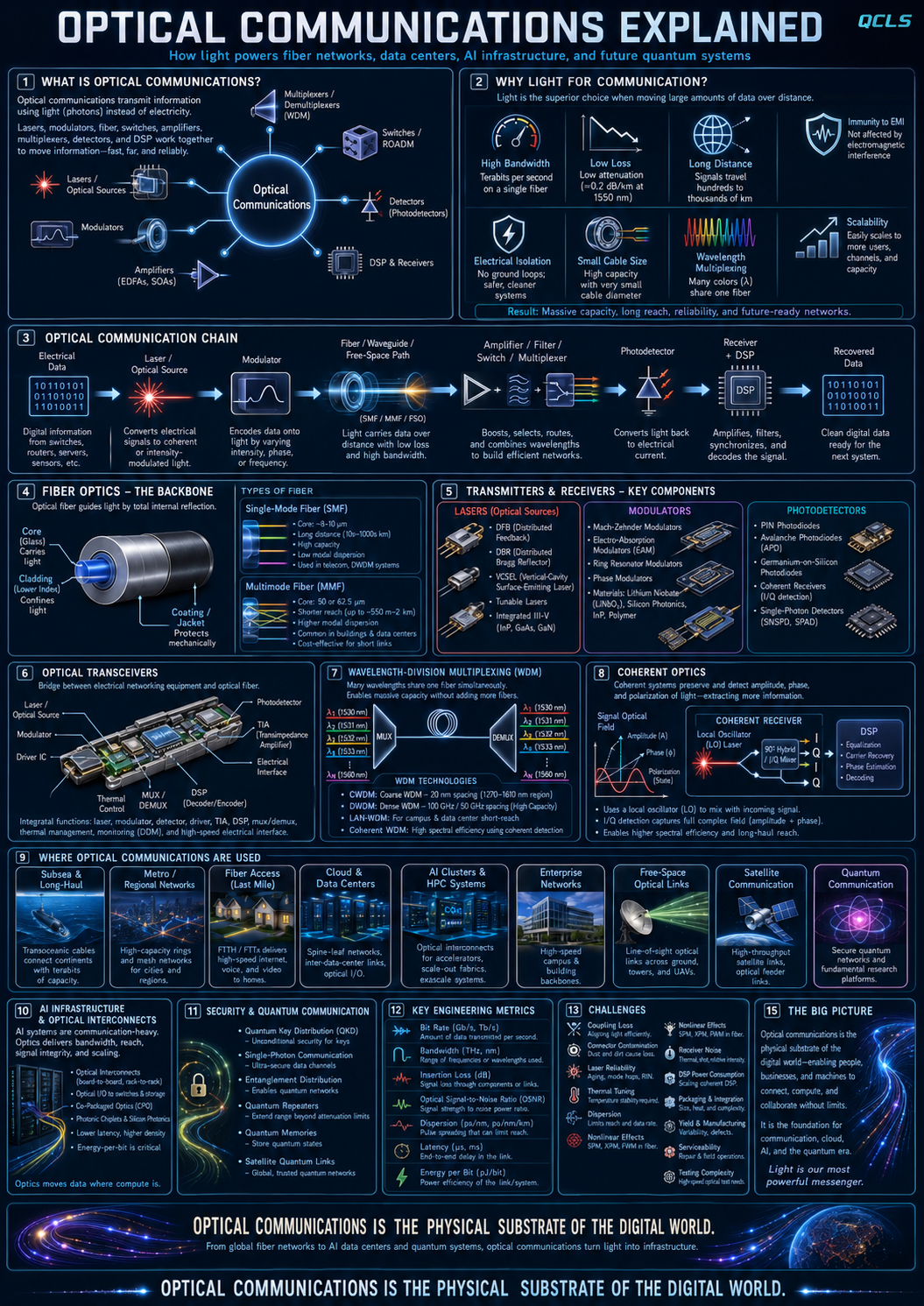
View larger infographic →
Core thesis: Optical communications are the backbone of modern information infrastructure. Fiber optics, WDM, coherent systems, and integrated photonics made global bandwidth possible — and now optical communication is moving closer to chips, AI clusters, quantum networks, and secure sensing systems.
The optical communications chain
Every optical link is a system. Data begins as an electrical signal, becomes encoded onto light, travels through fiber or free space, gets amplified or routed, and is finally detected and converted back into electrical information.
Executive Technical Summary
Optical communications is the use of light to transmit information. Instead of moving data only through electrical currents in copper wires, optical communication systems encode information onto photons and send those photons through optical fiber, photonic waveguides, or free-space paths.
The basic idea is simple, but the system architecture is sophisticated. A laser creates an optical carrier. A modulator encodes data onto that carrier. Fiber or waveguides transport the signal. Amplifiers, filters, switches, multiplexers, and routers manage the optical path. Photodetectors convert the signal back into electronics. Digital signal processing cleans up and reconstructs the information.
Optical communication matters because modern systems need extreme bandwidth over distance with manageable power, heat, latency, and signal integrity.
- the global internet
- subsea fiber cables
- long-haul telecom networks
- metro fiber networks
- cloud data centers
- AI infrastructure
- 5G and future wireless backhaul
- enterprise networking
- scientific instruments
- satellite and free-space optical communication
- quantum communication research
- secure timing and sensing networks
The internet is not just software. It is a physical optical infrastructure made of glass fiber, lasers, transceivers, amplifiers, photonic chips, switches, routers, data centers, and measurement systems.
What Is Optical Communications?
Optical communications means transmitting information using light. In most modern systems, that light travels through optical fiber. In other systems, light can travel through free space, inside photonic integrated circuits, between chips, across boards, between satellites, or through specialized sensing networks.
A communication system needs three basic functions:
- Transmit information by encoding it onto a carrier.
- Transport the carrier through a channel.
- Receive the signal and recover the information.
In radio systems, the carrier is usually an electromagnetic wave at radio or microwave frequencies. In optical systems, the carrier is light — usually infrared light for fiber communications.
Optical communications became dominant for high-capacity networks because photons can carry enormous bandwidth through low-loss fiber over long distances. That is why optical fiber became the physical foundation of the modern internet.
Why Use Light for Communication?
Light is useful for communication because optical frequencies are extremely high. A high-frequency carrier can support very large bandwidths, especially when combined with advanced modulation and wavelength-division multiplexing.
Optical fiber also has very low attenuation compared with many electrical transmission media. That allows data to travel long distances before needing regeneration or amplification.
The advantages of optical communication
- high bandwidth
- long transmission distance
- low loss in optical fiber
- immunity to electromagnetic interference
- electrical isolation
- small cable diameter
- lower weight than many copper alternatives
- wavelength multiplexing
- compatibility with optical amplification
- scalability for networks and data centers
However, optical systems are not magic. They require precise sources, coupling, connectors, packaging, modulation, thermal control, signal processing, and careful management of loss, dispersion, nonlinearities, and noise.
The Optical Communication Chain
A simplified optical link can be described like this:
Electrical data
↓
Laser or optical source
↓
Modulator
↓
Optical fiber / waveguide / free-space path
↓
Amplifier, filter, switch, or multiplexer
↓
Photodetector
↓
Electrical receiver
↓
Digital signal processing
↓
Recovered data
Every part of this chain affects the final system performance. A faster modulator does not help if the detector is too noisy. A powerful laser does not help if coupling losses are excessive. A low-loss fiber does not solve dispersion if the signal is not managed properly. Optical communications is a system-level discipline.
Fiber Optics: The Physical Backbone
Optical fiber is a thin glass or plastic waveguide designed to confine and guide light over distance. Most high-performance communication fiber uses glass because it offers low loss and excellent optical properties.
A fiber typically has a core, cladding, and protective coating. The core has a slightly higher refractive index than the cladding, allowing light to remain guided by total internal reflection and waveguide confinement.
Single-mode fiber
Single-mode fiber supports one primary spatial mode. It is used for long-haul, metro, high-capacity telecom, and many data-center interconnect applications because it supports long-distance transmission with lower modal dispersion.
Multimode fiber
Multimode fiber supports multiple spatial modes. It is commonly used for shorter-distance links, such as inside buildings or data centers, where cost and connection simplicity can matter.
Why fiber changed the world
Fiber optics made it possible to move huge volumes of data across cities, continents, oceans, data centers, campuses, cell towers, and enterprise networks. Without optical fiber, the modern internet would not scale in its current form.
Transmitters and Receivers
Lasers
A laser provides the optical carrier. Communication lasers are designed for wavelength stability, power efficiency, linewidth control, modulation compatibility, thermal behavior, and reliability.
- distributed feedback lasers
- distributed Bragg reflector lasers
- vertical-cavity surface-emitting lasers
- external cavity lasers
- tunable lasers
- integrated III-V lasers
Modulators
Modulators encode data onto light. Some systems directly modulate the laser. Others use an external modulator to change the optical signal after it leaves the laser.
- Mach-Zehnder modulators
- electro-absorption modulators
- ring resonator modulators
- phase modulators
- lithium niobate modulators
- silicon photonic modulators
Photodetectors
Photodetectors convert optical power into electrical current. The receiver then amplifies, filters, samples, and interprets that signal.
- PIN photodiodes
- avalanche photodiodes
- germanium-on-silicon detectors
- coherent receiver photodiodes
- single-photon detectors for quantum systems
Optical Transceivers
An optical transceiver contains both transmitter and receiver functions. It connects electrical networking equipment to optical fiber.
Transceivers are one of the most important practical building blocks of modern networks. They are used in data centers, telecom networks, enterprise systems, cloud infrastructure, high-performance computing, and AI clusters.
A transceiver may include:
- lasers
- modulators
- photodetectors
- driver circuits
- transimpedance amplifiers
- clock and data recovery
- digital signal processing
- multiplexers and demultiplexers
- fiber coupling
- thermal control
- monitoring and diagnostics
As bandwidth needs rise, transceivers become denser, faster, more power-sensitive, and more closely tied to photonic integration.
Wavelength-Division Multiplexing
Wavelength-division multiplexing, or WDM, allows multiple optical channels to travel through the same fiber at the same time. Each channel uses a different wavelength of light.
This is one of the most important scaling tools in optical communications.
One fiber
=
λ1 + λ2 + λ3 + λ4 + ... + λN

Each wavelength can carry a separate data stream.
Instead of installing a new fiber for every data stream, operators can increase capacity by adding more wavelengths, faster modulation, better amplification, and improved signal processing.
Common WDM categories
- coarse wavelength-division multiplexing
- dense wavelength-division multiplexing
- LAN-WDM
- shortwave WDM
- coherent WDM systems
WDM is central to long-haul networks, metro networks, subsea cables, data-center interconnects, and high-capacity optical transport.
Coherent Optics
Coherent optical systems preserve and detect the phase and polarization of light, not just intensity. This allows more advanced modulation formats and higher spectral efficiency.
Coherent receivers use a local oscillator laser and digital signal processing to recover information encoded in amplitude, phase, and polarization.
Why coherent optics matters
- higher data rates
- longer transmission distances
- better spectral efficiency
- advanced modulation formats
- compensation for dispersion
- high-capacity long-haul and subsea links
Coherent optics is one of the major technologies that allowed optical networks to continue scaling as bandwidth demands grew.
Where Optical Communications Are Used
Optical Communications in Data Centers
Data centers rely heavily on optical communication because electrical links become difficult over distance at high speeds. Optical fiber links move data between switches, servers, racks, rows, halls, and facilities.
Data-center optical links are designed for high bandwidth, low power, compact packaging, short to medium reach, and high reliability.
Major trends include:
- higher-speed pluggable optical modules
- parallel fiber links
- wavelength multiplexing
- silicon photonics transceivers
- co-packaged optics
- linear drive optics
- optical circuit switching
- optical I/O near processors
- photonic chiplets
As AI data centers scale, optical communication is moving from a networking technology into a core compute-infrastructure technology.
Why Optical Communications Matter for AI
AI clusters are communication-heavy systems. Training and inference require data movement between accelerators, memory, switches, storage, and networking layers.
As clusters become larger, interconnects become a central bottleneck. Bandwidth, power, latency, distance, heat, and packaging all matter.
Optical communication can help AI infrastructure by supporting:
- high-bandwidth accelerator networks
- rack-to-rack communication
- switch-to-switch communication
- lower-loss high-speed links over distance
- better bandwidth density
- reduced electrical reach constraints
- co-packaged optics
- optical I/O
- future disaggregated computing architectures
QCLS views optical communication as one of the major physical technologies behind AI scaling, because AI performance depends not only on arithmetic but also on moving data efficiently through the system.
Optical Communications, Security, and Quantum Networks
Optical communication also matters for secure communication and quantum networking.
Classical optical networks carry encrypted traffic across fiber. Quantum communication research uses quantum states of light, single photons, entanglement, and measurement to explore new approaches to key distribution, network security, and future quantum information infrastructure.
Important areas
- quantum key distribution
- single-photon communication
- entanglement distribution
- quantum repeaters
- quantum memories
- satellite quantum communication
- secure timing networks
- fiber sensing for intrusion detection
Quantum communication is not a drop-in replacement for classical encryption. It is a specialized field with its own constraints, including loss, distance, hardware trust, endpoint security, authentication, integration, and deployment complexity. But photons are central to the field because they are natural carriers of quantum information across distance.
Key Metrics in Optical Communications
Bit rate
Bit rate measures how much data is transmitted per second.
bits per second: bps
gigabits per second: Gbps
terabits per second: Tbps
Bandwidth
Bandwidth describes the range or capacity available for transmitting information. Optical systems can scale bandwidth through faster modulation, parallel channels, WDM, and spatial multiplexing.
Insertion loss
Insertion loss measures power lost through a component, connector, module, waveguide, or link.
Optical signal-to-noise ratio
Optical signal-to-noise ratio affects how reliably the receiver can recover information from the optical signal.
Dispersion
Dispersion causes different parts of the optical signal to travel at different speeds or broaden over distance. Dispersion management is critical in high-speed and long-haul optical systems.
Latency
Latency is the time it takes information to travel through the system. Optical fiber has propagation delay, and electronics, DSP, switching, and routing can add additional latency.
Energy per bit
Energy per bit is increasingly important for data centers and AI systems. It measures how much energy is required to transmit each bit of information.
Major Challenges in Optical Communications
Optical communications are powerful because they solve many electrical transmission problems, but they introduce their own engineering challenges.
- fiber coupling loss
- connector contamination
- laser reliability
- thermal tuning
- dispersion
- nonlinear effects
- receiver noise
- DSP power consumption
- module packaging
- photonic chip yield
- co-packaged optics serviceability
- fiber management at scale
- testing and calibration complexity
The strongest optical systems are not just fast. They are manufacturable, serviceable, reliable, thermally stable, power-efficient, and economically deployable.
The Future of Optical Communications
The future of optical communications is moving in several directions at once.
More wavelengths
Wavelength-division multiplexing will continue to support capacity growth by placing more channels on optical infrastructure.
More integration
Photonic integrated circuits will make optical systems smaller, denser, and more manufacturable.
Closer to compute
Optics will continue moving closer to processors, switches, GPUs, AI accelerators, and advanced packages.
More coherent systems
Advanced modulation and coherent detection will continue to increase spectral efficiency and long-distance capacity.
More free-space and satellite links
Optical communication will play a growing role in satellite networks, inter-satellite links, deep-space communication, and specialized free-space systems.
More quantum communication research
Photons will remain central to quantum communication because they can carry quantum states through fiber and free space.
Why Optical Communications Matter
Optical communications matter because they are the physical substrate of the digital world. Cloud services, video, financial markets, AI clusters, mobile networks, scientific computing, enterprise systems, and global internet exchange all depend on optical data movement.
At QCLS, optical communications sit at the center of the photonics story because they connect the past, present, and future of the field.
Fiber optics proved that light could become global infrastructure. Integrated photonics is shrinking that infrastructure onto chips. AI data centers are demanding more optical bandwidth. Quantum systems are using photons as information carriers. Optical sensing is turning fiber and light into distributed measurement systems.
Optical communications are not just telecom. They are the foundation for scalable information movement.
Optical Communications Frequently Asked Questions
What is optical communication?
Optical communication is the transmission of information using light. Most modern optical communication uses lasers, modulators, optical fiber, photodetectors, and transceivers.
Why is fiber optic communication important?
Fiber optic communication is important because it can carry huge amounts of data over long distances with low loss and strong immunity to electromagnetic interference.
What is an optical transceiver?
An optical transceiver is a module that converts electrical signals into optical signals and optical signals back into electrical signals.
What is wavelength-division multiplexing?
Wavelength-division multiplexing allows multiple wavelengths of light to carry separate data channels through the same fiber.
What is coherent optics?
Coherent optics uses phase, amplitude, and polarization information to transmit and recover higher-capacity optical signals, often with advanced digital signal processing.
How does optical communication relate to AI infrastructure?
AI infrastructure requires massive data movement. Optical communication helps move data across racks, switches, servers, accelerators, and data centers with high bandwidth and manageable power.
Will optical communication replace copper?
No. Copper remains useful for short-reach electrical connections and power delivery. Optical communication becomes more important when bandwidth, reach, signal integrity, and power constraints favor light-based transmission.