Quantum Photonics
A Technical Guide to Photons, Qubits, Entanglement, Quantum Communication, Quantum Sensing, and Photonic Quantum Computing
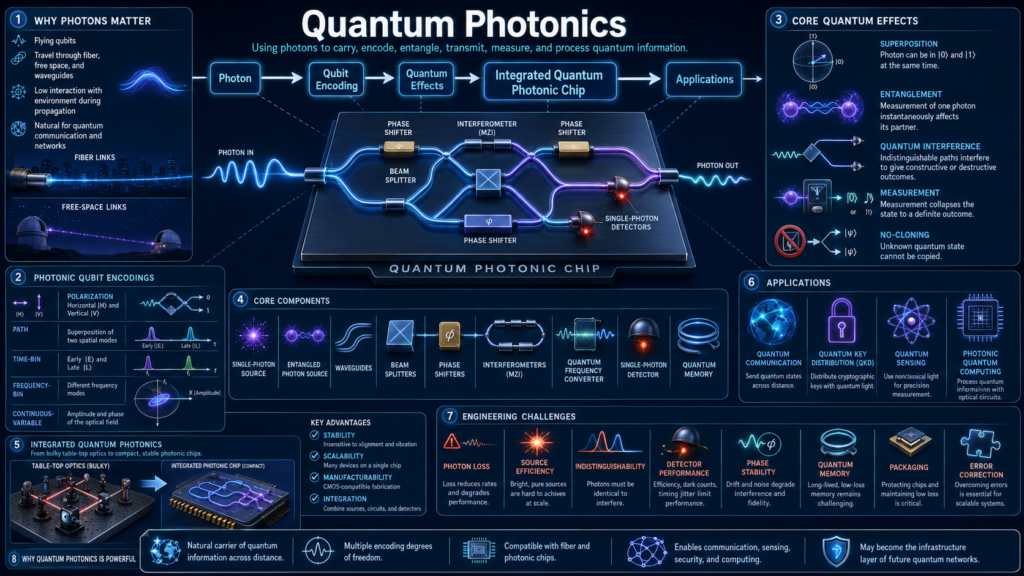
Click to enlarge technical visual
Quantum Photonics at a Glance
This visual reference connects the core engineering ideas: photons as flying qubits, quantum encodings, entanglement, integrated quantum photonic circuits, QKD, quantum sensing, quantum networks, and photonic quantum computing.
Download the full-size QCLS technical reference
This follows the QCLS Learning Center standard: the page teaches immediately, while the high-resolution downloadable visual builds the email list.
Quantum photonics is the engineering of light at the quantum level.
Classical photonics uses light to transmit, route, modulate, detect, and process information. Quantum photonics goes deeper: it uses individual photons and engineered quantum states of light to encode, transmit, entangle, measure, and process quantum information.
In classical optical systems, light may carry ordinary data through intensity, phase, wavelength, frequency, or polarization. In quantum photonic systems, light can carry quantum states: superpositions, entangled states, single-photon states, squeezed states, time-bin qubits, polarization qubits, frequency-bin qubits, and continuous-variable quantum states.
The difference is fundamental.
Classical photonics moves information with light. Quantum photonics moves quantum information with light.
Quantum photonics matters because photons are natural carriers of quantum information across distance. They can travel through optical fiber, free space, and integrated waveguides. They can connect remote systems. They can encode information in multiple degrees of freedom. They can support quantum communication, quantum key distribution, quantum networks, quantum sensing, quantum random number generation, and photonic quantum computing.
A 2024 PRX Quantum perspective describes integrated quantum photonics as a major path toward quantum communications and information processing by moving quantum optical functions onto scalable photonic platforms.
The serious version is this:
If classical photonics is the infrastructure of high-speed information, quantum photonics may become the infrastructure of secure, distributed, quantum-enabled systems.
If classical photonics is the infrastructure of high-speed information, quantum photonics may become the infrastructure of secure, distributed, quantum-enabled systems.
Executive Technical Summary
Quantum photonics uses photons and quantum states of light as carriers of quantum information.
Photons can encode qubits in several physical degrees of freedom, including polarization, optical path, time-bin, frequency-bin, phase, photon number, spatial mode, and continuous-variable field quadratures. This flexibility gives quantum photonics a uniquely rich hardware design space.
Quantum photonics is powerful because photons are mobile quantum systems. Unlike many stationary matter-based qubits, photons are naturally suited for transmission. They can propagate through optical fiber and free-space optical links, making them central to quantum communication and quantum networking.
Quantum photonics is especially important for:
- quantum communication
- quantum key distribution
- quantum networks
- quantum repeaters
- quantum sensing
- quantum metrology
- quantum random number generation
- photonic quantum computing
- integrated quantum photonic circuits
- distributed quantum computing
- hybrid quantum systems
Integrated quantum photonics attempts to move table-top quantum optics onto chip-scale platforms. A 2022 Roadmap on Integrated Quantum Photonics identifies key technical areas including photonic integrated circuit platforms, quantum light sources, quantum frequency conversion, integrated detectors, and applications in computing, communications, and sensing.
The core technical promise is large:
Photons can carry quantum information across distance, interfere with high precision, support secure communication protocols, and enable quantum-enhanced measurement.
The core technical challenge is equally large:
Photons are difficult to store, easy to lose, and do not naturally interact strongly with each other.
That is the engineering tension at the heart of quantum photonics.
What Is Quantum Photonics?
Quantum photonics is the field that uses quantum states of light for information, communication, sensing, measurement, security, and computation.
A classical photonic system may transmit ordinary bits through an optical fiber. A quantum photonic system may transmit qubits, entanglement, or nonclassical optical states.
Classical photonics uses optical properties such as:
- wavelength
- intensity
- phase
- amplitude
- frequency
- polarization
- propagation mode
- coherence
- timing
Quantum photonics uses quantum optical properties such as:
- superposition
- entanglement
- single-photon states
- squeezed states
- photon-number states
- quantum interference
- indistinguishability
- nonclassical correlations
- measurement-induced state collapse
- no-cloning behavior
In practical engineering terms, quantum photonics asks:
How can light be generated, routed, manipulated, interfered, detected, integrated, and measured while preserving useful quantum information?
That question connects physics, photonic chip design, cryogenic detection, laser systems, nonlinear optics, quantum information theory, semiconductor manufacturing, integrated photonics, electronics, control systems, and network engineering.
Why Photons Matter in Quantum Technology
Photons are not the only possible quantum information carriers. Quantum systems can also be built from superconducting circuits, trapped ions, neutral atoms, spins, defects in solids, or other physical platforms.
But photons have one advantage that is hard to replace:
Photons travel.
That makes them uniquely important for communication and networking.
1. Photons Are Natural Flying Qubits
Many quantum systems are good at storing or locally processing information. Photons are good at transporting it.
This is why photons are often called “flying qubits.” They can move quantum information between nodes, across optical fibers, through free-space links, or across integrated photonic circuits.
Even if future quantum processors use superconducting qubits, trapped ions, neutral atoms, or spin qubits for local computation, photons may still be needed to connect those systems into distributed quantum networks.
A major review of photonic quantum computation describes photons as physical systems for quantum computing and distinguishes between discrete-variable and continuous-variable photonic quantum computation.
2. Photons Can Propagate Through Existing Optical Infrastructure
Modern civilization already uses optical fiber for high-speed communication. Quantum photonics can build on this optical infrastructure, although quantum links have stricter requirements than classical fiber networks.
Fiber networks, lasers, modulators, detectors, filters, and photonic integrated circuits already form a mature technological base. Quantum photonics extends that base into quantum information.
3. Photons Support Multiple Quantum Encodings
Quantum information can be encoded in many photonic degrees of freedom:
- polarization
- path
- time-bin
- frequency-bin
- phase
- spatial mode
- orbital angular momentum
- photon number
- field quadratures
This gives photonic systems flexibility. Different applications can choose different encodings depending on stability, distance, platform, and detection requirements.
4. Photons Can Preserve Quantum Information While Traveling
Photons generally interact weakly with the environment compared with many matter-based quantum systems. That can be an advantage for transmitting quantum states.
The tradeoff is that weak interaction also makes photons difficult to use for deterministic two-qubit gates. Photons are excellent carriers, but they do not naturally “talk” to each other strongly.
5. Photons Are Central to Quantum Networks
Quantum networks require quantum states to move between nodes. Photons are the most natural medium for that movement.
A future quantum network may include matter qubits for memory and processing, but photonic links for transmitting entanglement or quantum states between those matter systems.
Strong conclusion:
Other platforms may be strong for local quantum processing. Photons are uniquely strong for moving quantum information between systems.
The Quantum Physics Behind Quantum Photonics
Quantum photonics is built on several key principles from quantum mechanics and quantum optics.
Superposition
A quantum system can exist in a combination of basis states until it is measured.
For a generic qubit:
|ψ⟩ = α|0⟩ + β|1⟩Where:
|ψ⟩is the quantum state|0⟩and|1⟩are basis statesαandβare complex probability amplitudes|α|² + |β|² = 1
For a polarization-encoded photonic qubit:
|ψ⟩ = α|H⟩ + β|V⟩Where:
|H⟩= horizontal polarization|V⟩= vertical polarization
The photon is not simply “partly horizontal and partly vertical” in a classical sense. It is in a quantum superposition of possible measurement outcomes.
Entanglement
Entanglement occurs when the quantum state of two or more systems cannot be fully described independently.
A common entangled photon state is the Bell state:
|Φ⁺⟩ = (|HH⟩ + |VV⟩) / √2This means the two photons share a joint state. If one photon is measured as horizontally polarized, the other will be correlated accordingly, even if the photons are separated.
Entanglement is central to:
- quantum communication
- quantum teleportation
- Bell tests
- quantum key distribution
- quantum repeaters
- photonic quantum computing
- quantum-enhanced sensing
Quantum Interference
Quantum interference occurs when probability amplitudes interfere.
In quantum photonics, interference is not just a wave effect. It can occur between indistinguishable quantum paths.
One important example is Hong-Ou-Mandel interference. When two indistinguishable photons enter a beam splitter from different input ports, they tend to exit together rather than separately. This effect is a foundational test of photon indistinguishability and is widely used in quantum photonic experiments.
Quantum interference is essential for:
- linear optical quantum computing
- boson sampling
- entanglement generation
- photonic quantum gates
- quantum state analysis
- integrated interferometer circuits
Measurement
Quantum measurement extracts information from a quantum system but changes the state.
In classical optics, a measurement can often be thought of as observing a signal. In quantum photonics, measurement is part of the system dynamics. It can collapse a superposition, project a state, herald another quantum state, or enable measurement-based computation.
No-Cloning Theorem
The no-cloning theorem states that an unknown arbitrary quantum state cannot be copied perfectly.
This is one of the foundations of quantum communication security. If an eavesdropper tries to copy an unknown quantum state, the attempt introduces detectable disturbance or errors under the right protocol conditions.
Squeezed Light
Squeezed light is a nonclassical state of light where quantum uncertainty is reduced in one field quadrature below the standard quantum limit while increased in the conjugate quadrature.
Squeezed states are important for:
- quantum sensing
- gravitational-wave detection
- continuous-variable quantum communication
- continuous-variable quantum computing
- precision metrology
Quantum photonics is therefore not only about single photons. It also includes engineered continuous quantum states of light.
Photonic Qubits: How Light Encodes Quantum Information
A photonic qubit is a quantum bit encoded into a property of a photon or optical mode.
Different encodings have different advantages and engineering tradeoffs.
Polarization Encoding
Polarization encoding uses two orthogonal polarization states as the qubit basis.
|0⟩ = |H⟩
|1⟩ = |V⟩
A general state is:
|ψ⟩ = α|H⟩ + β|V⟩Advantages:
- intuitive
- useful in free-space optical systems
- easy to manipulate with wave plates and polarization optics
- natural for certain entanglement experiments
Challenges:
- polarization drift in optical fiber
- environmental sensitivity
- requires stabilization over long distances
Path Encoding
Path encoding uses the physical path or waveguide occupied by the photon.
|0⟩ = photon in path A
|1⟩ = photon in path B
A general state is:
|ψ⟩ = α|A⟩ + β|B⟩Advantages:
- natural for integrated photonic chips
- compatible with beam splitters and interferometers
- useful for programmable photonic circuits
Challenges:
- phase stability
- balanced losses between paths
- sensitivity to fabrication variation
- calibration complexity
Path encoding is one reason integrated photonics is so important for quantum systems.
Time-Bin Encoding
Time-bin encoding uses photon arrival time.
|0⟩ = |early⟩
|1⟩ = |late⟩
A general state is:
|ψ⟩ = α|early⟩ + β|late⟩Advantages:
- robust in optical fiber
- useful for long-distance quantum communication
- less sensitive to polarization drift
Challenges:
- requires precise timing
- requires stable interferometers
- detector timing jitter matters
Time-bin encoding is especially important in fiber-based quantum communication.
Frequency-Bin Encoding
Frequency-bin encoding uses different optical frequencies as basis states.
|0⟩ = |ω₁⟩
|1⟩ = |ω₂⟩
Advantages:
- compatible with wavelength-domain multiplexing
- potentially useful for dense quantum networks
- can use existing optical filtering concepts
Challenges:
- precise frequency control
- frequency conversion
- spectral indistinguishability
- low-loss filtering
Frequency-bin quantum photonics is attractive because it connects quantum information to the same wavelength-domain logic used in classical optical networks.
Continuous-Variable Encoding
Continuous-variable quantum photonics encodes information in continuous optical field quadratures rather than discrete qubit states.
Instead of using only |0⟩ and |1⟩, continuous-variable systems use variables analogous to position and momentum of the optical field.
Advantages:
- compatible with coherent optical communication tools
- uses homodyne or heterodyne detection
- can leverage squeezed light
Challenges:
- sensitive to loss and noise
- requires strong error correction for scalable computing
- precision and calibration are difficult
Continuous-variable systems are important in photonic quantum computing and quantum communication.
Core Components of a Quantum Photonic System
A quantum photonic system requires components that can generate, control, route, interfere, convert, store, and detect quantum states of light.
Single-Photon Sources
A single-photon source generates individual photons.
Ideal sources should be:
- bright
- deterministic
- pure
- efficient
- indistinguishable
- wavelength-compatible
- scalable
- integrable with photonic circuits
Common approaches include:
- spontaneous parametric down-conversion
- spontaneous four-wave mixing
- quantum dots
- color centers
- trapped atoms coupled to optical cavities
- nonlinear integrated waveguides
Important metrics include:
- brightness
- single-photon purity
- indistinguishability
- repetition rate
- collection efficiency
- multi-photon emission probability
- spectral linewidth
- wavelength stability
- integration compatibility
Source quality is one of the most important bottlenecks in quantum photonics.
Entangled Photon Sources
Entangled photon sources generate pairs or groups of photons in correlated quantum states.
They are important for:
- quantum communication
- quantum teleportation
- entanglement distribution
- Bell tests
- quantum repeaters
- photonic quantum computing
Common generation methods include nonlinear optical processes such as spontaneous parametric down-conversion and spontaneous four-wave mixing.
The challenge is generating entangled photons efficiently, reliably, at useful wavelengths, with high indistinguishability and low noise.
Quantum Photonic Waveguides
Waveguides guide quantum states of light through a chip.
Integrated quantum photonic platforms can use:
- silicon
- silicon nitride
- lithium niobate
- silica
- indium phosphide
- gallium arsenide
- aluminum nitride
- diamond
- polymer platforms
Important waveguide performance metrics include:
- propagation loss
- dispersion
- nonlinear efficiency
- polarization behavior
- phase stability
- coupling loss
- fabrication tolerance
Loss is especially important because losing a photon means losing quantum information.
Beam Splitters and Couplers
Beam splitters and couplers create superposition and interference between optical paths.
They are foundational to:
- path-encoded qubits
- quantum interference
- Bell-state measurements
- linear optical quantum computing
- integrated interferometer networks
- entanglement generation
In integrated photonics, beam splitters are often implemented using directional couplers or multimode interference couplers.
Phase Shifters
Phase shifters control the relative phase between optical modes.
They are used for:
- interferometers
- reconfigurable quantum circuits
- state preparation
- quantum gates
- measurement settings
- programmable photonic processors
Phase shifters may use thermal, electro-optic, carrier-based, piezoelectric, or MEMS-based tuning mechanisms.
Key tradeoffs include speed, power consumption, loss, stability, and footprint.
Interferometers
Interferometers are central to quantum photonics.
They allow optical paths to interfere according to their relative phase. This enables quantum gates, measurement operations, sensing, and state analysis.
Common structures include:
- Mach-Zehnder interferometers
- Michelson interferometers
- Sagnac interferometers
- multiport interferometer meshes
Integrated interferometer networks are used in photonic quantum processors and programmable optical circuits.
Quantum Frequency Converters
Quantum frequency conversion changes the wavelength of a photon while preserving its quantum information.
This is important because different systems operate at different wavelengths. For example, a quantum emitter may produce photons at one wavelength, while optical fiber transmission is best at telecom wavelengths.
Quantum frequency conversion can help connect:
- quantum memories
- single-photon sources
- telecom fiber networks
- detectors
- matter qubits
- photonic processors
The Roadmap on Integrated Quantum Photonics identifies quantum frequency conversion as one of the field’s key research areas.
Single-Photon Detectors
Single-photon detectors measure individual photons.
Common detector types include:
- single-photon avalanche diodes
- superconducting nanowire single-photon detectors
- transition-edge sensors
Important detector metrics include:
- detection efficiency
- dark count rate
- timing jitter
- dead time
- photon-number resolution
- wavelength range
- maximum count rate
- cryogenic requirements
Superconducting nanowire single-photon detectors are among the highest-performance detectors but often require cryogenic operation.
Quantum Memories
A quantum memory stores a quantum state temporarily.
Quantum memories are essential for:
- quantum repeaters
- long-distance quantum networks
- entanglement distribution
- synchronization
- distributed quantum computing
A good quantum memory must have:
- high efficiency
- long storage time
- low noise
- high fidelity
- wavelength compatibility
- multiplexing capability
- integration potential
Quantum memory remains one of the hardest problems in quantum networking.
Integrated Quantum Photonics: Bringing Quantum Optics Onto Chips
Traditional quantum optics experiments often use table-top systems with lasers, mirrors, nonlinear crystals, lenses, filters, beam splitters, wave plates, fiber couplers, detectors, and active stabilization.
These systems can be powerful, but they are difficult to scale.
Integrated quantum photonics aims to shrink quantum optical systems onto chips.
An integrated quantum photonic circuit may include:
- waveguides
- beam splitters
- couplers
- phase shifters
- interferometers
- resonators
- nonlinear photon-pair sources
- filters
- multiplexers
- demultiplexers
- frequency converters
- integrated detectors
- electronic control systems
The advantages are significant:
- smaller footprint
- better stability
- improved scalability
- reproducible fabrication
- lower alignment complexity
- chip-scale interferometers
- integration with electronics
- compatibility with wafer-scale manufacturing
- potential for quantum photonic processors
- potential for quantum network nodes
A review of integrated photonics in quantum technologies describes progress across integrated sources, manipulation, detectors, quantum computing, cryptography, and simulation.
The engineering goal is not just to make quantum optics smaller.
The goal is to make quantum photonics manufacturable.
That is the difference between a laboratory demonstration and a technology platform.
Quantum Communication: Sending Quantum Information With Light
Quantum communication uses quantum states of light to transmit quantum information or establish quantum correlations between distant locations.
Classical communication sends bits.
Quantum communication distributes quantum states, quantum correlations, or cryptographic key material generated through quantum measurement.
Quantum communication can include:
- prepare-and-measure quantum links
- entanglement distribution
- quantum teleportation
- quantum key distribution
- satellite quantum communication
- free-space quantum links
- fiber-based quantum links
- quantum repeater networks
Photon Loss
Photon loss is the major obstacle in quantum communication.
In classical communication, signal loss can often be compensated with optical amplifiers. In quantum communication, unknown quantum states cannot simply be copied or amplified without disturbing them because of the no-cloning theorem.
That makes long-distance quantum communication difficult.
Quantum Repeaters
Quantum repeaters are proposed systems that extend quantum communication distance by dividing a long link into shorter segments, generating entanglement across each segment, storing quantum states, and swapping entanglement across the network.
Quantum repeaters require:
- quantum memories
- entangled photon sources
- Bell-state measurements
- high-efficiency detectors
- synchronization
- low-loss interfaces
Quantum repeaters are technically difficult but essential for long-distance quantum networks.
Quantum Teleportation
Quantum teleportation transfers an unknown quantum state from one system to another using shared entanglement and classical communication.
It does not transmit matter or information faster than light. It transfers quantum state information using entanglement plus a classical communication channel.
Quantum teleportation is important for quantum networks and distributed quantum computing.
Quantum Key Distribution: Powerful, But Not Magic
Quantum key distribution, or QKD, uses quantum states of light to help distribute cryptographic keys.
The basic idea is that eavesdropping on quantum states can introduce detectable errors. If two parties detect too much disturbance, they know the channel may not be secure.
Major QKD approaches include:
- BB84
- E91 entanglement-based QKD
- decoy-state QKD
- measurement-device-independent QKD
- continuous-variable QKD
- device-independent QKD
QKD is one of the most well-known applications of quantum photonics, but it must be explained carefully.
QKD does not encrypt data by itself. It distributes keys. The actual data encryption still occurs through classical cryptographic algorithms using the generated key material.
QKD also requires an authenticated classical channel. Without authentication, a man-in-the-middle attack can still compromise the system.
The NSA states that it does not recommend quantum key distribution or quantum cryptography for securing National Security Systems unless several limitations are overcome.
Important QKD limitations include:
- distance limits
- photon loss
- key rate limits
- trusted-node requirements
- implementation vulnerabilities
- detector side channels
- hardware cost
- denial-of-service vulnerability
- authentication requirements
- deployment complexity
- integration with existing networks
A serious QCLS explanation should say this clearly:
QKD is not magic encryption. It is a physical-layer key distribution method with powerful quantum principles and difficult engineering constraints.
That balanced view creates trust.
Quantum Networks: The Long-Term Infrastructure Layer
Quantum networks are networks that distribute quantum states, entanglement, or quantum correlations between nodes.
A future quantum network may include:
- quantum processors
- quantum memories
- photonic links
- entangled photon sources
- quantum repeaters
- quantum switches
- Bell-state measurement stations
- classical synchronization channels
- control electronics
A simplified quantum network node may look like this:
Quantum processor or memory
      ↓
Photon interface
      ↓
Optical fiber or free-space link
      ↓
Quantum repeater or entanglement station
      ↓
Remote quantum node
Quantum networks could enable:
- quantum-secure communication
- distributed quantum computing
- networked quantum sensors
- entanglement distribution
- blind quantum computing
- remote quantum state preparation
- quantum clock synchronization
Photons are central because they are the natural transmission medium between nodes.
Strong QCLS framing:
Photons may become the interconnect layer of the quantum internet.
Photonic Quantum Computing
Photonic quantum computing uses quantum states of light as the basis for computation.
This field has several approaches.
Linear Optical Quantum Computing
Linear optical quantum computing uses:
- single photons
- beam splitters
- phase shifters
- interferometers
- measurements
- feed-forward
- entanglement
Photons do not naturally interact strongly, so linear optical quantum computing often uses measurement-induced nonlinearity and probabilistic gates.
The challenge is making this scalable and fault tolerant.
Measurement-Based Photonic Quantum Computing
Measurement-based quantum computing uses a large entangled resource state, often called a cluster state. Computation occurs by measuring parts of the state in chosen bases.
Photonic systems are attractive for generating and measuring large optical cluster states, particularly in continuous-variable approaches.
Boson Sampling and Gaussian Boson Sampling
Boson sampling is a specialized photonic quantum sampling problem involving many photons passing through a complex interferometer.
It is not general-purpose quantum computing, but it is important because it can demonstrate quantum computational advantage in specific sampling tasks.
Continuous-Variable Photonic Quantum Computing
Continuous-variable photonic quantum computing uses field quadratures rather than discrete single-photon qubits.
It often involves:
- squeezed states
- beam splitters
- phase shifters
- homodyne detection
- cluster states
- Gaussian operations
- non-Gaussian resources
This approach is attractive because it uses tools from optical communication and quantum optics, but it faces challenges in fault tolerance, loss, and non-Gaussian operation generation.
Integrated Photonic Quantum Processors
Integrated photonic chips can implement interferometer networks, phase shifters, sources, detectors, and reconfigurable circuits.
A 2025 paper introduced a manufacturable platform for quantum computing with photons using monolithically integrated silicon-photonics-based modules.
This points toward one of the key themes of the field:
Scalable photonic quantum computing requires manufacturable photonic hardware, not just beautiful table-top experiments.
Why Photonic Quantum Computing Is Powerful
Photonic quantum computing is powerful because photons offer several unique advantages.
1. Photons Are Naturally Mobile
They can travel through fiber, waveguides, or free space. This makes them ideal for distributed systems and quantum networks.
2. Photons Can Use Many Degrees of Freedom
Quantum information can be encoded in polarization, path, time, frequency, phase, and continuous variables.
3. Photonic Circuits Can Be Integrated
Integrated photonics allows optical circuits to be built on chips, improving stability and scalability.
4. Photons Are Less Affected by Some Forms of Environmental Noise While Propagating
Photons do not suffer the same local decoherence mechanisms as stationary matter qubits during propagation.
5. Photonics Connects Computing and Communication
A photonic quantum processor naturally interfaces with optical communication links. This makes photonics attractive for distributed quantum systems.
Why Photonic Quantum Computing Is Difficult
The same properties that make photons good for communication also make them difficult for computation.
1. Photons Do Not Naturally Interact Strongly
Two-qubit gates are easier when qubits can interact. Photons usually pass through one another without strong interaction. This makes deterministic gate operations difficult.
2. Photon Loss Destroys Quantum Information
If a photon is lost, the quantum information it carried may be lost.
Loss is one of the biggest obstacles in photonic quantum computing.
3. Deterministic Single-Photon Sources Are Hard
Scalable systems need reliable sources that produce photons when needed, with high purity and indistinguishability.
4. Detectors Must Be Extremely Efficient
Lossy or noisy detectors reduce computation fidelity and communication performance.
5. Feed-Forward Must Be Fast
Many photonic quantum computing architectures require measurement results to rapidly change later operations.
This requires fast electronics, low-latency control, and tight synchronization.
6. Error Correction Overhead Is Large
Fault-tolerant quantum computing requires error correction. In photonic systems, loss and probabilistic operations can increase overhead.
7. Manufacturing Variation Matters
Integrated photonic circuits must control phase, loss, coupling, and interference across many optical paths.
Fabrication variation can create performance drift and calibration complexity.
The serious conclusion:
Photonic quantum computing is powerful because photons move easily. It is difficult because photons do not naturally interact strongly and are easily lost.
Quantum Photonic Sensing
Quantum photonics is not only about computing. Some of the earliest practical advantages may appear in sensing and measurement.
Quantum photonic sensing uses nonclassical light states to measure physical quantities with improved precision in certain regimes.
Applications include:
- gravitational sensing
- magnetometry
- biological imaging
- microscopy
- spectroscopy
- navigation
- timing
- interferometry
- strain sensing
- vibration sensing
- environmental monitoring
- medical diagnostics
Quantum sensing may use:
- squeezed light
- entangled photons
- single-photon detection
- quantum interferometry
- sub-shot-noise measurement
- quantum-enhanced imaging
The idea is to use quantum properties of light to reduce measurement noise, improve sensitivity, or extract information that classical systems cannot obtain as efficiently.
Nature Materials noted in 2025 that photonics is driving practical quantum technology development not only in computing, but also in sensing and secure communications.
Strong QCLS line:
Quantum sensing may become one of the first places where quantum photonics delivers practical value outside the laboratory.
Quantum Random Number Generation
Quantum random number generation, or QRNG, uses fundamentally probabilistic quantum measurement outcomes to generate randomness.
Photonic QRNG systems may measure:
- photon arrival times
- vacuum fluctuations
- beam splitter outcomes
- phase noise
- shot noise
- single-photon detection events
Randomness is important for:
- cryptography
- simulations
- secure systems
- authentication
- scientific computing
- gaming and fairness systems
- statistical sampling
Engineering concerns include:
- entropy validation
- detector bias
- post-processing
- tamper resistance
- certification
- environmental stability
- hardware trust
QRNG is a practical example of quantum photonics producing a useful system-level function.
Quantum Photonics Compared With Other Quantum Hardware
Quantum photonics is one hardware approach among several. Each platform has strengths and weaknesses.
| Platform | Strengths | Challenges |
|---|---|---|
| Photonic qubits | Communication, networking, low propagation decoherence, room-temperature potential for some components, integrated optics | Photon loss, deterministic gates, source quality, detector performance, quantum memory |
| Superconducting qubits | Fast gates, strong industry investment, mature microwave control | Cryogenics, wiring complexity, coherence, scaling |
| Trapped ions | High fidelity, long coherence | Gate speed, optical complexity, scaling systems |
| Neutral atoms | Scalable arrays, promising quantum simulation | Control complexity, gate fidelity, error correction maturity |
| Spin qubits | Semiconductor compatibility, compactness | Uniformity, control, coupling, readout |
| Topological qubits | Theoretical robustness | Very early, difficult experimental realization |
The practical future may be hybrid.
Matter qubits may be strong for local storage and processing. Photons may be strong for interconnection, communication, sensing, and distributed systems.
Key conclusion:
Quantum photonics may not replace every quantum platform. But almost every distributed quantum platform may eventually need photons.
Engineering Challenges in Quantum Photonics
Quantum photonics is one of the most capable quantum technology platforms, but its success depends on solving several hard engineering problems.
Photon Loss
Photon loss is the central enemy.
In classical optics, power loss degrades signal quality. In quantum photonics, loss can destroy the quantum state itself.
Loss occurs in:
- sources
- coupling interfaces
- waveguides
- splitters
- filters
- modulators
- detectors
- fiber links
- packaging
- connectors
Reducing loss is one of the highest priorities in quantum photonic engineering.
Source Efficiency
Scalable systems require sources that generate photons reliably.
Important source requirements include:
- high brightness
- high purity
- high indistinguishability
- deterministic operation
- low multi-photon noise
- telecom wavelength compatibility
- integration with chips
- stable repetition rate
Indistinguishability
Many quantum protocols require photons to be indistinguishable. If photons differ in frequency, timing, polarization, spatial mode, or linewidth, interference visibility drops.
Poor indistinguishability reduces gate fidelity, entanglement quality, and computational performance.
Detector Performance
Single-photon detectors must be efficient, quiet, fast, and reliable.
Important detector metrics include:
- detection efficiency
- dark count rate
- timing jitter
- recovery time
- maximum count rate
- photon-number resolution
- operating temperature
Phase Stability
Interferometric quantum circuits require stable phase relationships.
Temperature changes, vibration, fabrication variation, and optical path length drift can degrade performance.
Feed-Forward Latency
Some photonic quantum computing architectures require measurement results to control later operations in real time.
This requires fast detectors, electronics, control logic, and switching.
Quantum Memory
Long-distance quantum networks need quantum memories to store states while entanglement is distributed and synchronized.
Quantum memory remains a major challenge.
Packaging
Packaging is difficult because quantum photonic systems may require:
- low-loss fiber coupling
- cryogenic detector interfaces
- stable laser coupling
- thermal management
- electrical control
- mechanical stability
- low-vibration environments
- scalable manufacturing
- testing and calibration
Error Correction
Fault-tolerant quantum computing requires error correction.
In quantum photonics, error correction must handle photon loss, imperfect sources, detector inefficiency, and gate imperfections.
This creates significant overhead.
Strong page line:
Quantum photonics is not limited by one problem. It is limited by the system-level accumulation of loss, noise, source imperfection, detector imperfection, packaging difficulty, and error correction overhead.
That is the kind of statement serious readers will respect.
Quantum Photonics and Integrated Photonics
Integrated photonics may be the scaling engine for quantum photonics.
Table-top quantum optics is powerful, but difficult to scale. Integrated photonics offers a path toward compact, stable, manufacturable quantum circuits.
Integrated quantum photonics can enable:
- chip-scale interferometers
- integrated photon-pair sources
- low-loss waveguides
- programmable phase shifter networks
- reconfigurable quantum circuits
- integrated filters
- integrated detectors
- multiplexed quantum channels
- photonic quantum processors
- quantum network nodes
This connects directly to integrated photonics.
Internal link suggestion:
/integrated-photonics/The important point is:
Quantum photonics becomes more scalable when quantum optical functions move from the lab bench onto chips.
Quantum Photonics and AI Infrastructure
Classical photonics is already becoming important for AI infrastructure through optical interconnects, silicon photonics, co-packaged optics, and high-bandwidth data-center communication.
Quantum photonics may eventually connect to AI infrastructure in several ways:
- quantum-enhanced optimization research
- quantum-secure communication links
- quantum random number generation
- quantum sensing for infrastructure monitoring
- quantum photonic processors
- AI-assisted photonic circuit design
- AI-based calibration of quantum photonic systems
- quantum networks connecting distributed compute resources
Internal link suggestion:
/photonics-and-ai/The relationship should not be overstated. Quantum photonics will not immediately transform AI data centers. But over time, quantum photonics may become part of the broader evolution of secure, distributed, light-based computing infrastructure.
Balanced QCLS line:
Classical photonics is already shaping AI infrastructure. Quantum photonics may eventually shape how AI, quantum computing, secure networks, and advanced sensing converge.
The Future of Quantum Photonics
Quantum photonics is moving from table-top experiments toward integrated systems.
Near-Term Future
Near-term progress will likely focus on:
- better single-photon sources
- improved entangled photon sources
- lower-loss integrated circuits
- integrated detectors
- quantum random number generation
- quantum sensing
- QKD modules
- specialized photonic quantum processors
- frequency conversion
- chip-scale quantum optical circuits
Mid-Term Future
Mid-term development may include:
- larger integrated quantum photonic circuits
- improved quantum repeaters
- practical quantum network nodes
- hybrid matter-photon systems
- multiplexed photonic qubit systems
- chip-scale quantum sensing
- larger photonic cluster states
- better packaging and manufacturing
Long-Term Future
Long-term quantum photonics may support:
- distributed quantum computing
- quantum internet infrastructure
- fault-tolerant photonic quantum computers
- quantum-secure optical networks
- integrated quantum photonic processors
- quantum-enhanced sensing networks
- hybrid AI-quantum-photonic systems
The future of quantum photonics is not only faster computing.
It is the creation of a light-based quantum infrastructure layer for communication, sensing, security, and distributed intelligence.
QCLS Perspective: Why Quantum Photonics Matters
Quantum photonics matters because it extends photonics from classical information into quantum information.
Classical photonics moves bits with light.
Quantum photonics moves qubits, entanglement, correlations, and quantum states with light.
That shift is powerful.
It means light may not only carry internet traffic, but also distribute encryption keys, connect quantum processors, improve sensing precision, generate true randomness, and support new forms of computation.
Photonics already forms the backbone of modern communication. Quantum photonics may become the backbone of future quantum communication.
Photonics already helps AI infrastructure move data. Quantum photonics may eventually help distributed quantum systems move quantum states.
Photonics already supports sensing and measurement. Quantum photonics may push measurement closer to fundamental limits.
The serious version is this:
Quantum photonics is powerful because photons are the natural carriers of quantum information across distance.
And the practical engineering version is this:
Quantum photonics becomes transformative only when single-photon sources, low-loss circuits, detectors, packaging, quantum memory, and error correction become scalable.
That is where the field is heading.
Quantum Photonics FAQ
What is quantum photonics?
Quantum photonics uses photons and quantum states of light to transmit, process, measure, and secure quantum information.
Why are photons useful for quantum technology?
Photons can travel through optical fiber, free space, and waveguides while carrying quantum information, making them powerful for quantum communication and quantum networks.
What is a photonic qubit?
A photonic qubit is a quantum bit encoded into a property of light such as polarization, path, time-bin, frequency-bin, phase, or spatial mode.
What is integrated quantum photonics?
Integrated quantum photonics brings quantum optical components onto chips, including waveguides, sources, beam splitters, interferometers, phase shifters, filters, detectors, and control circuits.
Is quantum photonics used for quantum computing?
Yes. Photonic quantum computing uses quantum states of light for computation through interference, entanglement, measurement, and integrated optical circuits.
What are the biggest challenges in quantum photonics?
Major challenges include photon loss, deterministic single-photon generation, detector efficiency, source indistinguishability, phase stability, packaging, quantum memory, and error correction.
Will quantum photonics replace other quantum hardware?
Not necessarily. The likely future is hybrid: matter qubits may handle local processing and storage, while photons connect quantum systems through communication links and networks.
Why does quantum photonics matter?
Quantum photonics matters because photons are natural carriers of quantum information across distance, making them central to secure communication, quantum networks, advanced sensing, and distributed quantum systems.