
Squeezed Light Explained
Squeezed light is a nonclassical state of light where quantum uncertainty is reduced in one measurement variable, or quadrature, while uncertainty increases in the conjugate variable. In photonics, that trade-off can be engineered to improve precision measurements where the reduced-noise quadrature is the one that matters.
Squeezed Light at a Glance
This study graphic summarizes the core squeezed-light lesson: what squeezed light is, how quantum noise and quadratures work, why squeezing obeys the uncertainty principle, how squeezed states are generated, where they improve sensing and interferometry, why LIGO is an important real-world example, and which loss and phase-control challenges determine practical performance.
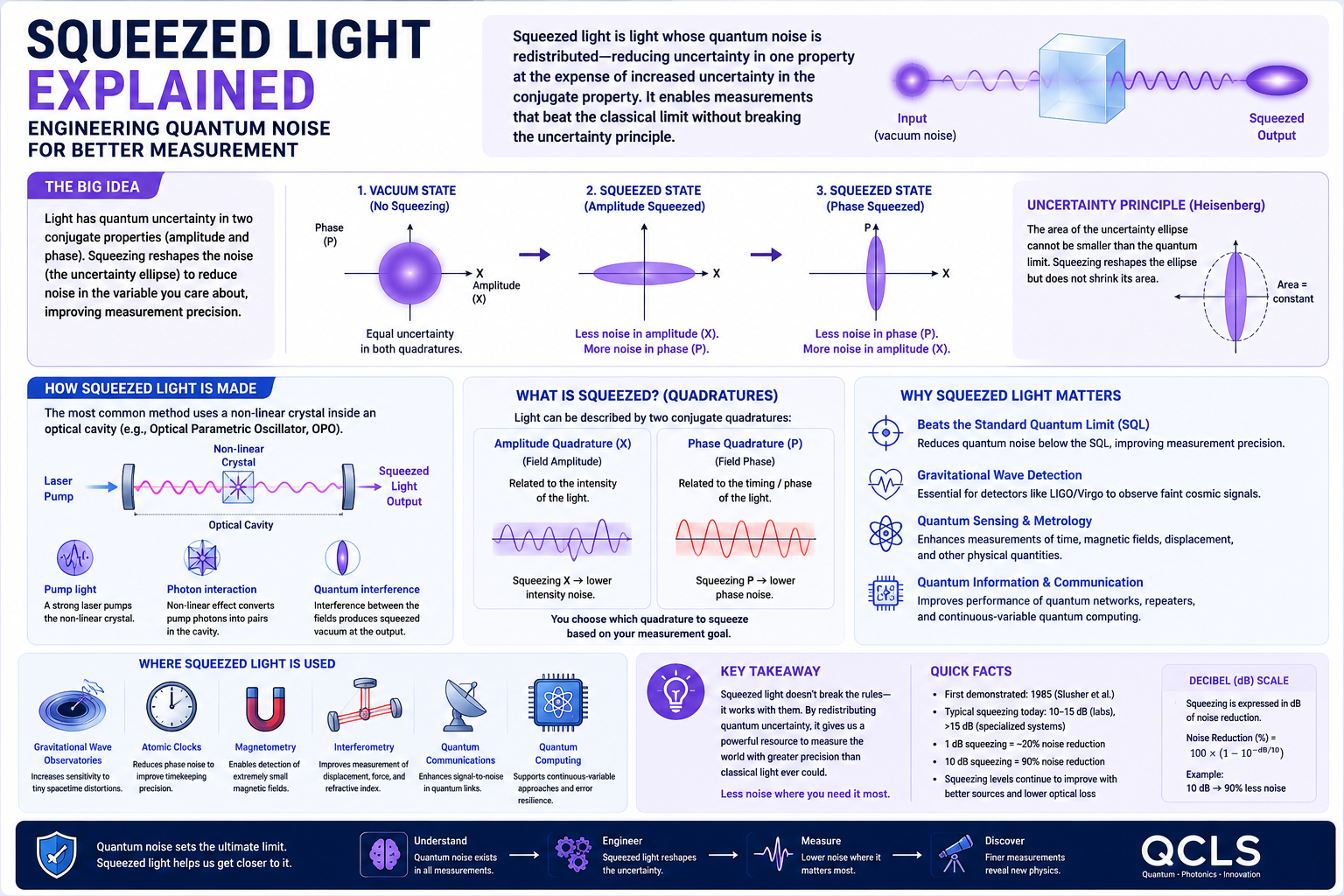
Offer this as a downloadable squeezed-light study reference.
Connect this form to your email platform and send visitors the full-size Squeezed Light infographic. This keeps the page educational while turning the visual reference into a useful lead magnet.
Squeezed light reduces quantum uncertainty where a measurement needs it most.
Light has quantum fluctuations. Even a perfect laser or vacuum field has uncertainty in measurable field variables. Squeezed light reshapes that uncertainty so one quadrature has less noise than a standard coherent state or vacuum state, while the conjugate quadrature has more noise.
The result is not “free precision.” It is a controlled trade-off. If a sensor measures the quieter quadrature, squeezed light can improve sensitivity beyond ordinary shot-noise limits in specific regimes.
Squeezed light does not break the uncertainty principle. It uses the uncertainty principle intelligently.
Squeezed light is light with redistributed quantum uncertainty.
A classical wave can be described by amplitude and phase. In quantum optics, these ideas are represented by field quadratures. For ordinary coherent light, quantum uncertainty is balanced between quadratures. For squeezed light, one quadrature is compressed below the ordinary quantum noise level while the other is stretched.
This is why squeezed states are often drawn as ellipses in phase space. A circular noise distribution becomes an ellipse: narrower in the squeezed direction, wider in the anti-squeezed direction.
Squeezed light: lower uncertainty in X, higher uncertainty in P
Measurement advantage: use the low-noise quadrature for the signal of interest
Quantum noise is not bad engineering. It is built into light.
Photonics is often limited by technical noise: temperature drift, vibration, electronics, laser instability, imperfect optics, and background light. But even after technical noise is reduced, quantum noise can remain.
Shot noise arises because light is quantized into photons. Vacuum fluctuations can enter unused optical ports and affect measurements. Radiation pressure noise can appear when fluctuating photon momentum pushes mirrors or mechanical systems. Squeezed light is valuable because it targets these quantum noise sources directly.
Photon counting uncertainty
At low light or high precision, discrete photon statistics create measurement noise.
Empty space is not quiet
Quantum vacuum fields can enter optical systems and contribute noise.
Measurement can disturb
Radiation pressure or measurement interaction can push the system being measured.
The key idea is choosing which uncertainty matters.
Optical field quadratures are like two connected measurement axes. They are often compared to position and momentum for an oscillator. Because they are conjugate variables, reducing uncertainty in one quadrature increases uncertainty in the other.
For sensing, that is useful when the signal is encoded mainly in one quadrature. A squeezed state can reduce noise in that quadrature and move the extra uncertainty into a quadrature the experiment is less sensitive to.
Squeezing is useful only when the reduced-noise quadrature lines up with the measurement you care about.
Squeezed states are usually produced through nonlinear optical interactions.
Squeezed light is commonly generated using nonlinear optical processes where strong pump light interacts with a nonlinear medium. The process creates correlations between optical field fluctuations that reduce noise in one quadrature.
Nonlinear gain
A pump field drives a nonlinear crystal or resonator to create squeezed vacuum or squeezed light.
Nonlinear mixing
Interactions between optical fields in fibers, atoms, or waveguides can generate squeezed states.
Light-mechanical interaction
Coupling between light and mechanical motion can produce squeezed optical or mechanical states.
The exact method depends on wavelength, power, bandwidth, loss, chip platform, and whether the target application needs squeezed vacuum, bright squeezed light, two-mode squeezing, or frequency-dependent squeezing.
Squeezed light can improve precision by reducing measurement noise.
Many optical sensors measure phase, displacement, intensity, timing, or frequency. If quantum noise limits the measurement, squeezed light can reduce the relevant noise component and improve sensitivity.
| Sensor Type | Measured Quantity | Why Squeezing Helps |
|---|---|---|
| Interferometers | Phase, displacement, path length | Reduced phase noise can reveal smaller path changes. |
| Gravitational-Wave Detectors | Mirror displacement from space-time strain | Squeezed vacuum can reduce quantum noise in the detection band. |
| Biological Imaging | Weak optical signals | Lower measurement noise can improve sensitivity at lower illumination levels. |
| Spectroscopy | Absorption, phase, molecular signatures | Quantum-enhanced readout can detect smaller changes. |
| Optomechanical Sensors | Motion, force, pressure | Squeezing can help manage imprecision and back-action noise. |
Gravitational-wave detectors use squeezed light to reduce quantum noise.
One of the most important practical examples is gravitational-wave detection. These detectors measure incredibly small changes in the length of long interferometer arms. At that scale, quantum noise in the optical readout becomes a serious limit.
Squeezed light can reduce the quantum noise that hides weak gravitational-wave signals. More advanced versions use frequency-dependent squeezing, where the squeezing angle changes with frequency to balance shot noise and radiation-pressure noise across a wider band.
LIGO shows why squeezed light matters: it is not just a theoretical state of light. It is a deployed quantum technology used to improve one of the most sensitive measurement systems ever built.
Different squeezed-light states support different quantum photonic systems.
Squeezing is a broad family of nonclassical light states. Each type has different uses in sensing, communication, computing, and fundamental physics.
No bright carrier required
A vacuum field with reduced noise in one quadrature. Important for interferometer readout.
Squeezed fluctuations on a field
A nonzero optical field with reduced quantum noise in a chosen quadrature.
Reduced intensity noise
Useful when amplitude or photon-number fluctuations limit the measurement.
Reduced phase noise
Useful in phase-sensitive interferometry and displacement sensing.
Correlated optical modes
Closely related to entanglement and continuous-variable quantum information.
Noise angle changes with frequency
Used when different noise sources dominate at different frequencies.
Integrated photonics could bring squeezed-light generation onto chips.
Traditional squeezed-light systems often use carefully aligned nonlinear crystals, cavities, and bulk optical components. Integrated photonics can shrink the nonlinear medium, stabilize the optical path, and enable compact squeezed-light sources.
Chip-scale squeezing may use nonlinear waveguides, resonators, silicon nitride, lithium niobate, periodically poled materials, III-V platforms, or hybrid integration. The challenge is controlling loss because loss rapidly destroys squeezing.
Squeezed light matters wherever quantum noise limits measurement or information processing.
The clearest current application is precision sensing, but squeezed states also matter in continuous-variable quantum communication, quantum computing concepts, imaging, spectroscopy, and fundamental quantum optics.
Sharper interferometers
Squeezed light can improve quantum-noise-limited detector sensitivity.
Sub-shot-noise readout
Squeezing can reveal smaller signals when measurement noise dominates.
Lower-noise optical measurement
Squeezed states can improve imaging or probing under carefully controlled conditions.
Small absorption and phase shifts
Reduced optical noise can improve detection of weak molecular signatures.
Quantum information with field quadratures
Squeezed states are core resources for continuous-variable quantum protocols.
Entangled optical modes
Two-mode squeezing can create correlations useful in quantum communication research.
Squeezing is fragile because loss and phase error quickly destroy the advantage.
Producing squeezed light is only the first step. The squeezed state must survive the optical system and align with the measurement. Loss, imperfect mode matching, detector inefficiency, phase noise, thermal drift, and excess technical noise can erase the advantage.
The biggest enemy
Loss mixes ordinary vacuum noise back into the squeezed state.
The quiet axis must align
If the squeezing angle drifts, the sensor may measure the wrong quadrature.
Readout must preserve squeezing
Inefficient detection degrades the observed noise reduction.
Fields must overlap cleanly
Poor spatial, spectral, or temporal matching reduces effective squeezing.
Classical noise can dominate
Squeezing helps only when quantum noise is actually the limiting factor.
Noise depends on frequency
Some systems need frequency-dependent squeezing to improve broadband sensitivity.
Squeezed light is one of the most practical examples of engineered quantum advantage.
Squeezed light is powerful because it does not require a full universal quantum computer. It uses quantum-state engineering to improve real measurements. That makes it one of the clearest bridges from quantum optics research into deployed quantum technology.
For QCLS, this page strengthens the quantum sensing cluster. The next natural page would be Single-Photon Imaging Explained or Optical Quantum Clocks Explained, depending on whether we want to expand sensing through detectors or through timing and metrology.
Squeezed light, explained clearly.
What is squeezed light?
Squeezed light is a nonclassical state of light with reduced quantum uncertainty in one quadrature and increased uncertainty in the conjugate quadrature.
Does squeezed light break the uncertainty principle?
No. It obeys the uncertainty principle by reducing uncertainty in one variable while increasing uncertainty in another.
Why is squeezed light useful?
It can reduce measurement noise in the variable a sensor cares about, improving precision when quantum noise is the limiting factor.
How is squeezed light made?
It is often made through nonlinear optical processes such as optical parametric amplification, four-wave mixing, or optomechanical interactions.
What is squeezed vacuum?
Squeezed vacuum is a vacuum state whose quantum fluctuations have been redistributed so one quadrature is quieter than ordinary vacuum.
What destroys squeezing?
Optical loss, detector inefficiency, phase drift, poor mode matching, and excess technical noise can degrade or erase squeezing.