
Quantum Repeaters Explained
Quantum repeaters are systems designed to extend quantum communication beyond the distance limits of direct photon transmission. Unlike classical repeaters, they cannot simply copy and amplify unknown quantum states. Instead, they rely on entanglement generation, quantum memories, entanglement swapping, purification, and classical coordination.
Quantum Repeaters at a Glance
This study graphic summarizes the core quantum-repeater lesson: why direct quantum links fail over long distance, why classical optical repeaters cannot simply amplify unknown quantum states, how repeaters use shorter entangled links plus memories and entanglement swapping, and why purification and coordination matter for long-distance quantum networking.
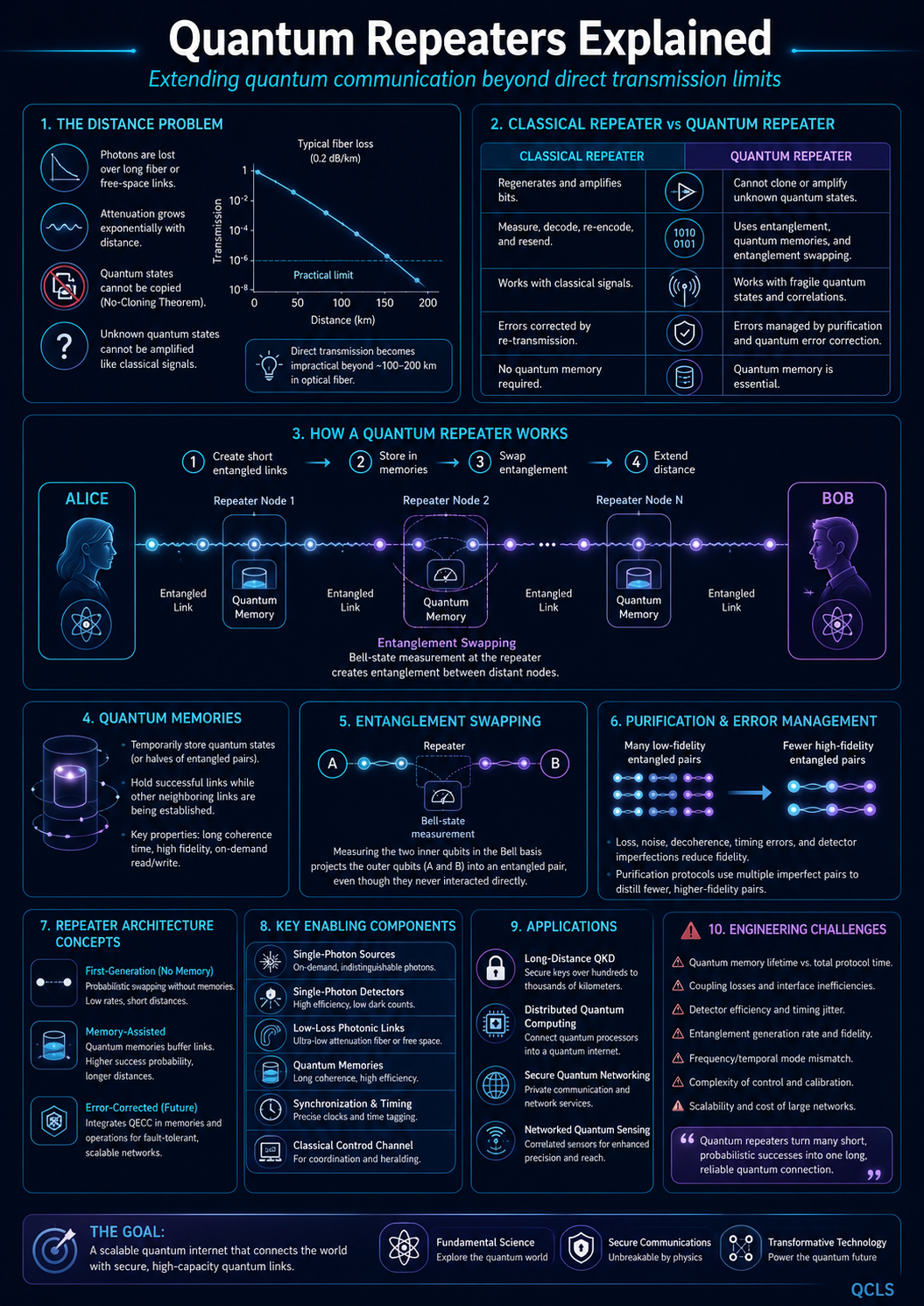
Offer this as a downloadable quantum-repeaters study reference.
Connect this form to your email platform and send visitors the full-size Quantum Repeaters infographic. This keeps the page educational while turning the visual reference into a useful lead magnet.
Quantum repeaters solve a problem classical repeaters cannot solve.
A classical optical repeater can read, regenerate, and amplify ordinary information. A quantum repeater cannot do that with an unknown quantum state because unknown quantum states cannot be perfectly copied.
Quantum repeaters are proposed systems for extending quantum communication across long distances by dividing the channel into shorter segments, generating entanglement over those segments, storing successful links in quantum memories, and connecting them through entanglement swapping.
The purpose of a quantum repeater is not to amplify a photon. It is to extend usable entanglement across distance.
Photons are excellent carriers, but they are still lost over distance.
Quantum networks rely on photons to carry quantum information through fiber or free space. But optical channels are lossy. In fiber, some photons are absorbed, scattered, coupled out, or otherwise lost. In free space, pointing, turbulence, weather, and background light can reduce successful transmission.
For classical communication, loss can often be overcome with optical amplifiers and repeaters. For quantum communication, unknown quantum states cannot be copied and amplified in the ordinary way. That creates a distance bottleneck.
more distance → more photon loss → lower entanglement rate → lower key rate or protocol success
Classical solution: amplify and regenerate
Quantum solution: generate, store, swap, purify, and coordinate entanglement
Quantum repeaters are fundamentally different from telecom repeaters.
Classical repeaters work because ordinary data can be measured, copied, cleaned up, and retransmitted. Quantum information cannot be handled that way without destroying the state.
| Feature | Classical Optical Repeater | Quantum Repeater |
|---|---|---|
| Signal type | Classical optical data | Quantum states or entanglement |
| Can copy? | Yes, classical bits can be copied | No, unknown quantum states cannot be perfectly cloned |
| Main operation | Amplify, reshape, retime, retransmit | Generate entanglement, store states, perform Bell measurements, swap entanglement |
| Hardware need | Optical amplifiers, receivers, transmitters | Quantum memories, photon sources, detectors, classical control, low-loss optics |
| Goal | Extend classical data transmission | Extend entanglement and quantum communication capability |
Repeaters break a long quantum link into shorter, more manageable segments.
The basic idea is to divide a long channel into shorter links. Each shorter link tries to create entanglement between neighboring nodes. When links succeed, quantum memories store the states. Entanglement swapping then connects adjacent entangled links into a longer entangled link.
Divide the long channel
Shorter links have higher probability of successful photon transmission.
Create local entanglement
Photon sources and detectors establish entanglement between neighboring nodes.
Hold successful links
Quantum memories keep successful entangled states while other segments catch up.
Connect entanglement
Bell-state measurements can extend entanglement across multiple segments.
Manage fidelity
Protocols estimate or improve the quality of distributed entanglement.
Run a network service
The entanglement can support QKD, teleportation, sensing, or distributed quantum computing.
Quantum memories are the holding tanks of a repeater network.
Link creation is probabilistic. One segment may succeed while another fails. Without memory, the successful link may be wasted before the rest of the network is ready. Quantum memories allow the system to store successful states long enough to coordinate multi-segment entanglement.
Entanglement swapping connects two shorter links into one longer link.
Suppose Node A is entangled with Repeater R, and Repeater R is entangled with Node B. A Bell-state measurement at the repeater can project the outer nodes into an entangled relationship, even though they never directly interacted.
A ↔ R1 and R2 ↔ B are entangled pairs
Bell-state measurement at repeater:
R1 and R2 measured jointly
After swapping:
A ↔ B become entangled across the longer distance
This is the core mechanism that allows shorter entangled links to become longer entangled links.
Repeaters must manage imperfect entanglement.
Real entangled links are not perfect. Loss, detector noise, memory decoherence, mode mismatch, timing errors, and channel noise can reduce fidelity. Some repeater approaches use entanglement purification, where multiple lower-quality entangled pairs are processed to produce fewer higher-quality pairs.
Other approaches rely more on quantum error correction, multiplexing, or improved hardware. The best architecture depends on memory performance, channel loss, source quality, detector efficiency, and the target application.
A quantum repeater is not just a distance extender. It is a fidelity-management system for fragile quantum correlations.
There is more than one way to build a quantum repeater.
Quantum repeaters are an active research area. Different architectures trade memory quality, photon source quality, error correction, hardware complexity, and deployment practicality.
| Architecture Idea | Main Mechanism | Key Challenge |
|---|---|---|
| Memory-Based Repeaters | Generate entanglement over segments, store successful states, then swap | Requires high-quality long-lived quantum memories. |
| Purification-Based Repeaters | Improve fidelity by consuming multiple lower-quality entangled pairs | Requires extra resources and coordination. |
| Error-Corrected Repeaters | Encode quantum information to tolerate loss and errors | Requires high-performance hardware and significant overhead. |
| All-Photonic Repeaters | Use photonic cluster states or encoded photonic resources to avoid long-lived memories | Requires large photonic resource states, excellent sources, and low loss. |
| Hybrid Repeaters | Combine matter qubits, memories, photons, and photonic circuits | Requires strong interfaces between stationary and flying qubits. |
Quantum repeaters support the long-distance layer of quantum networks.
Repeaters matter because many quantum-network applications require more than short point-to-point links.
Beyond direct fiber limits
Repeaters could help distribute secure key material over longer distances without relying only on trusted nodes.
Entanglement between distant nodes
Repeaters are a pathway toward entanglement distribution across city, regional, and eventually continental networks.
Link smaller processors
Repeaters may connect modular quantum processors into larger distributed systems.
Correlated measurement systems
Entanglement and timing coordination can support advanced sensing concepts.
State transfer protocol
Teleportation depends on shared entanglement and classical communication.
Test quantum protocols
Repeaters enable experiments in routing, memory, entanglement swapping, and network control.
Quantum repeaters require several hard technologies to work together.
The repeater problem is hard because every component has to be good enough at the same time: sources, memories, channels, detectors, interfaces, timing, and control.
States must survive waiting
Memories must preserve quantum states while other network segments succeed.
Storage and retrieval must work
Low storage or retrieval efficiency reduces the overall network rate.
Loss reduces success probability
Fiber, free space, coupling, switching, and detection losses all matter.
Swapping requires reliable measurement
Joint measurements must be efficient, accurate, and compatible with the encoding.
Timing is everything
Photon arrivals, memory operations, and classical messages must be coordinated.
Lab systems must become infrastructure
Repeaters need packaging, calibration, stability, serviceability, and interoperability.
Quantum repeaters are the missing middle layer of long-distance quantum networks.
Short-distance quantum links and QKD testbeds already exist in various forms. The long-term challenge is connecting many nodes over large distances without trusting every intermediate location and without losing the quantum resource.
Quantum repeaters are one of the most important technologies on that roadmap. They sit between individual quantum devices and a future quantum internet.
Quantum repeaters, explained clearly.
What is a quantum repeater?
A quantum repeater is a system designed to extend quantum communication distance by generating, storing, and swapping entanglement across shorter network segments.
Why can’t quantum networks use normal optical amplifiers?
Unknown quantum states cannot be perfectly copied, so they cannot be amplified and regenerated like classical data without destroying the quantum information.
What is entanglement swapping?
Entanglement swapping is a protocol that connects two shorter entangled links into a longer entangled link using a joint measurement at an intermediate node.
Why do repeaters need quantum memories?
Quantum memories store successful entangled states while other network segments attempt to create their own entanglement.
Are quantum repeaters deployed at scale today?
Quantum repeaters remain an active research and development area. Many components are advancing, but large-scale practical repeater networks are still difficult.
How are repeaters related to QKD?
Repeaters could help extend quantum-secured communication beyond direct-transmission limits and reduce reliance on trusted intermediate nodes in some future architectures.