
Quantum Memories Explained
Quantum memories store fragile quantum states long enough for quantum networks, repeaters, teleportation, synchronization, and distributed quantum systems to work. They are not ordinary computer memory — they must preserve superposition, entanglement, phase, and coherence.
Quantum Memories at a Glance
This study graphic summarizes the core quantum-memory lesson: what a quantum memory is, why it matters for repeaters and networks, how quantum states are stored and retrieved, which performance metrics matter most, what hardware platforms are being explored, and why photonic interfaces are essential for real quantum communication systems.
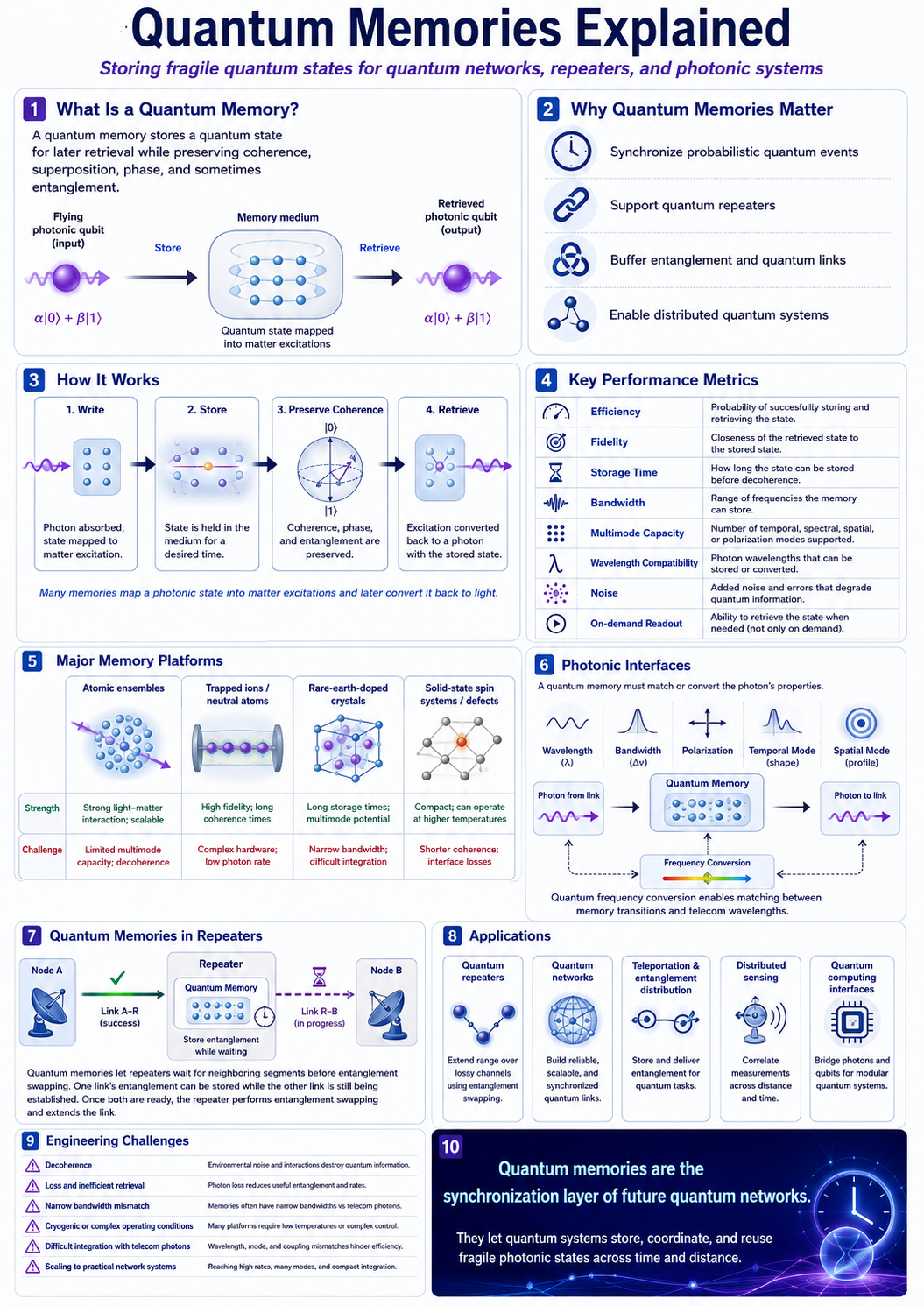
Offer this as a downloadable quantum-memories study reference.
Connect this form to your email platform and send visitors the full-size Quantum Memories infographic. This keeps the page educational while turning the visual reference into a useful lead magnet.
Quantum memories store quantum states without turning them into ordinary data.
A quantum memory is a physical system that can accept, preserve, and later retrieve a quantum state. In photonic quantum networks, the memory often needs to store a quantum state carried by light and then release it as a photon again when the network is ready.
Quantum memories are central to long-distance quantum networking because entanglement generation is probabilistic. One network segment may succeed before another. Memories allow successful quantum states to wait, making entanglement swapping and repeater-based communication possible.
Classical memory stores bits. Quantum memory must store coherence, phase, superposition, and sometimes entanglement.
A quantum memory stores a qubit or quantum state for later use.
A classical memory cell stores a 0 or 1. A quantum memory stores a quantum state such as a superposition, a photonic qubit, a spin state, an atomic excitation, or part of an entangled pair.
The key requirement is that the memory preserve the information in a quantum form. If the state decoheres into ordinary classical information, the memory has failed for quantum networking purposes.
Quantum memory: stores |ψ⟩ = α|0⟩ + β|1⟩
Network memory: may store one half of an entangled state while another link is created
Quantum networks are probabilistic. Memories make them coordinate.
Photon transmission, entanglement generation, and Bell-state measurements often succeed only with some probability. Without memory, a successful event may be wasted because another part of the network has not succeeded yet.
Hold successful links
Memories let one successful entangled segment wait while another segment is still being created.
Enable distance extension
Quantum repeaters rely on memories to store local entanglement before entanglement swapping.
Support state transfer
Teleportation protocols need shared entanglement and timed measurement coordination.
A memory maps a flying photonic state into a stable matter system.
Many quantum memories work by converting the quantum state of a photon into an excitation of matter. That stored state may live in an atom, ion, crystal defect, rare-earth ion ensemble, atomic vapor, solid-state spin, or other system. Later, the memory retrieves the state and emits it back into an optical mode.
Absorb or map the state
The incoming photonic state is transferred into a matter-based degree of freedom.
Preserve coherence
The memory must protect the quantum state from environmental noise and decoherence.
Retrieve on demand
The state is released as a photon or transferred into another quantum system.
A useful quantum memory must be efficient, faithful, long-lived, and compatible.
Quantum memories are evaluated by how well they preserve a quantum state and how well they fit into real networks.
| Metric | Meaning | Why It Matters |
|---|---|---|
| Storage Efficiency | Probability that the memory stores and retrieves the state successfully | Low efficiency destroys network rates. |
| Fidelity | How accurately the retrieved state matches the original state | Low fidelity makes entanglement and protocols unusable. |
| Storage Lifetime | How long the state survives before decoherence | Repeaters need enough lifetime for other links to succeed. |
| Bandwidth | Range of photon frequencies or pulse durations the memory can accept | Must match sources, photons, and network rates. |
| Multimode Capacity | Ability to store many temporal, spectral, spatial, or spin-wave modes | Multiplexing can dramatically improve network throughput. |
| Wavelength Compatibility | Whether the memory works at telecom or requires conversion | Fiber networks often prefer telecom wavelengths for lower loss. |
Quantum memories can be built from atoms, ions, crystals, defects, and ensembles.
There is no single perfect quantum memory platform. Each approach trades lifetime, efficiency, wavelength, bandwidth, temperature, integration, and scalability.
Many atoms act together
Can store collective excitations and support photon-memory interfaces.
Solid-state optical memories
Rare-earth-doped crystals can support long coherence and spectral storage protocols.
Highly controlled qubits
Can provide strong coherence and precision, but require complex trapping systems.
Defects in solids
Diamond and silicon-carbide defects can connect spin states with optical photons.
Semiconductor emitters
Often discussed for photon generation and spin-photon interfaces.
Interfaces between platforms
Hybrid memories may link microwave, optical, spin, and mechanical degrees of freedom.
Quantum memories must talk to photons.
For a memory to be useful in quantum photonics, it must interface with light. That means matching the photon’s wavelength, bandwidth, polarization, temporal mode, spatial mode, and timing.
Sometimes the best memory transition is not at telecom wavelength. In those cases, quantum frequency conversion may be required to connect low-loss fiber photons with the memory platform.
Memories are what let repeaters wait.
Quantum repeaters divide long links into shorter segments. If one segment succeeds, its entangled state must be held until neighboring segments succeed. The memory acts as the buffer that allows the network to coordinate probabilistic quantum events.
A quantum repeater without memory is like a network switch that cannot hold a packet long enough for the next link to become available — except the “packet” is a fragile quantum state.
Some repeater architectures use long-lived memories directly. Others attempt all-photonic or memory-light designs using special graph or cluster states. But for many repeater concepts, memory quality is one of the defining bottlenecks.
Quantum memories support the long-distance and synchronized parts of quantum technology.
Memories matter wherever quantum events need to be stored, synchronized, transferred, or retrieved.
Long-distance entanglement
Memories store successful links for entanglement swapping.
Networked quantum resources
Memories help coordinate entanglement distribution between many nodes.
State transfer protocols
Memories can hold states while measurements and classical communication complete.
Modular processors
Memory links may connect smaller quantum processors into larger systems.
Synchronized measurement
Stored quantum states can support coordinated sensing concepts.
Connect different hardware
Memories can interface photons with matter qubits, processors, and communication links.
Quantum memory is one of the hardest pieces of the quantum-network stack.
The ideal memory would be efficient, high-fidelity, long-lived, broadband, multimode, telecom-compatible, on-demand, low-noise, integrated, and deployable. Real systems involve trade-offs.
The state fades over time
Environmental noise, magnetic fields, phonons, collisions, and material defects can damage stored quantum states.
Write and read losses hurt rates
Even high-quality states are not useful if too few are successfully stored and retrieved.
Accuracy matters
Errors in storage or retrieval reduce entanglement quality and protocol success.
Photons must match memory
Many memories accept only limited pulse shapes, wavelengths, or spectral widths.
Rates need parallel modes
Large networks may need memories that store many modes at once.
Systems must leave the lab
Practical memories need packaging, control electronics, photonic interfaces, and stability.
Quantum memories are the synchronization layer of future quantum networks.
As quantum networks move from point-to-point links toward multi-node systems, memory becomes increasingly important. The ability to store entanglement, synchronize probabilistic events, and interface photons with matter qubits may determine how far quantum networks can scale.
The next QCLS page should be **Quantum Teleportation Explained**, because teleportation shows why entanglement plus memory plus classical communication is a central network protocol.
Quantum memories, explained clearly.
What is a quantum memory?
A quantum memory is a physical system that stores a quantum state and retrieves it later while preserving its quantum properties.
Why are quantum memories important for repeaters?
They store successful entangled links while other network segments attempt to create their own entanglement.
How is quantum memory different from classical memory?
Classical memory stores bits. Quantum memory must preserve coherence, superposition, phase, and sometimes entanglement.
What makes a quantum memory good?
Important metrics include efficiency, fidelity, storage lifetime, bandwidth, wavelength compatibility, noise, and multimode capacity.
Can quantum memories store photons?
Many memories store the quantum state of a photon by mapping it into a matter-based excitation, then retrieving it as light later.
Are quantum memories ready for large-scale networks?
Quantum memories are advancing quickly, but practical large-scale deployment still requires improvements in efficiency, lifetime, fidelity, multiplexing, integration, and packaging.