
Quantum Teleportation Explained
Quantum teleportation is a protocol for transferring an unknown quantum state from one system to another using shared entanglement, a Bell-state measurement, classical communication, and a correction operation. It does not teleport matter, and it does not send usable information faster than light.
Quantum Teleportation at a Glance
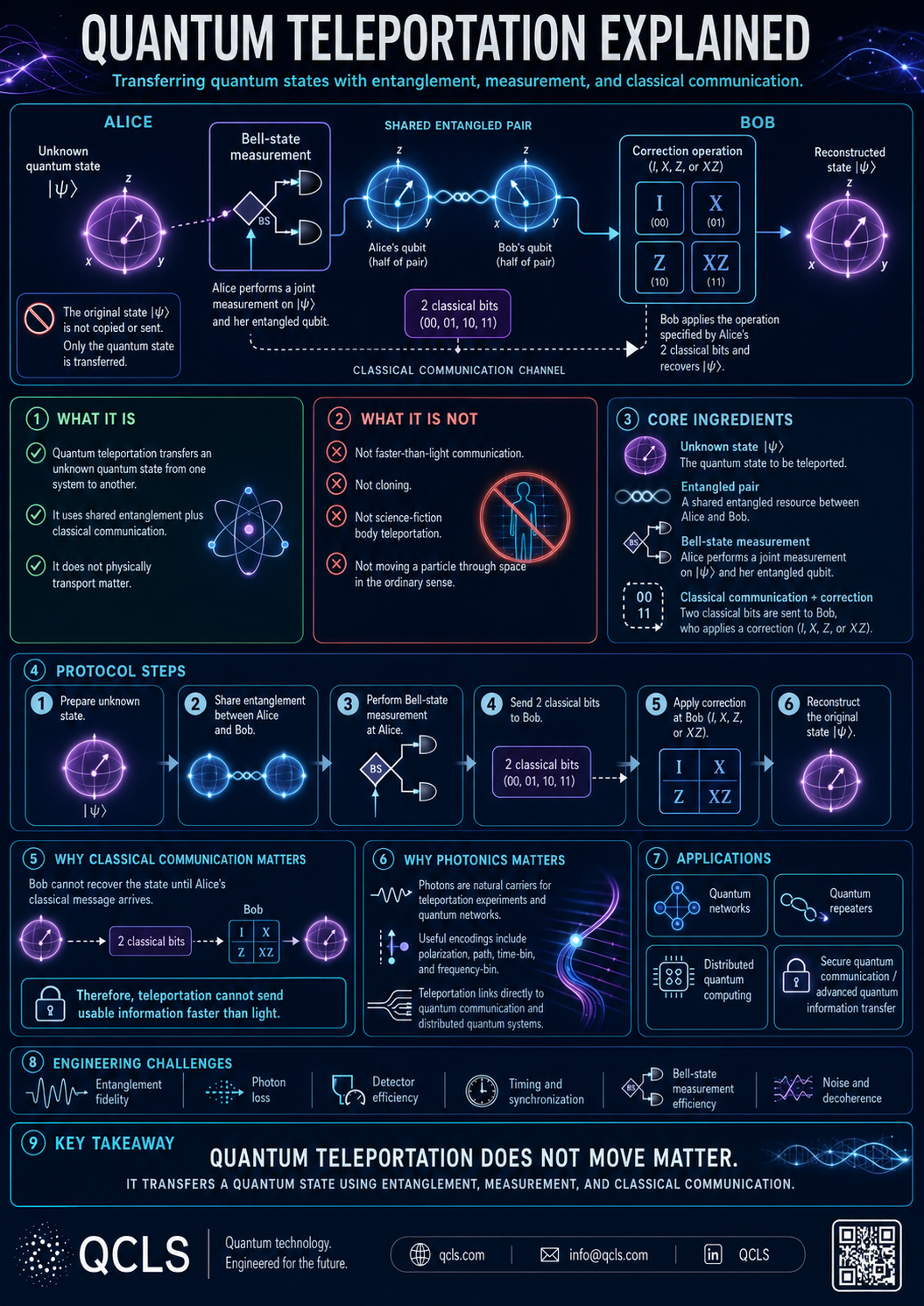
This study graphic summarizes the core quantum-teleportation lesson: what quantum teleportation is, what it is not, which ingredients are required, how the protocol works step by step, why classical communication is necessary, how photonic teleportation fits into quantum networks, and which engineering constraints shape real-world implementations.
Offer this as a downloadable quantum-teleportation study reference.
Connect this form to your email platform and send visitors the full-size Quantum Teleportation infographic. This keeps the page educational while turning the visual reference into a useful lead magnet.
Quantum teleportation transfers a quantum state using entanglement and classical communication.
Quantum teleportation is one of the most important protocols in quantum information science. It allows an unknown quantum state to be reconstructed at a distant location without physically sending that exact quantum system through the entire channel.
The protocol consumes shared entanglement and requires classical communication. Alice performs a Bell-state measurement, sends classical bits to Bob, and Bob applies a correction operation. The original unknown state is destroyed by Alice’s measurement and reconstructed on Bob’s system.
The key idea: quantum teleportation moves the state, not the object. It requires entanglement plus classical communication, so it cannot transmit usable information faster than light.
It is a state-transfer protocol, not science-fiction transportation.
Quantum teleportation transfers the information contained in an unknown quantum state from one system to another. The destination system becomes the new carrier of the original state after the proper correction is applied.
This is different from copying. The original state is not duplicated. The measurement step destroys the original quantum state in the process, which keeps the protocol consistent with the no-cloning theorem.
|ψ⟩ = α|0⟩ + β|1⟩
After Bell measurement + classical bits + Bob’s correction:
Bob’s qubit becomes |ψ⟩
Teleportation does not move matter, clone qubits, or beat relativity.
The word “teleportation” creates confusion. In quantum information, teleportation has a precise technical meaning. It does not mean a person, object, photon, or particle is physically transported from one place to another.
Teleportation needs three resources working together.
The protocol is simple to state but difficult to implement well. It needs an unknown quantum state, a shared entangled pair, and a classical communication channel.
The state to transfer
A qubit or quantum state exists at Alice’s location and is not known in classical detail.
The quantum resource
Alice and Bob share an entangled pair before the teleportation step.
The correction information
Alice sends Bob classical measurement results so he knows which correction to apply.
The state is reconstructed after measurement and correction.
The standard one-qubit teleportation protocol is often explained using Alice and Bob.
Alice has |ψ⟩
Alice holds the unknown quantum state that will be transferred.
Alice and Bob share a Bell pair
One qubit of the entangled pair is with Alice and the other is with Bob.
Alice measures jointly
Alice performs a Bell-state measurement on the unknown state and her half of the entangled pair.
Alice sends results
The measurement produces classical information that must be sent to Bob.
Bob applies an operation
Bob uses Alice’s classical bits to choose the correct quantum operation.
Bob obtains |ψ⟩
Bob’s qubit becomes the transferred quantum state.
Entanglement alone is not enough to complete teleportation.
After Alice’s Bell-state measurement, Bob’s qubit is related to the original state, but it may be transformed by one of several possible corrections. Alice must send classical measurement results so Bob knows what to do.
This classical communication requirement is why quantum teleportation cannot send usable information faster than light. Bob cannot recover the intended state until Alice’s classical message arrives.
Entanglement creates the quantum connection. Classical communication makes the teleportation usable.
Photons are natural carriers for teleportation experiments and networks.
In quantum photonics, teleportation can involve photonic qubits encoded in polarization, path, time-bin, frequency-bin, or other optical modes. Photons are useful because they travel well through optical fiber and free space.
Photonic teleportation usually depends on high-quality entangled photon pairs, low-loss optical circuits, Bell-state measurements, fast detectors, timing synchronization, and classical feed-forward.
| Photonic Component | Role in Teleportation | Why It Matters |
|---|---|---|
| Entangled Photon Source | Creates the shared quantum resource | The quality of entanglement limits teleportation fidelity. |
| Photonic Qubit Encoding | Stores the state in optical modes | Polarization, time-bin, path, or frequency encodings shape the hardware. |
| Bell-State Measurement | Performs the joint measurement | The measurement determines which correction Bob must apply. |
| Single-Photon Detectors | Record outcomes | Efficiency, timing jitter, and dark counts affect success and fidelity. |
| Classical Feed-Forward | Communicates correction information | Bob needs this information before the state can be recovered. |
Teleportation is a core protocol for future quantum networks.
Quantum networks aim to distribute quantum resources between distant nodes. Teleportation provides a way to transfer quantum states between nodes using shared entanglement rather than directly sending the original quantum system over the full distance.
This connects teleportation to quantum repeaters. Repeaters use entanglement swapping and memories to create long-distance entanglement. Once entanglement exists across a network path, teleportation-style protocols can transfer quantum states between endpoints.
Extend entanglement
Repeaters help create the long-distance entanglement teleportation needs.
Hold states while links succeed
Memories help synchronize probabilistic network events.
Choose network paths
Future quantum networks may route entangled resources between requested nodes.
Teleportation can also move gates and states inside quantum processors.
Teleportation is not only a communication protocol. It also appears in quantum computing architectures, including gate teleportation, measurement-based quantum computing, modular quantum computing, and distributed quantum processors.
In these systems, entanglement plus measurement plus feed-forward can effectively move quantum information or implement operations between locations that may be physically separated.
Teleportation fidelity depends on the whole quantum system.
Successful teleportation requires more than a beautiful protocol diagram. Real systems need high-quality entanglement, efficient measurements, low loss, synchronization, correction operations, and noise control.
The shared resource must be clean
Noisy entanglement reduces teleportation accuracy.
Joint measurement is hard
Photonic Bell-state measurements can be probabilistic or limited by detector and circuit performance.
Lost photons break the protocol
Fiber, chip, coupling, and detector losses reduce success rates.
Measurement must be accurate
Efficiency, timing jitter, dark counts, and photon-number resolution shape outcomes.
Timing and control matter
Correction operations require fast, reliable classical communication and control.
Networks need waiting time
Quantum memories may be required to coordinate networked teleportation events.
Teleportation is the state-transfer language of quantum networks.
Quantum teleportation is not a consumer teleportation device. It is a foundational protocol that helps explain how future quantum networks, repeaters, memories, and distributed quantum processors could transfer quantum states across distance.
For QCLS, this page completes the bridge from quantum memory to networked quantum protocols. The next expansion could be **Satellite Quantum Communication Explained** or **Integrated Quantum Photonics Explained**.
Quantum teleportation, explained clearly.
What is quantum teleportation?
Quantum teleportation is a protocol that transfers an unknown quantum state from one system to another using shared entanglement, measurement, classical communication, and correction.
Does quantum teleportation move matter?
No. It transfers a quantum state, not a physical object, person, or particle.
Does teleportation copy a quantum state?
No. The original state is destroyed by measurement while the destination system becomes the carrier of the transferred state.
Can quantum teleportation send information faster than light?
No. Bob needs Alice’s classical measurement results before he can recover the intended state.
Why is entanglement required?
Entanglement provides the shared quantum resource that makes the state transfer possible.
Why does teleportation matter for quantum networks?
Teleportation can transfer quantum states between network nodes once entanglement has been distributed between them.