Satellite Quantum Communication Explained
Satellite quantum communication uses photons traveling through free-space optical links to connect ground stations, satellites, and future quantum network nodes. It may support quantum key distribution, entanglement distribution, quantum networking, and long-distance secure communication where terrestrial fiber becomes too lossy.
Satellite Quantum Communication at a Glance
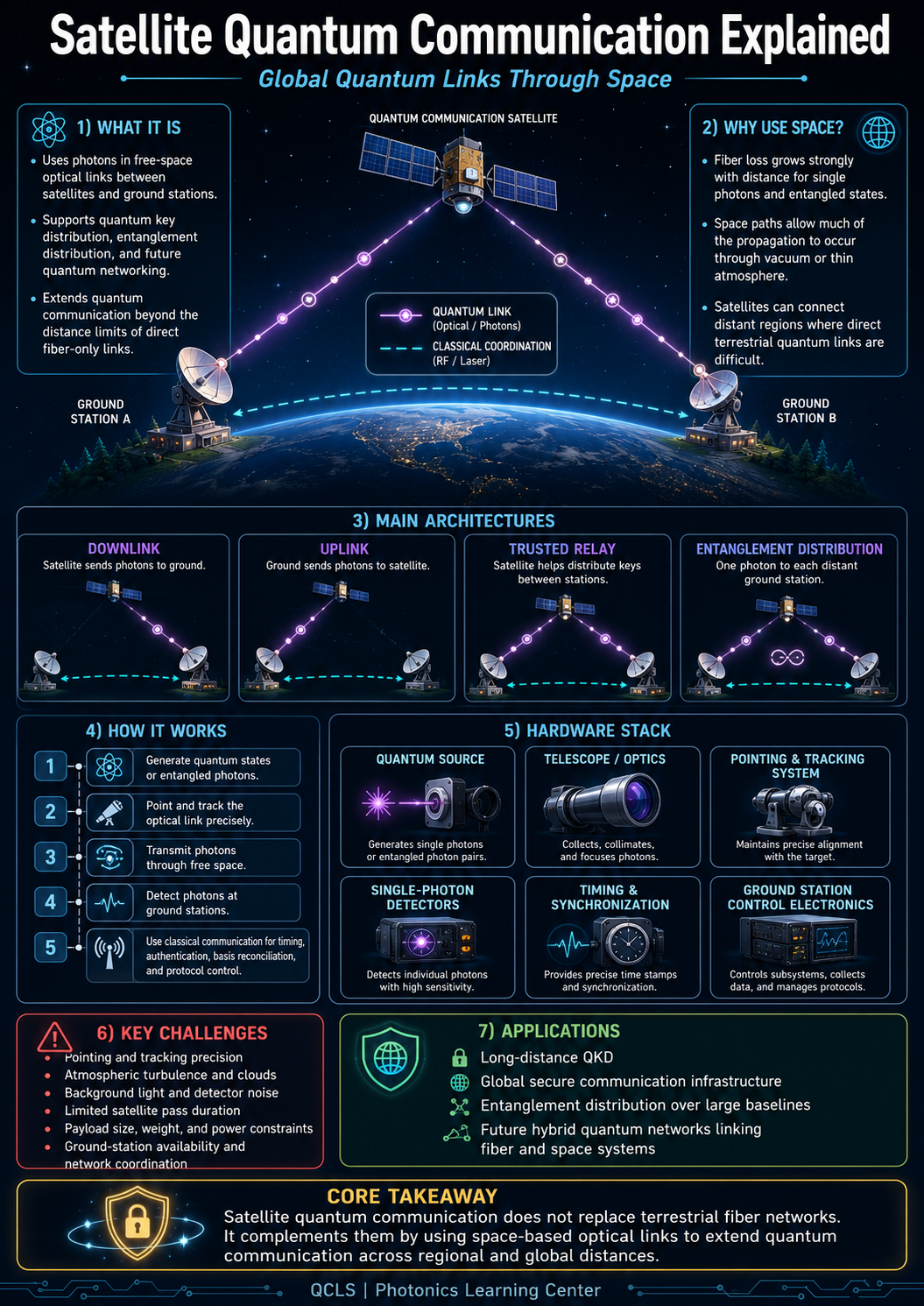
This study graphic summarizes the core satellite-quantum-communication lesson: what it is, why space helps overcome long-distance fiber limits, how ground stations and satellites exchange quantum states, which architectures are used, how QKD and entanglement distribution fit in, what hardware is required, and which atmospheric and systems-engineering challenges shape real deployments.
Offer this as a downloadable satellite-quantum-communication study reference.
Connect this form to your email platform and send visitors the full-size Satellite Quantum Communication infographic. This keeps the page educational while turning the visual reference into a useful lead magnet.
Satellite quantum communication uses space as a long-distance optical quantum channel.
Terrestrial fiber is essential for quantum networks, but photon loss grows with distance. Satellite quantum communication uses free-space optical links to move quantum states, quantum keys, or entangled photons over much larger geographic spans than direct fiber links can usually support.
In practice, a satellite system may use photons to distribute quantum keys, deliver entangled photon pairs, connect distant ground stations, or support future quantum network services. But it also requires precision pointing, acquisition and tracking, low-noise detectors, timing synchronization, atmospheric correction, weather-aware scheduling, and careful security architecture.
Satellite quantum communication is not a shortcut around physics. It trades fiber attenuation for free-space pointing, atmosphere, timing, payload, and ground-station engineering.
It is quantum communication through optical links that include space segments.
Satellite quantum communication sends or receives quantum optical states between satellites and ground stations, or potentially between satellites. The quantum states may be encoded in photon polarization, phase, time-bin, frequency, orbital angular momentum, or other optical modes.
The satellite can act as a transmitter, receiver, trusted relay, entangled photon source, optical terminal, or future quantum network node depending on the architecture.
Space links can reduce the long-distance loss problem that limits fiber-only quantum links.
Optical fiber is powerful but lossy. Over long distances, single photons or entangled states become difficult to preserve without repeaters. A satellite path can move much of the optical propagation through vacuum or thin atmosphere, reducing some distance-related constraints.
This is why satellite links are often discussed as a bridge toward global quantum communication and hybrid quantum networks that combine fiber, free-space, satellite, and eventually repeater-assisted links.
Connect distant ground stations
Satellites can link locations separated by hundreds or thousands of kilometers.
Avoid long fiber attenuation
Much of the beam path may travel through space rather than lossy terrestrial fiber.
Hybrid infrastructure
Satellites can connect regional fiber quantum networks into broader systems.
Quantum photons travel through free-space optical links while classical systems coordinate the protocol.
Most satellite quantum communication concepts still require classical communication. Classical channels handle authentication, basis reconciliation, timing, pointing control, ephemeris data, key management, and protocol decisions.
Create quantum states
Photon sources generate weak coherent pulses, single photons, or entangled photon pairs.
Aim the optical terminal
Satellite and ground station align narrow optical beams with high precision.
Send photons through free space
Photons travel through atmosphere and space, carrying quantum information.
Measure quantum states
Single-photon detectors record arrivals, bases, timing, or correlations.
Run the protocol
Classical processing performs sifting, error estimation, correction, and privacy amplification for QKD.
Apply the result
Keys, entanglement, timing, or quantum-state transfer support network services.
Satellite quantum links can be uplink, downlink, trusted relay, or entanglement-based.
The satellite can play different roles depending on where the source, detectors, and security assumptions are placed.
| Architecture | How It Works | Key Trade-Off |
|---|---|---|
| Satellite Downlink | Satellite transmits quantum states to a ground receiver | Source is in space; receiver complexity can stay on the ground. |
| Ground Uplink | Ground station transmits quantum states to a satellite receiver | More atmosphere early in the beam path can increase turbulence effects. |
| Trusted Satellite Relay | Satellite establishes separate keys with ground stations and relays key material securely by assumption | Operationally useful but requires trusting the satellite. |
| Entanglement Source in Space | Satellite sends entangled photons to two separated ground stations | Can reduce trust in the satellite, but source, pointing, and dual-link loss are difficult. |
| Inter-Satellite Quantum Links | Satellites exchange quantum states or entanglement with each other | Could expand coverage, but requires precise moving optical terminals. |
Satellite QKD aims to distribute encryption keys across long distances.
Quantum key distribution uses quantum states to help two parties create shared secret key material while detecting measurement disturbance or attack attempts under the protocol model. In a satellite setting, QKD can extend key distribution beyond direct fiber reach.
Satellite QKD still needs authentication, classical post-processing, key management, trusted device assumptions, and careful implementation security. It is a key-distribution method, not automatic protection for every endpoint or application.
Satellite QKD distributes key material through quantum optical links. The protected application still depends on classical encryption, authentication, endpoint security, and operational design.
Entangled photon distribution can connect distant ground stations without direct fiber.
A satellite can generate entangled photon pairs and send one photon to each of two separated ground stations. If both photons are detected and correlations are preserved, the two ground stations can share entanglement across a long baseline.
This approach points toward quantum networks where entanglement becomes a distributed resource, but it requires high-quality entangled photon sources, efficient optical terminals, low-noise detectors, precise timing, and strong atmospheric-link performance.
source creates photon pair → photon A sent to ground station A → photon B sent to ground station B → detections verify shared correlations
A satellite quantum link is a precision optical system.
Satellite quantum communication depends on both quantum hardware and classical space communication engineering.
Photons or entangled pairs
Sources must be compact, stable, efficient, and suitable for space payload constraints.
Pointing and beam control
Telescopes, fine steering mirrors, beacons, and tracking systems aim narrow optical beams.
Single-photon measurement
SPADs, SNSPDs, and timing systems detect weak quantum signals.
Synchronize events
Precise timing aligns photon detections, protocol windows, and correlation analysis.
Control and post-processing
Classical communication handles authentication, tracking, key sifting, and coordination.
Receive and process
Ground terminals provide telescopes, detectors, control systems, and network integration.
Space avoids fiber loss, but the atmosphere and orbit create new constraints.
Satellite quantum links face weather, turbulence, beam wander, diffraction, clouds, daylight background, atmospheric absorption, satellite motion, limited pass duration, and ground-station availability.
Satellite quantum communication is part of the future global quantum-network stack.
Satellite links may not replace fiber quantum networks. Instead, they can complement them by connecting regional networks and supporting long-distance quantum services.
Long-distance key distribution
Satellites can help connect distant users or regional QKD networks.
Remote quantum correlations
Space-based sources can distribute entanglement over long baselines.
Fiber plus satellite
Satellite links can bridge separated terrestrial quantum networks.
High-security communication
QKD-style systems may support specialized security use cases.
Fundamental tests
Long-baseline entanglement experiments test quantum physics across large distances.
Global infrastructure
Space links may become one layer of a broader quantum internet architecture.
The hard part is making weak quantum light reliable in a moving space system.
Satellite quantum communication combines the hardest parts of photonics, quantum optics, space engineering, cryptography, and networking.
Keep the beam aligned
Small angular errors can miss the receiver entirely.
Weather and turbulence matter
Clouds, turbulence, and absorption can interrupt or degrade the quantum link.
Weak signals are vulnerable
Dark counts and background light can reduce fidelity or key rates.
Precise windows are essential
Photon detections and correlations require accurate time tagging.
Trust assumptions matter
Trusted satellite relay architectures are different from entanglement-based trust-minimized approaches.
Ground station coverage matters
Cloud diversity, geographic coverage, orbital scheduling, and network integration are required.
Satellite quantum communication could become the global layer of quantum networks.
The future likely combines multiple technologies: metro fiber QKD networks, quantum repeaters, quantum memories, photonic chips, ground stations, satellite links, and classical network control.
For QCLS, this page completes a strong quantum-network expansion: repeaters, memories, teleportation, and satellites. The next page should be **Integrated Quantum Photonics Explained**, because photonic integration is what can shrink these quantum systems into deployable chips and payloads.
Satellite quantum communication, explained clearly.
What is satellite quantum communication?
Satellite quantum communication uses photons traveling through free-space optical links to support quantum key distribution, entanglement distribution, or future quantum network services.
Why use satellites instead of fiber?
Fiber loss grows with distance. Satellites can move much of the optical path through space and connect distant ground stations over large geographic spans.
Does satellite QKD encrypt messages by itself?
No. QKD distributes key material. Classical encryption, authentication, endpoint security, and key management are still required.
What is an entanglement-based satellite link?
A satellite may send entangled photon pairs to separated ground stations so the stations share quantum correlations.
What makes satellite quantum communication hard?
Pointing, atmosphere, weather, background light, detector noise, payload limits, timing, security assumptions, and ground-station availability are major challenges.
Will satellites replace quantum repeaters?
Probably not. Satellites and repeaters solve distance problems in different ways and may both become part of hybrid quantum networks.