
Single-Photon Imaging Explained
Single-photon imaging forms images by detecting individual photons and converting each arrival into spatial, temporal, and statistical information. Instead of measuring only bright optical intensity, photon-counting imagers can build pictures from extremely weak light, timing data, fluorescence events, time-of-flight returns, correlations, and quantum optical signatures.
Single-Photon Imaging at a Glance
This study graphic summarizes the core single-photon-imaging lesson: what single-photon imaging is, why it matters, how photon-counting image formation works, which detector technologies are used, why timing information matters, how LiDAR and biophotonics benefit, where quantum imaging fits in, and which engineering constraints shape real systems.
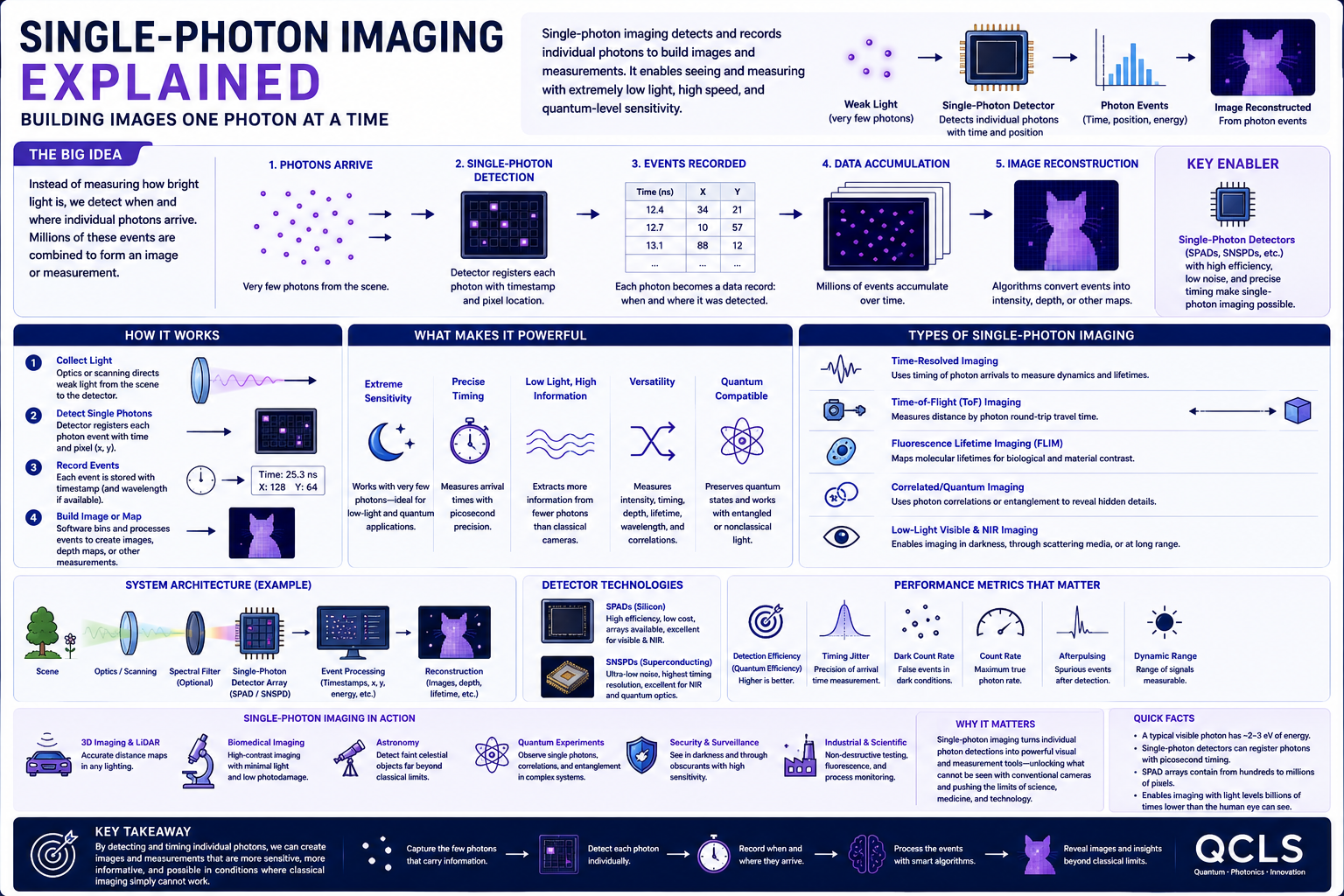
Offer this as a downloadable single-photon-imaging study reference.
Connect this form to your email platform and send visitors the full-size Single-Photon Imaging infographic. This keeps the page educational while turning the visual reference into a useful lead magnet.
Single-photon imaging turns individual photon arrivals into images and measurements.
A single-photon imaging system detects individual photons across space, time, or both. Each detected photon may provide a pixel location, arrival time, wavelength band, polarization state, correlation event, or lifetime measurement.
This makes single-photon imaging useful for weak-light environments, time-of-flight ranging, fluorescence lifetime imaging, quantum imaging, night vision, deep-tissue optical sensing, astronomy, remote sensing, and advanced microscopy.
Traditional imaging asks, “How much light hit this pixel?” Single-photon imaging asks, “Which photons arrived, where did they arrive, when did they arrive, and what do those events reveal?”
It is imaging at the level of individual light quanta.
In ordinary cameras, many photons contribute to the intensity value of a pixel. In single-photon imaging, the detector is sensitive enough to record individual photon events. The image is built from many discrete detection events over time.
Depending on the system, those events may be accumulated into a conventional image, converted into a depth map, analyzed for fluorescence lifetime, used to estimate correlations between photon pairs, or processed with computational imaging algorithms.
Single-photon imaging can extract information from extremely weak light.
Some imaging problems do not have the luxury of bright illumination. Biological samples can be light-sensitive. Remote objects may return very few photons. Quantum imaging may require photon-pair correlations. Astronomy and deep-space sensing may involve faint signals. Single-photon imaging gives those photons value.
See with fewer photons
Photon counting can extract images when light levels are extremely low.
Measure when photons arrive
Arrival times can reveal distance, fluorescence lifetime, motion, or correlations.
Measure photon statistics
Single-photon imagers can study nonclassical light, entangled photons, and correlations.
Reduce sample damage
In biological imaging, fewer photons can mean less phototoxicity and photobleaching.
Time-of-flight information
Single-photon timing can support LiDAR, 3D imaging, and range finding.
Beyond ordinary brightness
Correlation, lifetime, spectral, and quantum-state data can add new dimensions.
The camera records events, then computation reconstructs the image.
Single-photon imaging is often event-based. The detector records photon arrivals rather than simply integrating brightness continuously. Those events are processed into a useful image or measurement.
Photons reach the system
Light may come from a laser, fluorescence, reflected pulse, star, quantum source, or ambient scene.
Pixels register events
SPADs, SNSPDs, or other photon-counting detectors record individual arrivals.
Time becomes data
Timing electronics may record arrival time for each event or each pixel.
Separate signal from noise
Gating, wavelength filters, coincidence analysis, or algorithms suppress background.
Build an image
Computation converts photon events into intensity, depth, lifetime, or correlation maps.
Extract meaning
The final result may be a 2D image, 3D scene, lifetime map, quantum correlation image, or measurement.
Single-photon imaging depends on detector arrays and timing electronics.
The detector is the heart of the system. Different applications choose different detector technologies based on wavelength, timing precision, dark counts, count rate, pixel count, temperature, and cost.
| Technology | Strength | Trade-Off |
|---|---|---|
| SPAD Arrays | CMOS-compatible photon-counting pixels, time-of-flight, FLIM, LiDAR, compact imaging | Dark counts, afterpulsing, fill factor, crosstalk, and timing limits must be managed. |
| SNSPD Imagers | High efficiency, low dark counts, excellent timing, infrared and quantum optics applications | Usually require cryogenic operation and complex readout. |
| EMCCD / sCMOS Low-Light Cameras | High-sensitivity imaging and mature camera formats | May not provide true per-photon timing or event-level photon counting. |
| Photomultiplier Tubes | Strong sensitivity and mature photon-counting heritage | Bulky, not naturally dense image sensors, higher voltage systems. |
| Hybrid Detectors | Specialized performance for scientific imaging | Complexity, cost, and application-specific design. |
When a photon arrives can be as important as where it arrives.
Single-photon imaging becomes especially powerful when every photon event is timestamped. Arrival time can reveal distance in LiDAR, excited-state lifetime in fluorescence imaging, or photon correlations in quantum optics.
Photon counting can support depth imaging with very weak returns.
Single-photon LiDAR sends optical pulses toward a scene and measures the return time of detected photons. Because the system can work with very few returned photons, it is valuable for long-range, low-power, eye-safety-constrained, or low-reflectivity situations.
However, photon-counting LiDAR must handle background light, multiple returns, pile-up distortion, detector dead time, timing jitter, atmospheric effects, and computational reconstruction.
Single-photon LiDAR is not just a brighter flashlight. It is a timing system that uses photon arrivals to infer distance and structure.
Single-photon imagers can reveal biological signals with low light.
Biological imaging often benefits from sensitive detectors because samples can be damaged or altered by intense illumination. Photon-counting and time-resolved imaging can help capture weak fluorescence, lifetime changes, Raman signals, or single-emitter behavior.
Fluorescence lifetime imaging
Measures how long molecules emit after excitation, revealing environmental and biochemical information.
Track faint emitters
Photon counting helps detect and localize extremely weak biological or chemical signals.
Weak signatures
Low-signal optical signatures can benefit from sensitive detection and time-resolved methods.
Quantum imaging uses photon statistics and correlations, not only brightness.
Some imaging systems use nonclassical light or photon correlations to extract information. Entangled photon pairs, ghost imaging, quantum illumination concepts, and correlation-based microscopy all rely on detection statistics that ordinary intensity imaging may not capture.
Single-photon imagers are valuable in this area because they can measure individual events across many pixels and time bins. That makes it possible to build correlation maps, coincidence images, and quantum-statistical measurements.
Quantum/correlation image: relationships between photon detections across pixels, times, or modes
The future of single-photon imaging is detector arrays plus computation.
Single-photon imaging is becoming more powerful as detector arrays, timing electronics, photonic chips, and computational reconstruction improve together. The hardware captures sparse event data. Algorithms turn that sparse data into useful images.
Pixels with time stamps
SPAD arrays increasingly integrate timing and processing near the pixel.
Filter and route light
Integrated photonics can help with filtering, splitting, spectral routing, and coupling.
Recover more from fewer photons
Algorithms use prior information, statistics, and timing data to reconstruct scenes.
Counting photons is powerful, but every false count and missed count matters.
Single-photon imaging systems must manage detector noise, timing errors, background light, optical loss, pixel nonuniformity, and data volume.
False photon events
Detector noise can create events even when no signal photon arrived.
Uncertain arrival time
Jitter reduces depth precision, lifetime accuracy, and correlation resolution.
Pixels need recovery
After detecting a photon, a detector may be temporarily unable to count another event.
False follow-up events
SPAD arrays must control effects that create artificial correlations or counts.
Early photons dominate
In time-correlated measurements, detector behavior can bias timing histograms.
Event streams can be huge
High-rate photon events require fast readout, compression, reconstruction, and calibration.
Single-photon imaging turns scarce light into useful data.
As SPAD arrays, SNSPD imagers, timing electronics, integrated photonics, and computational imaging improve, single-photon imaging will become increasingly important across sensing, biophotonics, LiDAR, microscopy, astronomy, quantum optics, and security.
For QCLS, this page expands the quantum sensing cluster from squeezed light into photon-counting imaging. The next natural page is Optical Quantum Clocks Explained, because timing and precision measurement are another major branch of quantum photonics.
Single-photon imaging, explained clearly.
What is single-photon imaging?
Single-photon imaging is imaging that detects individual photon events and uses their position, timing, and statistics to build images or measurements.
What is a SPAD camera?
A SPAD camera uses single-photon avalanche diode pixels to detect individual photons, often with timing information.
Why is timing important?
Photon arrival time can reveal distance, fluorescence lifetime, motion, correlations, or time-resolved optical behavior.
How does single-photon LiDAR work?
It sends light pulses and measures the arrival time of returned photons to estimate distance and build 3D information.
What is quantum imaging?
Quantum imaging uses nonclassical light, photon correlations, or photon statistics to extract information beyond ordinary intensity imaging.
What limits single-photon imaging?
Important limits include dark counts, timing jitter, dead time, afterpulsing, crosstalk, background light, optical loss, and reconstruction complexity.