Optical Quantum Clocks Explained
Optical quantum clocks use quantum transitions in atoms or ions as extraordinarily stable frequency references. Instead of defining time by a swinging pendulum or a quartz oscillator, they lock ultra-stable lasers to atomic transitions and count optical-frequency cycles with the help of optical frequency combs.
Optical Clockatom + laser + comb + feedback
Optical Quantum Clocks at a Glance
This study graphic summarizes the core optical-quantum-clocks lesson: what optical quantum clocks are, why optical transitions matter, how the clock works step by step, which core components are required, how atoms, ions, and frequency combs fit together, what performance concepts define clock quality, where the applications are strongest, and which engineering challenges shape real-world optical clock systems.
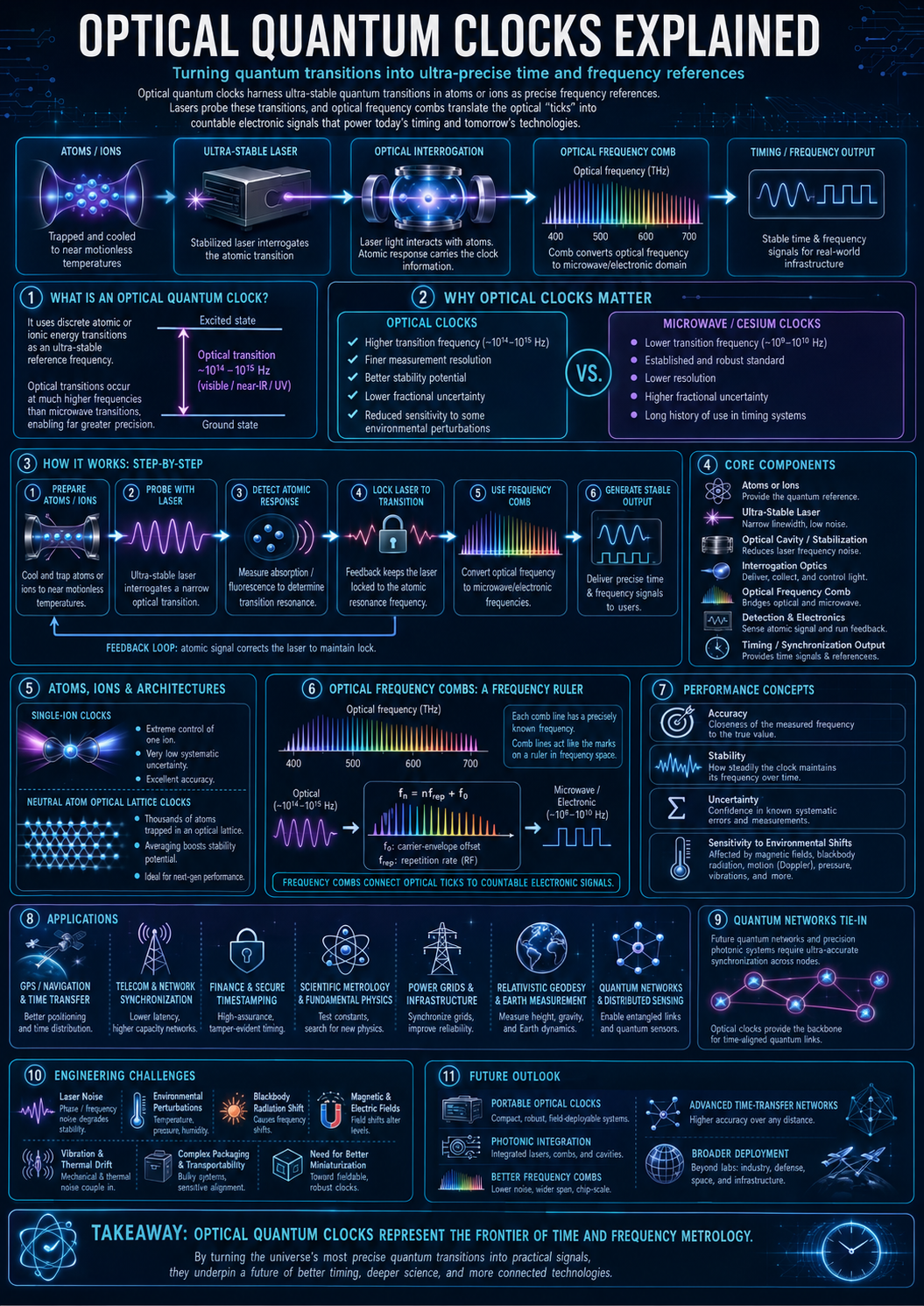
Offer this as a downloadable optical-quantum-clocks study reference.
Connect this form to your email platform and send visitors the full-size Optical Quantum Clocks infographic. This keeps the page educational while turning the visual reference into a useful lead magnet.
Optical quantum clocks are precision timekeepers built from atomic quantum transitions.
An optical quantum clock uses a very stable optical transition in an atom or ion as a reference. A laser is tuned to match that transition. When the laser frequency is exactly right, the atoms respond in a measurable way. The system uses that response to keep the laser locked to the atomic reference.
The reason optical clocks are so powerful is that optical frequencies are much higher than microwave frequencies. A faster “tick” gives more cycles to count, which can improve precision when the clock is engineered correctly.
An optical clock is not a clock because it has hands. It is a clock because quantum matter tells a laser exactly how fast to tick.
It is a clock that uses quantum energy levels as the reference.
Atoms and ions have discrete energy levels. When light with the right frequency interacts with the atom, it can drive a transition between energy states. That transition frequency is determined by quantum physics and can serve as an extremely stable reference.
In an optical clock, the reference transition occurs at an optical frequency rather than a microwave frequency. The clock measures, stabilizes, and counts that optical frequency to create time and frequency output.
stable quantum transition → laser locked to transition → optical cycles counted → time and frequency output
Optical frequencies tick far faster than microwave clocks.
Traditional cesium atomic clocks use microwave transitions. Optical clocks use optical transitions with much higher frequencies. That higher frequency can provide a finer ruler for time, similar to using more closely spaced tick marks on a measuring instrument.
Optical clocks can also act as extremely sensitive probes. Because time is affected by gravity and motion, precise clocks can measure tiny differences in height, gravitational potential, and fundamental physical effects.
More cycles to count
Optical frequencies are much higher than microwave frequencies, enabling finer timing resolution.
Less drift over time
Carefully engineered optical clocks can maintain extremely stable frequency references.
Time becomes a measurement tool
Clock comparisons can reveal gravity, elevation, motion, and possible changes in fundamental constants.
The clock locks a laser to a quantum transition.
Most optical clock systems follow the same core loop: prepare the atoms or ions, interrogate them with a laser, measure their response, correct the laser, and count the stabilized optical frequency.
Cool and isolate atoms
Atoms or ions are trapped, cooled, and shielded from environmental disturbances.
Probe with laser light
An ultra-stable laser tests whether its frequency matches the atomic transition.
Read the atomic response
The system measures how many atoms made the transition or how the ion responded.
Lock the laser
Feedback adjusts the laser frequency toward the atomic resonance.
Use a frequency comb
An optical frequency comb connects the optical frequency to countable electronic signals.
Deliver precision timing
The clock output supports timing, frequency transfer, synchronization, and measurement.
Optical clocks are full systems, not just atoms.
The quantum reference is essential, but the surrounding photonic and control hardware determines whether the clock actually performs well.
| Component | Role | Why It Matters |
|---|---|---|
| Atoms or Ions | Provide the quantum transition reference | The transition must be stable, narrow, measurable, and well isolated. |
| Trap or Lattice | Holds particles in place | Motion, collisions, and environmental shifts must be minimized. |
| Ultra-Stable Laser | Interrogates the transition | Laser linewidth and frequency noise limit clock performance. |
| Optical Frequency Comb | Counts and transfers optical frequency | The comb bridges optical clock ticks to electronics and other clocks. |
| Feedback System | Locks the laser to the atoms | The clock must correct drift continuously. |
| Environmental Control | Suppresses unwanted shifts | Temperature, magnetic fields, blackbody radiation, collisions, and vibration can shift the reference. |
Different optical clocks use different quantum references.
Some optical clocks use trapped ions. Others use neutral atoms held in optical lattices. Each architecture has trade-offs.
Extreme control
A single trapped ion can be isolated and controlled with very low systematic uncertainty.
Many atoms in light traps
Thousands of neutral atoms can provide strong measurement signals and high stability.
Paired-ion readout
One ion can serve as the clock reference while another helps cool and read out the system.
Common optical-clock candidates include strontium, ytterbium, aluminum ions, mercury ions, calcium ions, and other carefully chosen atomic or ionic systems.
Frequency combs are the gears between optical time and electronics.
Optical frequencies are far too fast for ordinary electronics to count directly. An optical frequency comb solves that by producing a spectrum of evenly spaced frequency lines. Those lines act like a ruler that links the optical clock frequency to microwave and radio-frequency signals.
Without optical frequency combs, optical clocks would have extraordinary quantum references but no practical way to connect those optical ticks to the electronic world.
Frequency combs also help compare different optical clocks, transfer frequency across systems, support precision spectroscopy, and connect timing infrastructure to photonic systems.
Clock performance depends on both quantum physics and engineering.
Three ideas are especially important: accuracy, stability, and uncertainty. A clock can be stable but shifted, accurate but noisy, or limited by uncertainty in environmental corrections.
| Metric | Meaning | Why It Matters |
|---|---|---|
| Accuracy | How close the clock is to the true reference frequency | Determines whether the clock is correct, not just consistent. |
| Stability | How much the clock fluctuates over a given averaging time | Determines how quickly high precision can be reached. |
| Systematic Uncertainty | Uncertainty from shifts and corrections | Environmental and hardware shifts must be understood and controlled. |
| Linewidth | Width of the atomic transition or laser reference | Narrow lines allow more precise frequency discrimination. |
| Uptime | How reliably the clock operates | Real infrastructure needs robust, continuous performance. |
Optical clocks are useful anywhere precision time and frequency matter.
Time is infrastructure. Better clocks can improve systems that depend on synchronization, frequency control, navigation, measurement, or distributed coordination.
Beyond GPS timing
Precision clocks can improve navigation systems and support GPS-independent timing concepts.
Network synchronization
High-performance clocks can synchronize optical networks, wireless systems, and data infrastructure.
Measure gravity with time
Clock comparisons can reveal height differences through gravitational redshift.
Test nature
Optical clocks can test relativity, search for changes in constants, and probe new physics.
Synchronize critical infrastructure
Precise timing supports transaction ordering, grid monitoring, and distributed systems.
Metrology backbone
Precision spectroscopy, frequency standards, and measurement labs rely on accurate references.
Future quantum networks will need extraordinary synchronization.
Quantum communication, entanglement distribution, satellite quantum links, single-photon imaging, and distributed sensing all depend on precise timing. Optical clocks can provide the reference layer for future quantum networks and high-precision photonic systems.
Clock networks can also become sensors. Comparing clocks at different locations can reveal gravitational potential differences, motion, or environmental effects. In that sense, a clock network can become a distributed quantum sensing system.
The hardest part is protecting the quantum reference from the real world.
Optical clocks are extraordinary, but they are not simple. The clock frequency can be shifted by magnetic fields, electric fields, blackbody radiation, motion, collisions, laser noise, vibration, gravitational potential, and measurement back action.
The probe must be extremely stable
The laser must stay narrow and quiet enough to interrogate the atomic transition.
The world changes the clock
Temperature, fields, collisions, and motion can shift the transition frequency.
Atoms must be isolated
Many clocks require ultra-high vacuum, laser cooling, trapping, and careful shielding.
Counting optical ticks is difficult
Combs need stabilization, calibration, and robust coupling to the optical clock.
Lab clocks must become field systems
Infrastructure use requires smaller, more rugged, lower-power clock packages.
A clock is most useful when connected
Optical clocks need reliable links to compare and distribute their timing signals.
Optical clocks may redefine time infrastructure.
Optical clocks are central to the future of metrology. They may contribute to future definitions of the second, improved navigation, relativistic geodesy, precision physics, telecom synchronization, and quantum-network timing.
For QCLS, this page expands quantum sensing into precision time and frequency. The next natural page could be Optical Frequency Combs Explained, because frequency combs are the bridge that makes optical clocks usable in electronics, spectroscopy, communications, and photonic measurement.
Optical quantum clocks, explained clearly.
What is an optical quantum clock?
An optical quantum clock uses an optical transition in atoms or ions as an extremely stable frequency reference for timekeeping.
Why are optical clocks more precise than older atomic clocks?
Optical transitions occur at much higher frequencies than microwave transitions, giving a faster tick and finer frequency reference when engineered correctly.
What does the laser do?
The laser interrogates the atomic transition and is locked to the quantum reference through feedback.
What is an optical frequency comb?
A frequency comb is a set of evenly spaced optical frequency lines that connects optical clock frequencies to countable microwave and electronic signals.
Why do optical clocks matter for sensing?
Precise clocks can detect tiny changes in gravity, height, motion, and fundamental physical effects through time and frequency comparisons.
What makes optical clocks hard to deploy?
They require stable lasers, trapped atoms or ions, environmental control, frequency combs, feedback systems, and reliable time-transfer infrastructure.