
Optical Frequency Combs Explained
Optical frequency combs are specialized lasers whose spectra contain many evenly spaced, precisely known optical frequencies. They act like rulers for light, connecting optical clocks, precision spectroscopy, distance measurement, telecommunications, microwave generation, and photonic metrology.
Optical Frequency Combs at a Glance
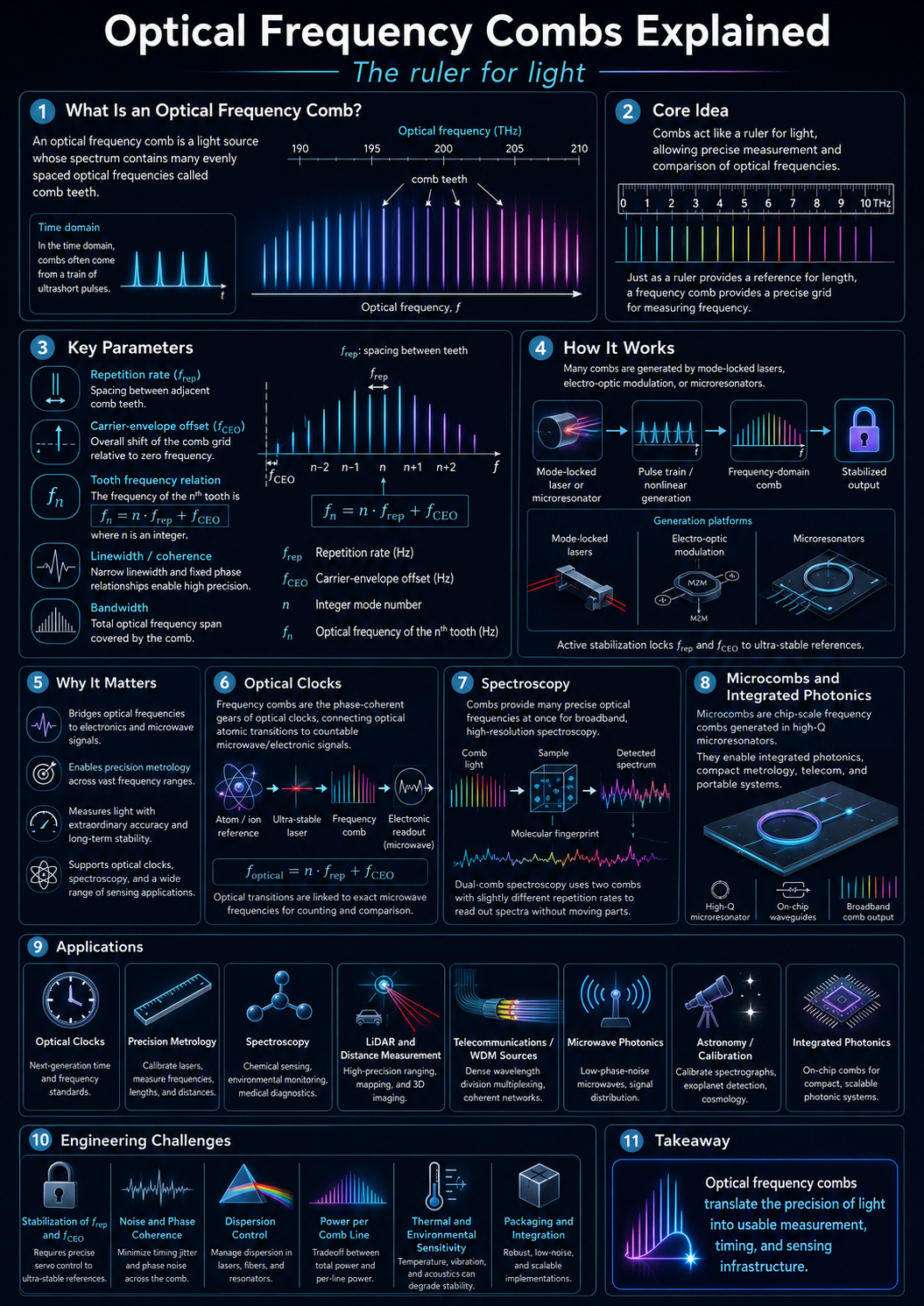
This study graphic summarizes the core optical-frequency-comb lesson: what a frequency comb is, why it matters, how comb teeth work, how combs are generated, which key parameters define performance, how they support optical clocks and spectroscopy, why microcombs matter for integrated photonics, where the main applications are, and which engineering challenges shape practical comb systems.
Offer this as a downloadable optical-frequency-combs study reference.
Connect this form to your email platform and send visitors the full-size Optical Frequency Combs infographic. This keeps the page educational while turning the visual reference into a useful lead magnet.
Optical frequency combs are precision rulers for measuring light.
An optical frequency comb produces a spectrum made of many sharp, evenly spaced frequency lines. Each line is called a comb tooth. If the spacing and offset are known, every tooth can be assigned a precise optical frequency.
This lets scientists measure optical frequencies that would otherwise be too fast for electronics to count directly. Frequency combs connect optical clocks to microwave signals, compare optical references, measure spectra, generate low-noise microwaves, and support precision distance measurement.
A frequency comb turns light into a ruler: each comb tooth is a known mark on the optical-frequency scale.
It is a laser spectrum made of evenly spaced optical frequencies.
In the frequency domain, a comb looks like many narrow lines spaced at regular intervals. That is where the name comes from: the spectrum resembles the teeth of a comb.
In the time domain, many frequency combs come from trains of ultra-short laser pulses. A repeated pulse train creates regularly spaced frequency components. The timing of the pulses and their phase relationship determine the comb spacing and offset.
fₙ = n · fᵣₑₚ + f₀
fᵣₑₚ = repetition rate
f₀ = carrier-envelope offset frequency
n = comb tooth number
They connect optical precision to usable measurement systems.
Optical frequencies are hundreds of terahertz, far beyond direct electronic counting. A frequency comb provides a phase-coherent bridge between optical frequencies and lower-frequency electronics.
This is why frequency combs are essential to optical clocks. They translate an ultra-stable optical reference into countable microwave and radio-frequency signals, while also allowing comparisons between different optical references.
Assign exact frequencies
Comb teeth provide calibrated marks across optical spectra.
Optical to microwave
Combs translate ultra-fast optical oscillations into accessible electronic signals.
Link optical references
Different optical clocks can be compared through comb measurements.
Broadband spectroscopy
Many comb teeth can probe many wavelengths at once.
Precision ranging
Comb timing and phase can improve distance, time-of-flight, and ranging measurements.
Many carriers from one source
Combs can supply many stable optical channels for communications and signal processing.
The power of a frequency comb comes from knowing every tooth.
Each comb tooth is a narrow optical frequency. The teeth are separated by the repetition rate. The entire comb is shifted by the carrier-envelope offset. Once those two parameters are controlled, the full set of comb frequencies becomes known.
This makes a comb different from a normal broad laser spectrum. The comb is not just many colors. It is many precisely related optical frequencies.
A broad spectrum tells you many colors are present. A frequency comb tells you exactly where those colors are.
Most combs begin with a laser that creates a precise pulse train or nonlinear optical oscillation.
Many classic frequency combs are based on mode-locked lasers. A mode-locked laser produces ultra-short pulses at a regular repetition rate. In frequency space, that pulse train becomes a set of evenly spaced lines.
Other combs are generated using electro-optic modulation or nonlinear microresonators. The best architecture depends on bandwidth, spacing, noise, power, size, wavelength, stability, and application.
Pulse train to comb spectrum
A stable train of femtosecond pulses produces evenly spaced frequency lines.
Modulated laser source
Phase or intensity modulation creates sidebands around a laser frequency.
Chip-scale nonlinear optics
A continuous-wave pump laser drives nonlinear comb generation inside a high-Q resonator.
Repetition rate, offset, linewidth, bandwidth, and coherence define comb quality.
Different comb applications care about different performance parameters. Optical clocks demand phase coherence and low noise. Spectroscopy may demand broad bandwidth and flatness. Telecom may care about channel spacing, power per line, and integration.
| Parameter | Meaning | Why It Matters |
|---|---|---|
| Repetition Rate | Spacing between comb teeth | Determines line spacing and timing pulse rate. |
| Carrier-Envelope Offset | Frequency offset of the comb grid | Needed to know the absolute position of every tooth. |
| Linewidth | Sharpness of each comb tooth | Narrow teeth support precision measurements and clock comparisons. |
| Bandwidth | Spectral range covered by the comb | Broad combs can measure or probe more wavelengths. |
| Phase Coherence | Stability of relationships between teeth | Essential for metrology, clocks, and coherent communications. |
| Power per Tooth | Optical power in each comb line | Important for detection, spectroscopy, and optical channel use. |
Frequency combs are the gears of optical timekeeping.
Optical clocks use optical transitions that tick at hundreds of terahertz. Electronics cannot directly count those ticks. A frequency comb divides and translates the optical reference into lower-frequency signals while preserving phase coherence.
The comb can also compare two optical clocks operating at different frequencies. That makes frequency combs essential for optical-clock research, timekeeping, and future definitions of time.
Optical frequency precision becomes usable timing infrastructure
Frequency combs can measure many molecular frequencies at once.
In spectroscopy, different molecules absorb light at specific wavelengths. A frequency comb can provide many precise optical frequencies simultaneously, allowing broadband, high-resolution, high-speed measurements.
Dual-comb spectroscopy uses two combs with slightly different spacing. The optical spectrum is mapped into a radio-frequency signal that can be measured electronically without moving mechanical parts.
Trace molecules
Comb teeth can identify molecular absorption fingerprints over broad spectral ranges.
Fast broadband readout
Two combs convert optical spectral information into electronically measurable signals.
Measure transitions accurately
Combs can probe atomic and molecular transitions with high frequency precision.
Microcombs bring frequency-comb technology onto photonic chips.
A microcomb is typically generated in a high-Q optical microresonator using nonlinear optics. Microcombs can be much smaller than traditional femtosecond-laser combs, making them attractive for integrated photonics, telecom, portable clocks, spectroscopy, LiDAR, and signal processing.
Microcombs are not automatically better for every use. They still face challenges in noise, stabilization, thermal control, pump lasers, packaging, and reproducibility. But they are a major path toward deployable frequency-comb systems.
Frequency combs are foundational tools for modern precision photonics.
Frequency combs started as precision metrology tools, but their reach now spans science, communications, sensing, timing, spectroscopy, and integrated photonics.
Counting optical time
Combs connect optical atomic transitions to usable electronic outputs.
Identify molecules
Comb teeth act as calibrated probes for chemical and gas detection.
Many optical carriers
One comb can supply many evenly spaced channels for wavelength-division systems.
Precision ranging
Comb timing and phase can support accurate distance and time-of-flight measurements.
Optical precision to RF
Combs can divide optical frequency stability down to low-noise microwave signals.
Calibrate spectrographs
Frequency combs can provide precise wavelength references for astronomical measurements.
Frequency combs are precise only when the whole system is stabilized.
A comb is powerful because its teeth are predictable. But that requires controlling noise, drift, offset, repetition rate, power, dispersion, and environmental sensitivity.
The comb grid must stay fixed
Repetition rate and carrier-envelope offset must be controlled for absolute measurements.
Phase and amplitude noise matter
Noise limits clock transfer, spectroscopy, ranging, and microwave generation.
Applications need the right spectrum
Comb bandwidth must match molecular lines, clock wavelengths, or telecom bands.
Many teeth divide the energy
Some applications need enough optical power in each comb tooth.
Chip-scale systems must be packaged
Microcombs need pump lasers, coupling, thermal control, and stable electronics.
Metrology performance is not automatic
High-performance comb systems require careful locking, calibration, and system design.
Frequency combs are becoming a platform technology for precision photonics.
The future of frequency combs is moving in two directions at once: higher-performance laboratory systems for the most demanding measurements, and smaller integrated systems for field deployment. Both matter.
For QCLS, this page connects optical clocks to spectroscopy, telecom, sensing, and integrated photonics. The next natural page would be Dual-Comb Spectroscopy Explained, because it shows how frequency combs become fast, broadband chemical and molecular measurement systems.
Optical frequency combs, explained clearly.
What is an optical frequency comb?
An optical frequency comb is a laser source whose spectrum contains many evenly spaced, precisely related optical frequency lines called comb teeth.
Why is it called a comb?
In frequency space, the spectrum looks like a comb because it consists of many regularly spaced narrow lines.
What does a frequency comb measure?
It can measure optical frequencies, compare clocks, calibrate spectrometers, support spectroscopy, generate microwave signals, and measure distance.
How does a comb help an optical clock?
It translates optical clock frequencies into lower-frequency electronic signals while preserving the clock’s precision.
What is a microcomb?
A microcomb is a compact frequency comb generated in a microresonator, often using nonlinear integrated photonics.
What limits frequency comb performance?
Important limits include repetition-rate noise, carrier-envelope offset noise, phase noise, optical loss, bandwidth, power per tooth, environmental drift, and stabilization complexity.