Advanced Sensing
Technical guide to photonic sensing, spectroscopy, LiDAR, interferometry, fiber sensors, biosensing, environmental sensing, industrial measurement, single-photon imaging, optical clocks, frequency combs, and quantum-enhanced measurement systems.
Spectroscopy
LiDAR
Fiber Sensors
Quantum Sensing
Precision Measurement
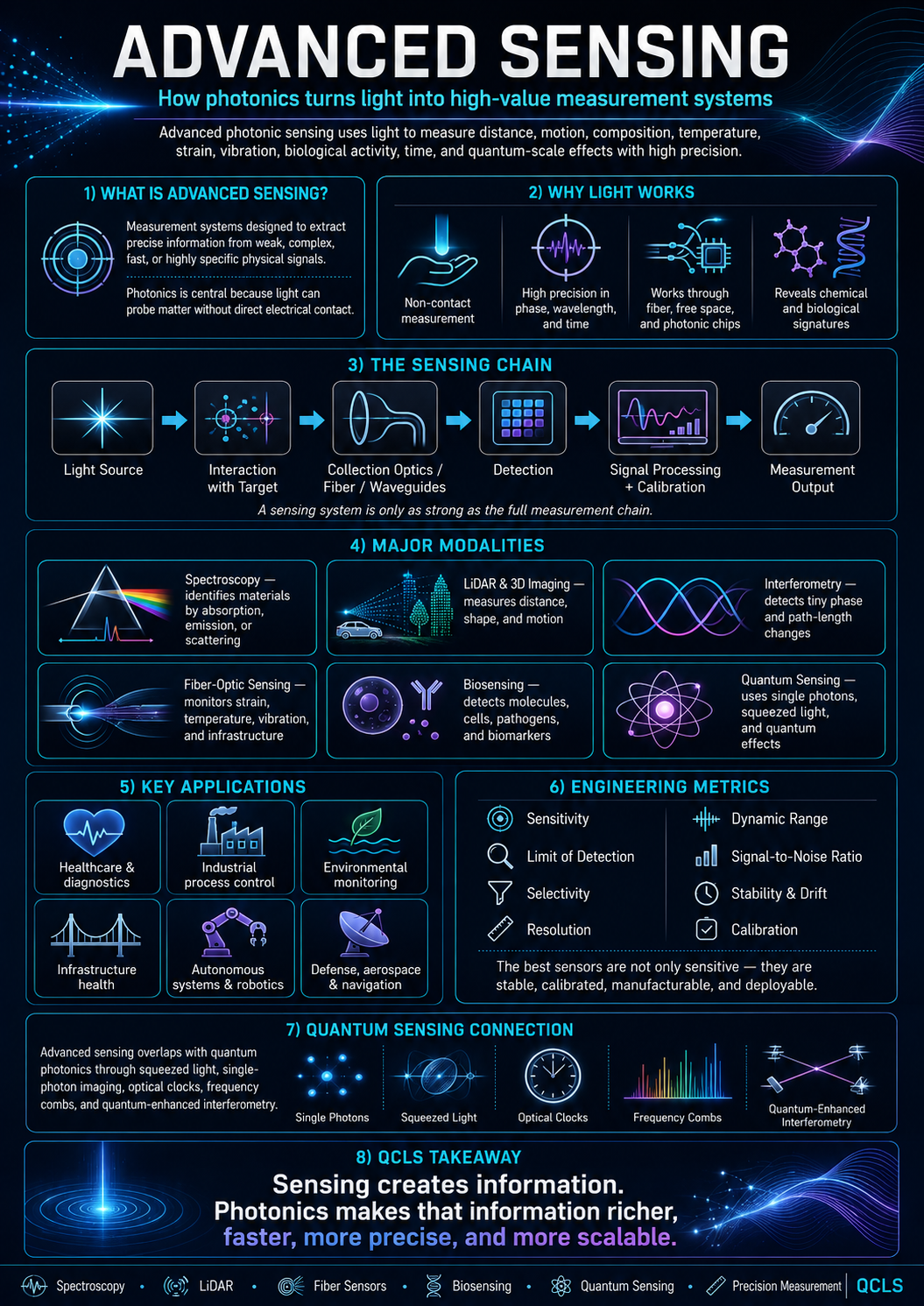
View larger infographic →
Core thesis: Advanced photonic sensing uses light to extract information from the physical world. It connects optics, materials, detectors, signal processing, photonic chips, quantum measurement, and AI analytics into systems that can measure what electronics alone cannot easily see.
The advanced sensing chain
A photonic sensing system sends, receives, or observes light that interacts with a target, material, environment, or quantum system. The measured signal is then converted into information through detection, calibration, and signal processing.
Executive Technical Summary
Advanced sensing is the use of sophisticated physical systems to measure the world with high precision, sensitivity, speed, selectivity, or spatial resolution. Photonic sensing is one of the most important parts of advanced sensing because light interacts with matter in ways that reveal structure, composition, motion, distance, time, fields, temperature, pressure, and biological activity.
Photonic sensors can operate through reflection, absorption, scattering, fluorescence, interference, phase change, polarization change, refractive-index shift, time-of-flight, frequency shift, Raman response, or quantum-state behavior.
Advanced photonic sensing is important because modern systems increasingly need better information about physical reality.
- medical diagnostics
- industrial process control
- robotics
- autonomous vehicles
- defense and aerospace
- environmental monitoring
- infrastructure health
- agriculture and soil analysis
- chemical detection
- semiconductor manufacturing
- quantum measurement
- security and surveillance
- precision timing and navigation
- AI-enabled measurement systems
The future of sensing is not just better detectors. It is complete sensing architecture: source, optics, photonic integration, detector, calibration, signal processing, AI interpretation, and system deployment.
What Is Advanced Sensing?
Advanced sensing refers to measurement systems that go beyond basic detection. These systems are designed to extract high-value information from weak, noisy, complex, fast-moving, hidden, or highly specific physical signals.
A basic sensor may tell whether something is present or absent. An advanced sensor can estimate concentration, distance, velocity, strain, vibration, chemical identity, biological binding, temperature distribution, surface shape, spectral signature, field strength, time reference, or quantum state.
Photonic sensing is a major category of advanced sensing because photons can probe matter without direct electrical contact and can carry information across distance, through fiber, through free space, or inside optical chips.
At QCLS, advanced sensing is treated as a system-level topic that includes optical physics, photonic hardware, electronics, software, signal interpretation, deployment environment, and economics.
Why Light Is Powerful for Sensing
Light is useful for sensing because it can interact with matter in many measurable ways. It can be absorbed, reflected, refracted, scattered, delayed, shifted, polarized, interfered with, or emitted. Each interaction can reveal a different physical property.
Light can measure without touching
Many photonic sensors are non-contact. They can measure distance, motion, temperature, surface structure, gas concentration, biological fluorescence, and chemical signatures without placing electrodes or probes directly on the target.
Light can be extremely precise
Optical phase, wavelength, frequency, and time-of-flight can be measured with remarkable precision. This enables interferometers, optical clocks, frequency combs, coherent LiDAR, metrology systems, and quantum-enhanced sensors.
Light can travel through fiber
Fiber sensors can measure strain, vibration, temperature, acoustic signals, pressure, and infrastructure changes over long distances. A fiber can become both the communication path and the sensing element.
Light can reveal chemical identity
Spectroscopy uses wavelength-dependent interactions to identify materials, gases, molecules, and biological markers. Different substances absorb, emit, or scatter light in characteristic ways.
The Photonic Sensing Chain
A simplified photonic sensing system can be described like this:
Light source
↓
Beam shaping / fiber / waveguide / optics
↓
Interaction with target or environment
↓
Modified optical signal
↓
Detector or imaging array
↓
Analog electronics
↓
Digital signal processing
↓
Calibration and inference
↓
Measurement output
Every step matters. A better detector cannot fix a poor optical design. A bright source cannot overcome bad calibration. A powerful AI model cannot extract reliable information from a measurement chain that is physically unstable, poorly sampled, or dominated by noise.
Major Types of Advanced Photonic Sensing
Spectroscopy
Spectroscopy measures how light interacts with matter across wavelength, frequency, or energy. Because molecules and materials interact with light in characteristic ways, spectroscopy can identify composition, concentration, structure, and state.
Common spectroscopic methods
- absorption spectroscopy
- emission spectroscopy
- fluorescence spectroscopy
- Raman spectroscopy
- infrared spectroscopy
- near-infrared spectroscopy
- UV-visible spectroscopy
- laser-induced breakdown spectroscopy
- frequency-comb spectroscopy
- photoacoustic spectroscopy
Spectroscopy is especially important for chemical detection, environmental monitoring, medical diagnostics, food testing, agriculture, pharmaceutical quality control, combustion analysis, semiconductor process monitoring, and remote sensing.
Integrated photonics can shrink spectroscopic systems by bringing waveguides, filters, interferometers, resonators, and detector interfaces onto chips.
LiDAR, Imaging, and 3D Measurement
LiDAR uses light to measure distance and construct spatial information about a scene. It can support autonomous vehicles, robotics, mapping, industrial automation, drones, defense systems, and infrastructure inspection.
Core LiDAR approaches
- direct time-of-flight LiDAR
- indirect time-of-flight LiDAR
- frequency-modulated continuous-wave LiDAR
- flash LiDAR
- scanning LiDAR
- solid-state LiDAR
- coherent LiDAR
- single-photon LiDAR
Advanced imaging can also use single-photon detection, computational imaging, hyperspectral imaging, optical coherence tomography, infrared imaging, and time-resolved imaging to extract information that ordinary cameras cannot capture.
Interferometry
Interferometry uses the wave nature of light. When two optical paths recombine, their phase relationship creates interference. A tiny change in distance, refractive index, vibration, temperature, strain, or field can change the interference pattern.
This makes interferometers extremely sensitive measurement tools.
Interferometry is used in
- displacement measurement
- vibration sensing
- surface metrology
- optical coherence tomography
- fiber gyroscopes
- gravitational wave detection
- precision manufacturing
- refractive-index sensing
- integrated photonic sensors
Integrated photonics can build interferometers on chips, allowing compact sensors for biosensing, environmental measurement, coherent detection, and quantum photonic circuits.
Fiber-Optic Sensing
Fiber-optic sensing uses optical fiber as a sensor. Because fiber can run for long distances, it can monitor large physical systems continuously.
Fiber sensors can measure strain, temperature, acoustic signals, pressure, vibration, displacement, and intrusion events. This makes them powerful for infrastructure, energy, defense, industrial monitoring, aerospace, pipelines, bridges, perimeter security, and seismic sensing.
Common fiber sensing methods
- fiber Bragg grating sensors
- distributed acoustic sensing
- distributed temperature sensing
- distributed strain sensing
- Rayleigh scattering sensors
- Raman scattering sensors
- Brillouin scattering sensors
- fiber interferometers
- fiber gyroscopes
Fiber sensing is important because it can turn infrastructure into a measurement network.
Biosensing and Medical Photonics
Photonic biosensors use light to detect biological activity, molecular binding, cells, proteins, pathogens, biomarkers, tissue properties, or biochemical changes.
Light is useful in medical and biological systems because it can be non-contact, non-ionizing in many optical ranges, highly sensitive, spectrally selective, and compatible with imaging.
Important biosensing approaches
- fluorescence sensing
- surface plasmon resonance
- ring resonator biosensors
- interferometric biosensors
- Raman biosensing
- optical coherence tomography
- lab-on-chip photonics
- silicon photonic biosensors
- spectroscopic diagnostics
- single-photon imaging
The long-term opportunity is smaller, faster, cheaper, more sensitive diagnostic and monitoring platforms that combine photonics, microfluidics, electronics, and AI interpretation.
Quantum Sensing with Photonics
Quantum sensing uses quantum properties to improve or enable measurement. In photonics, this can include squeezed light, single photons, entangled photons, quantum interference, optical clocks, frequency combs, and precision optical readout of quantum systems.
Important quantum-photonic sensing areas
- squeezed-light measurement
- single-photon imaging
- entangled photon sensing
- optical atomic clocks
- optical frequency combs
- quantum-enhanced interferometry
- magnetometry with optical readout
- gravitational wave detection concepts
- quantum-limited detection
Quantum sensing should not be treated as a magic upgrade to every sensor. Its value depends on the specific noise source, measurement limit, target application, hardware complexity, calibration, and operating environment.
Still, photonics is central to quantum sensing because photons are excellent carriers of timing, phase, frequency, polarization, and quantum-state information.
Where Advanced Photonic Sensing Is Used
Key Metrics in Advanced Sensing
Sensitivity
Sensitivity describes how strongly the sensor output changes in response to the quantity being measured.
Limit of detection
The limit of detection is the smallest signal, concentration, displacement, or physical change that can be reliably distinguished from noise.
Selectivity
Selectivity describes the ability to detect the desired target while rejecting interfering signals or similar materials.
Resolution
Resolution can refer to spatial, spectral, temporal, frequency, or amplitude resolution depending on the sensing system.
Dynamic range
Dynamic range describes the span between the smallest and largest measurable signals.
Signal-to-noise ratio
Signal-to-noise ratio determines how clearly the desired measurement stands out from noise.
Stability and drift
Long-term stability matters when sensors must operate over hours, days, months, or years without frequent recalibration.
Calibration
Calibration connects raw optical signals to meaningful physical units. Without calibration, a sensor may detect change but fail to produce reliable measurement.
Major Challenges in Advanced Photonic Sensing
Advanced sensing is difficult because real-world signals are often weak, noisy, variable, and context-dependent.
- low signal levels
- background noise
- stray light
- thermal drift
- mechanical vibration
- environmental variation
- calibration complexity
- material degradation
- sensor fouling
- optical alignment
- packaging reliability
- detector noise
- data interpretation
- false positives and false negatives
- cost and deployability
The best sensing systems are not merely sensitive. They are stable, calibrated, manufacturable, interpretable, robust, deployable, and economically useful.
The Future of Advanced Sensing
The future of sensing is moving toward smaller, smarter, more integrated, more distributed, and more precise systems.
Integrated photonic sensors
Photonic chips can shrink interferometers, resonators, spectrometers, filters, and optical readout systems into compact platforms.
AI-assisted sensing
AI models can help interpret complex optical data, classify signatures, reduce noise, detect anomalies, and improve measurement workflows. But the physical measurement chain still matters.
Distributed sensing networks
Fiber, satellite, drone, industrial, and infrastructure sensors can become large measurement networks that continuously monitor the physical world.
Quantum-enhanced measurement
Quantum sensing may improve specific measurements where noise limits can be meaningfully reduced or where quantum states enable new measurement methods.
Lab-on-chip and field-deployable diagnostics
Photonics, microfluidics, biosensors, and integrated electronics can support smaller and faster diagnostic systems outside traditional labs.
Why Advanced Sensing Matters
Advanced sensing matters because technology increasingly depends on understanding the physical world in real time. Computing and communication move information. Sensing creates information.
Photonics is uniquely positioned because light can measure distance, frequency, phase, chemical identity, biological response, temperature, strain, vibration, time, fields, and motion with extraordinary flexibility.
At QCLS, advanced sensing is treated as one of the core pillars of photonics because it connects the science of light to healthcare, industry, security, infrastructure, environment, robotics, AI, and quantum systems.
The serious version is simple: photonic sensing turns light into knowledge about the world.
Advanced Sensing Frequently Asked Questions
What is advanced sensing?
Advanced sensing refers to measurement systems that extract precise, high-value information from physical signals, often with high sensitivity, resolution, selectivity, or speed.
What is photonic sensing?
Photonic sensing uses light to measure physical, chemical, biological, spatial, spectral, or quantum properties.
Why is light useful for sensing?
Light can interact with matter through absorption, reflection, scattering, fluorescence, phase change, polarization, interference, and frequency shift. These interactions reveal information about the target.
What is spectroscopy used for?
Spectroscopy is used to identify materials, molecules, gases, biological markers, and chemical concentrations by measuring how light interacts with matter across wavelengths.
How does LiDAR work?
LiDAR uses light to measure distance and create spatial information. It can use time-of-flight, phase, frequency modulation, scanning, or single-photon detection depending on the system.
What is fiber-optic sensing?
Fiber-optic sensing uses optical fiber to measure strain, temperature, vibration, acoustic signals, pressure, or intrusion events over distance.
What is quantum sensing?
Quantum sensing uses quantum properties such as squeezed light, single photons, entanglement, atomic transitions, or quantum coherence to enable or improve certain measurements.