
Integrated Quantum Photonics Explained
Integrated quantum photonics brings quantum light onto chips. It combines single-photon sources, entangled photon generation, waveguides, interferometers, phase shifters, switches, filters, detectors, and electronic control into compact photonic circuits for quantum computing, communication, sensing, and networking.
Integrated Quantum Photonics at a Glance
This study graphic summarizes the core integrated-quantum-photonics lesson: what integrated quantum photonics is, why integration matters, which chip building blocks are required, which material platforms are used, how photonic quantum chips support computing, networking, and sensing, and which loss, packaging, detector, and control challenges shape real chip-scale quantum systems.
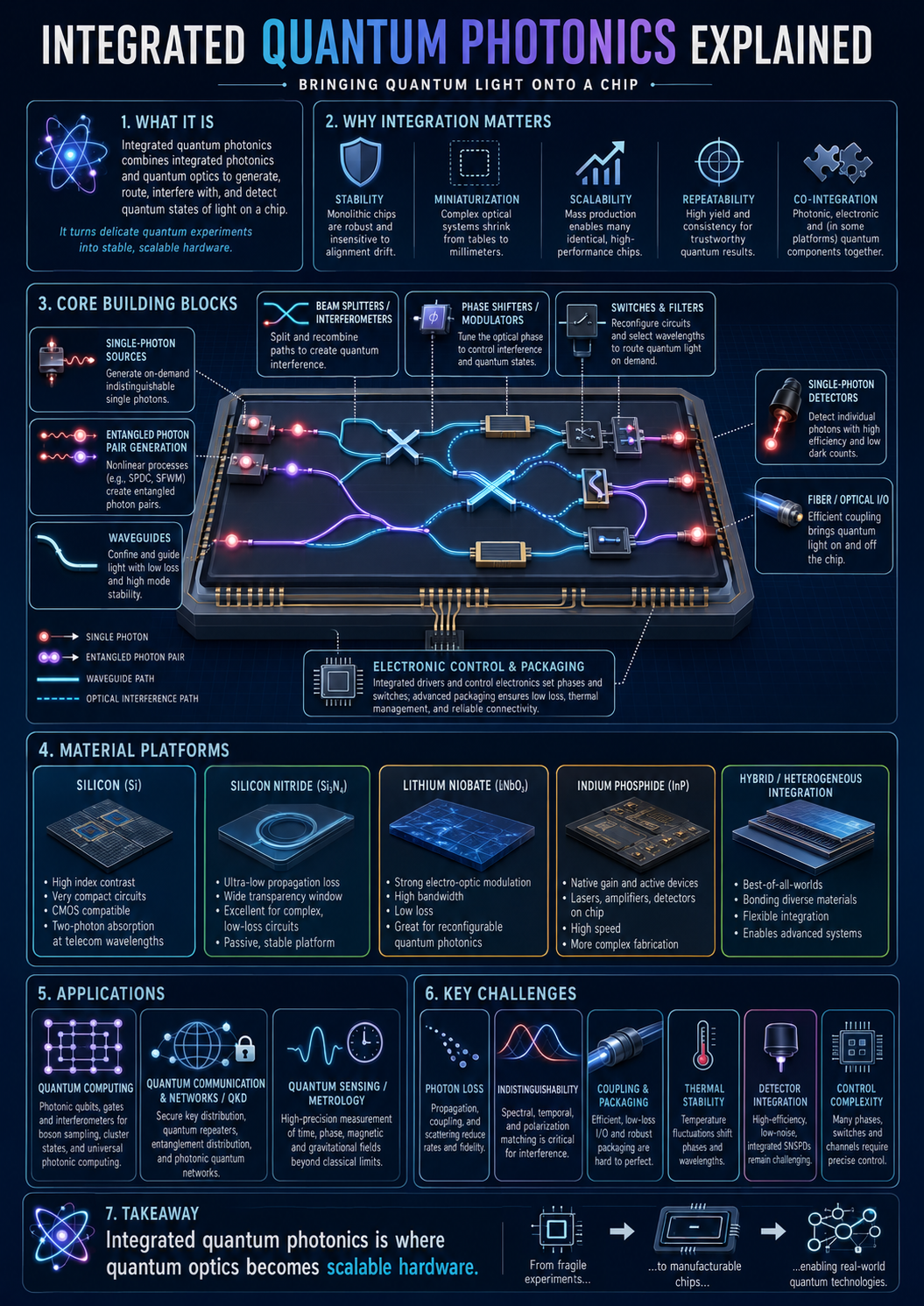
Offer this as a downloadable integrated-quantum-photonics study reference.
Connect this form to your email platform and send visitors the full-size Integrated Quantum Photonics infographic. This keeps the page educational while turning the visual reference into a useful lead magnet.
Integrated quantum photonics makes quantum optical systems smaller, more stable, and more scalable.
Integrated quantum photonics is the use of photonic integrated circuits to generate, manipulate, interfere, route, and detect quantum states of light. Instead of building a quantum optics experiment from many bulk lenses, mirrors, beam splitters, and fiber components, the optical functions are moved onto a chip.
This matters because quantum photonics needs precision. Photons must arrive in the right mode, at the right time, with low loss, low noise, high indistinguishability, stable phase, and reliable detection. Chip-scale integration can improve stability, reduce footprint, enable manufacturing, and support larger quantum systems.
Integrated quantum photonics is not just “quantum on a chip.” It is the attempt to turn quantum light into a manufacturable hardware platform.
It is the merger of integrated photonics and quantum optics.
Integrated photonics moves optical components onto chips. Quantum photonics uses individual photons, entangled states, squeezed light, and quantum measurement. Integrated quantum photonics combines both ideas: it builds quantum optical systems using lithographically defined circuits.
A single quantum photonic chip may include waveguides, couplers, splitters, phase shifters, interferometers, filters, resonators, switches, sources, detectors, heaters, modulators, and electronic control interfaces.
Quantum optics needs stability and scale that tabletop systems struggle to provide.
Traditional quantum optics often uses carefully aligned bulk optical components. That can be excellent for research, but it becomes difficult to scale into many modes, many photons, many channels, and many stable interferometers.
Less alignment drift
On-chip waveguides and interferometers can reduce mechanical drift compared with large tabletop setups.
More optical modes
Integrated circuits can pack many optical paths, couplers, and phase shifters into a compact footprint.
Repeatable hardware
Wafer-scale fabrication can eventually support more repeatable quantum photonic devices.
Deployable systems
Practical quantum products need fiber attach, electronics, thermal control, and robust enclosures.
Use the right material for each function
Sources, low-loss routing, modulators, nonlinear elements, and detectors may require different materials.
Electronics meet photonics
Large circuits need tuning, calibration, feedback, and fast feed-forward.
Quantum photonic chips combine sources, circuits, and detectors.
Different applications use different chip designs, but many integrated quantum photonic systems share the same hardware categories.
| Building Block | Role | Why It Matters |
|---|---|---|
| Single-Photon Sources | Generate individual photons or heralded photons | Source purity, brightness, and indistinguishability limit system performance. |
| Entangled Photon Sources | Create correlated quantum states | Essential for QKD, teleportation, networks, and photonic quantum computing. |
| Waveguides | Guide photons on chip | Loss, dispersion, and mode control determine whether photons survive. |
| Couplers and Splitters | Mix optical modes | Beam-splitter-style interference is fundamental to many photonic quantum protocols. |
| Phase Shifters | Control optical phase | Programmable circuits require phase tuning and calibration. |
| Detectors | Measure photons | Detection efficiency, dark counts, timing jitter, and photon-number resolution shape results. |
The chip is a controlled environment for quantum interference.
Many quantum photonic protocols depend on interference. For interference to work, photons must be indistinguishable in the relevant properties, and the circuit must preserve phase relationships while minimizing loss.
Integrated circuits can create stable interferometers, multi-mode networks, programmable phase meshes, resonator arrays, and photonic processors. These chips may support linear optical quantum computing, boson sampling, quantum simulation, quantum communication, quantum sensing, or quantum random number generation.
In integrated quantum photonics, the chip is not just a passive waveguide board. It is the quantum optical processor.
No single material platform solves every quantum photonics problem.
Integrated quantum photonics often uses hybrid or heterogeneous integration because different materials excel at different functions. Low-loss routing, nonlinear generation, electro-optic modulation, active light emission, spin-photon interfaces, and superconducting detection may all require different materials.
CMOS-compatible photonics
Useful for dense circuits and mature fabrication, but indirect bandgap limits native light emission.
Low-loss routing
Attractive for low-loss waveguides, nonlinear optics, and wide transparency windows.
Active light emission
Important for lasers and some quantum light-source approaches.
Fast electro-optic control
Strong electro-optic properties support high-speed modulation and switching.
Color-center interfaces
Can host defect-based quantum emitters and spin-photon interfaces.
Integrated detection
SNSPDs can be integrated with waveguides for high-performance single-photon detection.
Photonic quantum computers need large, low-loss, controllable optical circuits.
Integrated quantum photonics is one of the leading paths for photonic quantum computing because it can support many modes, stable interference, programmable circuits, feed-forward, and compact scaling.
Key approaches include linear optical quantum computing, measurement-based photonic quantum computing, fusion-based architectures, continuous-variable photonics, and sampling-style processors. All of them depend heavily on source quality, detector performance, circuit loss, switching, and packaging.
Quantum networks need compact sources, filters, switches, memories, and detectors.
Integrated quantum photonics can support quantum networks by shrinking the hardware needed to generate, route, process, and detect quantum states of light. Photonic chips may be used in QKD transmitters, entangled photon sources, Bell-state measurement modules, quantum repeater nodes, satellite payloads, and ground-station systems.
Integration is especially valuable when systems need rugged packaging, stability, low power, many channels, and repeatable deployment.
Compact transmitters and receivers
Chips can encode, modulate, filter, and detect quantum states for key distribution.
Swapping and routing
Integrated circuits can support Bell-state measurements, switching, and photon-memory interfaces.
Smaller optical systems
Chip-scale quantum photonics can reduce size, weight, and alignment complexity for space systems.
Integrated quantum photonics can also improve precision measurement.
Quantum sensing uses quantum states, interference, squeezed light, entanglement, or single photons to improve measurement capability in specific regimes. Integrated photonics can make these systems smaller, more stable, and more practical.
Potential sensing areas include magnetic fields, timing, biological signals, chemical detection, inertial sensing, spectroscopy, and chip-scale atomic systems.
Integrated quantum photonics is not only about computers. It can also become a platform for compact quantum sensors and precision measurement systems.
The hardest part may be outside the photonic circuit itself.
A quantum photonic chip is only useful if it can be packaged and controlled. That means coupling light into and out of the chip, stabilizing temperature, connecting electronics, calibrating phase shifters, reading detectors, suppressing noise, and maintaining alignment over time.
Loss is the central enemy of integrated quantum photonics.
Classical photonic systems can tolerate and sometimes compensate for loss. Quantum photonic systems are far less forgiving. A lost photon can destroy a qubit, erase entanglement, reduce a key rate, or break a computational path.
The dominant constraint
Propagation loss, coupling loss, filter loss, switch loss, and detector inefficiency all compound.
Good photons are hard
Sources must be bright, pure, indistinguishable, stable, and compatible with the circuit.
Measurement must scale
High-performance detectors may need special materials, packaging, and cooling.
Photons must look identical
Interference depends on matching spatial, spectral, polarization, and temporal modes.
Phase stability matters
Programmable circuits require calibration and stabilization over time.
Quantum tolerances are tight
Small fabrication differences can shift resonances, phases, and coupling ratios.
Integrated quantum photonics is where quantum optics becomes quantum hardware.
The long-term direction is clear: quantum photonic systems need to become smaller, more reliable, more manufacturable, and more deeply integrated with electronics, packaging, cryogenics, networks, and control software.
For QCLS, this page ties the quantum cluster back into the broader integrated photonics pillar. The next expansion could be Quantum Sensing with Photonics Explained, Linear Optical Quantum Computing Explained, or Photonic Integrated Circuits for QKD Explained.
Integrated quantum photonics, explained clearly.
What is integrated quantum photonics?
Integrated quantum photonics uses photonic chips to generate, route, interfere, process, and detect quantum states of light.
Why does quantum photonics need integration?
Integration can improve stability, reduce footprint, enable larger circuits, and support repeatable manufacturing compared with bulk optical systems.
What components go on a quantum photonic chip?
Common components include waveguides, couplers, phase shifters, interferometers, filters, switches, sources, detectors, and electronic control interfaces.
What is the biggest challenge?
Photon loss is one of the biggest challenges because lost photons can destroy quantum information or reduce protocol success.
Which materials are used?
Platforms include silicon, silicon nitride, lithium niobate, III-V semiconductors, diamond, silicon carbide, superconducting films, and hybrid combinations.
How does this connect to quantum networks?
Integrated quantum photonics can shrink and stabilize QKD modules, entangled photon sources, repeater-node components, detectors, and satellite quantum payloads.