Quantum Networks Explained
A quantum network connects quantum systems by distributing quantum states, entanglement, or secure key material between nodes. Photonics is central because photons are the natural flying qubits that can carry quantum information through fiber, free space, integrated photonic circuits, and future quantum repeater links.
Quantum Networks at a Glance
This study graphic summarizes the core quantum-network lesson: what a quantum network is, how photons and entanglement connect remote systems, how quantum nodes, channels, repeaters, memories, and detectors fit together, and why quantum networks matter for secure communication, distributed quantum computing, and future quantum infrastructure.
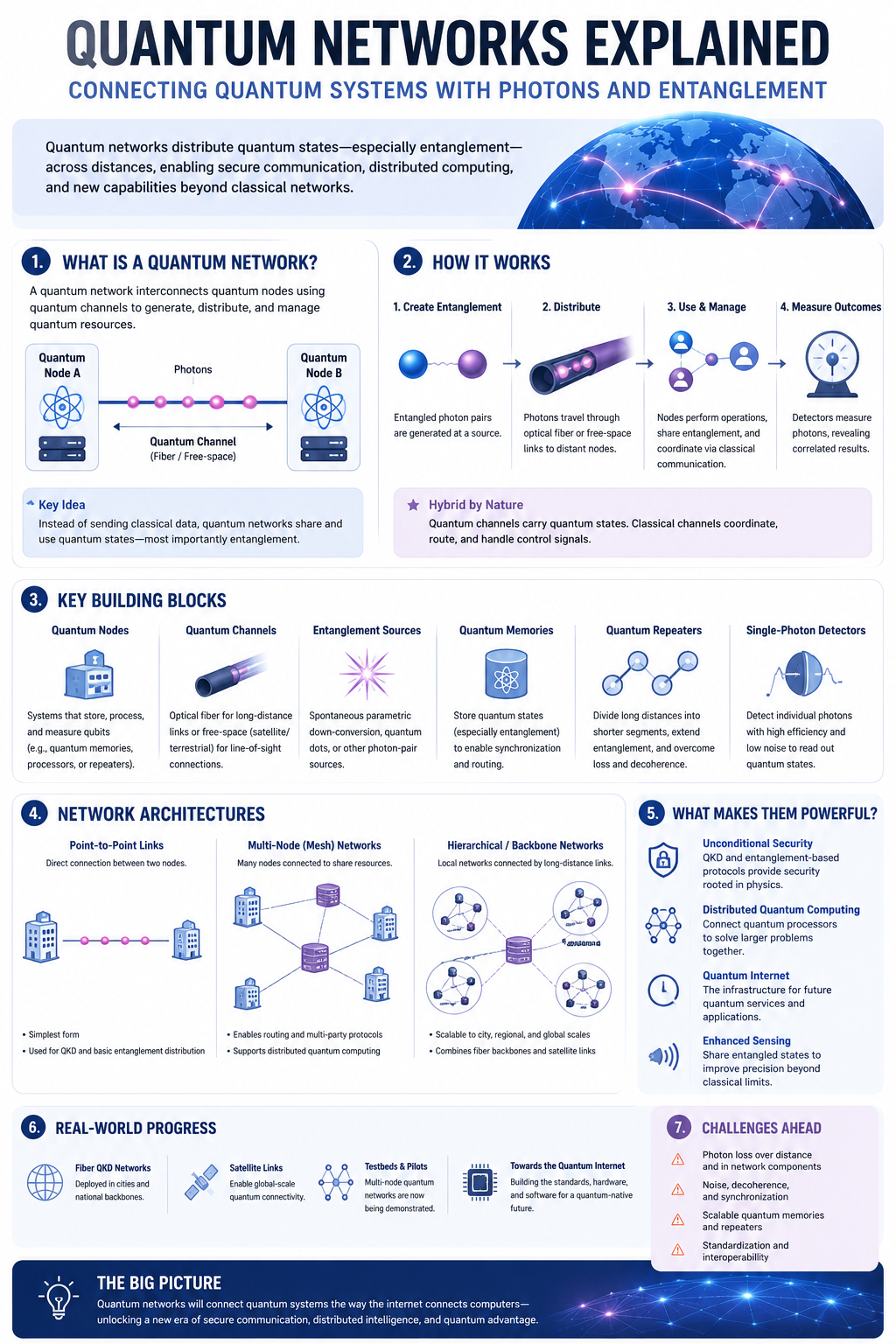
Offer this as a downloadable quantum-networks study reference.
Connect this form to your email platform and send visitors the full-size Quantum Networks infographic. This keeps the page educational while turning the visual reference into a useful lead magnet.
Quantum networks distribute quantum resources between remote systems.
A quantum network is a communication system designed to move, share, or coordinate quantum information between nodes. Instead of only sending classical bits, a quantum network may distribute entangled states, photonic qubits, quantum keys, or correlations that enable quantum protocols.
Photonics is the backbone of quantum networking because photons can carry quantum states through optical fiber and free-space links. But building useful quantum networks requires more than sending photons. It also requires single-photon sources, detectors, low-loss channels, synchronization, quantum memories, repeaters, routing, error management, and trusted or trust-minimized network architectures.
A classical network moves information. A quantum network can distribute entanglement — a resource that can enable communication, security, sensing, and distributed quantum computing protocols.
A quantum network connects quantum nodes using quantum channels and classical control.
A quantum node may be a quantum processor, sensor, memory, communication terminal, or photonic device. The network links those nodes using quantum channels, typically optical, and classical channels for coordination.
Quantum networks usually need both quantum and classical communication. The quantum channel carries fragile quantum states or entanglement. The classical channel shares measurement results, timing information, basis choices, routing information, authentication, and protocol control.
Quantum networks are not just faster classical networks.
A quantum network does not simply send ordinary internet packets at higher speed. It enables tasks that depend on quantum states, measurement, no-cloning, entanglement, and quantum correlations.
| Feature | Classical Network | Quantum Network |
|---|---|---|
| Information carrier | Classical bits in electrical or optical signals | Quantum states, photonic qubits, or entanglement |
| Copying | Classical signals can be copied and amplified | Unknown quantum states cannot be perfectly copied |
| Amplification | Repeaters can read and regenerate data | Quantum repeaters must preserve or recreate entanglement without simply copying states |
| Main resource | Bandwidth, latency, reliability, packet routing | Entanglement fidelity, photon arrival, memory lifetime, loss, timing, key rate |
| Applications | Internet, cloud, telecom, data centers | QKD, entanglement distribution, teleportation, distributed quantum computing, quantum sensing |
Photons are the natural carriers for quantum networking.
Photons are often called flying qubits because they can carry quantum information across distance. They can travel through optical fiber, free-space optical links, integrated waveguides, and satellite channels.
Compatibility with optical infrastructure
Photonic qubits can use fiber concepts from telecommunications, although quantum states impose stricter loss and noise constraints.
Ground, airborne, and satellite paths
Free-space optical links may connect locations where fiber is unavailable or where satellite distribution is useful.
Chip-scale quantum networking hardware
Photonic chips can help generate, route, interfere, filter, and detect quantum light.
Entanglement is the key network resource.
Entanglement distribution means creating shared entangled states between remote nodes. Once nodes share entanglement, they can use it for quantum teleportation, certain QKD protocols, entanglement swapping, distributed sensing, or networked quantum computing.
Entanglement distribution is difficult because photons are easily lost. Unlike classical signals, unknown quantum states cannot be copied and boosted with ordinary amplifiers. That is why long-distance quantum networking needs repeaters, memories, and error-managed architectures.
In future quantum networks, entanglement may be treated like a network resource that can be requested, routed, stored, consumed, and refreshed.
Quantum repeaters aim to extend quantum links beyond direct transmission limits.
Classical repeaters can read, copy, amplify, and retransmit bits. Quantum repeaters cannot simply copy unknown quantum states. Instead, they use entanglement generation, entanglement swapping, quantum memories, purification, error correction, and classical coordination to extend entanglement across longer distances.
Break distance into shorter links
Shorter links improve the chance that photons arrive successfully.
Use quantum memories
Memories hold quantum states while other link segments succeed.
Connect entanglement
Entanglement swapping can extend entanglement across multiple segments.
Quantum memories store fragile quantum states long enough for networking protocols.
A quantum memory stores a quantum state for later use. In quantum networks, memories are important because link generation is probabilistic. One part of the network may succeed before another. Memory lets the successful state wait.
Practical memories need high efficiency, long storage time, high fidelity, wavelength compatibility, low noise, and integration with photonic interfaces. They may use atoms, ions, ensembles, rare-earth systems, color centers, or other matter-based quantum platforms.
QKD is one early application, but quantum networks are broader.
Quantum key distribution uses quantum states of light to help create shared secret key material. It is one of the most practical near-term quantum communication applications.
But a full quantum network is broader than QKD. It may distribute entanglement, connect quantum processors, synchronize quantum sensors, support blind or delegated quantum computation, or enable networked quantum experiments.
| Network Function | What It Does | Core Photonics Role |
|---|---|---|
| QKD | Distributes secret key material | Photons carry encoded quantum states or entangled states. |
| Entanglement Distribution | Shares entangled states between nodes | Photon sources and detectors create and verify nonclassical correlations. |
| Teleportation | Transfers an unknown quantum state using entanglement and classical communication | Photonic Bell-state measurements and entanglement links support the protocol. |
| Distributed Quantum Computing | Connects smaller processors into larger systems | Photonic interconnects may link remote or modular quantum nodes. |
| Quantum Sensing Networks | Correlates measurements across sensors | Quantum states of light can connect or enhance distributed sensors. |
Teleportation is a network protocol, not science-fiction transportation.
Quantum teleportation transfers an unknown quantum state from one system to another using shared entanglement and classical communication. It does not move matter, and it does not transmit information faster than light.
In a network setting, teleportation is important because it allows a quantum state to be transferred without directly sending that exact state through the full channel. It is one of the foundational protocols behind quantum repeaters and distributed quantum information.
Teleportation is not instant travel. It is a protocol for transferring quantum state information using entanglement plus classical communication.
A useful quantum network needs hardware, protocols, and control layers.
Quantum networking is a full-stack challenge. Optical hardware alone is not enough. The network needs timing, routing, synchronization, authentication, error handling, memory control, and classical coordination.
Sources and emitters
Single-photon and entangled-photon sources provide the quantum carriers.
Fiber or free-space links
Optical paths move photons between nodes while minimizing loss and noise.
Detectors and readout
Single-photon detectors verify arrivals, correlations, and Bell-state events.
Store quantum states
Quantum memories synchronize probabilistic link generation.
Classical coordination
Classical messages coordinate basis choices, heralding, routing, and feed-forward.
Network services
QKD, teleportation, entanglement swapping, repeater protocols, and distributed computation run on top.
Quantum networks are limited by loss, memory, timing, and fidelity.
The core problem is that quantum information is fragile. Photons are lost in fiber, coupling, switches, filters, and detectors. Memories are imperfect. Entanglement generation is often probabilistic. Timing and synchronization must be precise.
The biggest scaling barrier
Lost photons reduce rates and can destroy quantum states or entanglement.
Storage is hard
Quantum memories need long lifetime, high efficiency, and high fidelity.
Events must align
Photon arrival times, memory operations, and detector readout must be precisely coordinated.
Quality determines usefulness
Low-fidelity entanglement may not support the target protocol without purification or correction.
Entanglement is not a normal packet
Networks need new routing models for probabilistic and stateful quantum resources.
Hardware must become deployable
Photonic chips, cryogenic systems, memories, detectors, and classical electronics must work together.
Quantum networks are the bridge from isolated quantum devices to connected quantum systems.
Today, many quantum devices are isolated experiments or point-to-point links. The long-term goal is to connect processors, memories, sensors, and secure communication systems into larger quantum-enabled infrastructure.
For QCLS, this page extends the quantum cluster from device-level learning into system-level architecture. The next pages could go deeper into quantum repeaters, quantum memories, quantum teleportation, or satellite quantum communication.
Quantum networks, explained clearly.
What is a quantum network?
A quantum network connects quantum systems using quantum channels and classical control to distribute quantum states, entanglement, or secure key material.
Is a quantum network just a faster internet?
No. Quantum networks are not primarily about faster classical data. They distribute quantum resources such as entanglement and photonic qubits.
Why are photons important for quantum networks?
Photons can carry quantum information through fiber, free space, and integrated photonic circuits, making them natural flying qubits.
What is a quantum repeater?
A quantum repeater is a system designed to extend quantum communication distance using entanglement generation, memory, swapping, purification, or error correction.
What is a quantum memory?
A quantum memory stores a quantum state long enough to coordinate probabilistic network operations such as entanglement distribution.
Does quantum teleportation send information faster than light?
No. Teleportation requires shared entanglement plus classical communication, so it cannot transmit usable information faster than light.