
Single-Photon Detectors Explained
A single-photon detector is a device sensitive enough to register the arrival of individual photons. In quantum photonics, detectors convert fragile quantum light into measurable electrical events, making them essential for QKD, quantum networks, quantum sensing, entanglement experiments, and photonic quantum computing.
Single-Photon Detectors at a Glance
This study graphic summarizes the core single-photon-detector lesson: what single-photon detectors are, why they matter in quantum photonics, how SPADs and SNSPDs work, which performance metrics define detector quality, and how detector choices shape QKD, quantum networks, sensing, and photonic quantum computing.
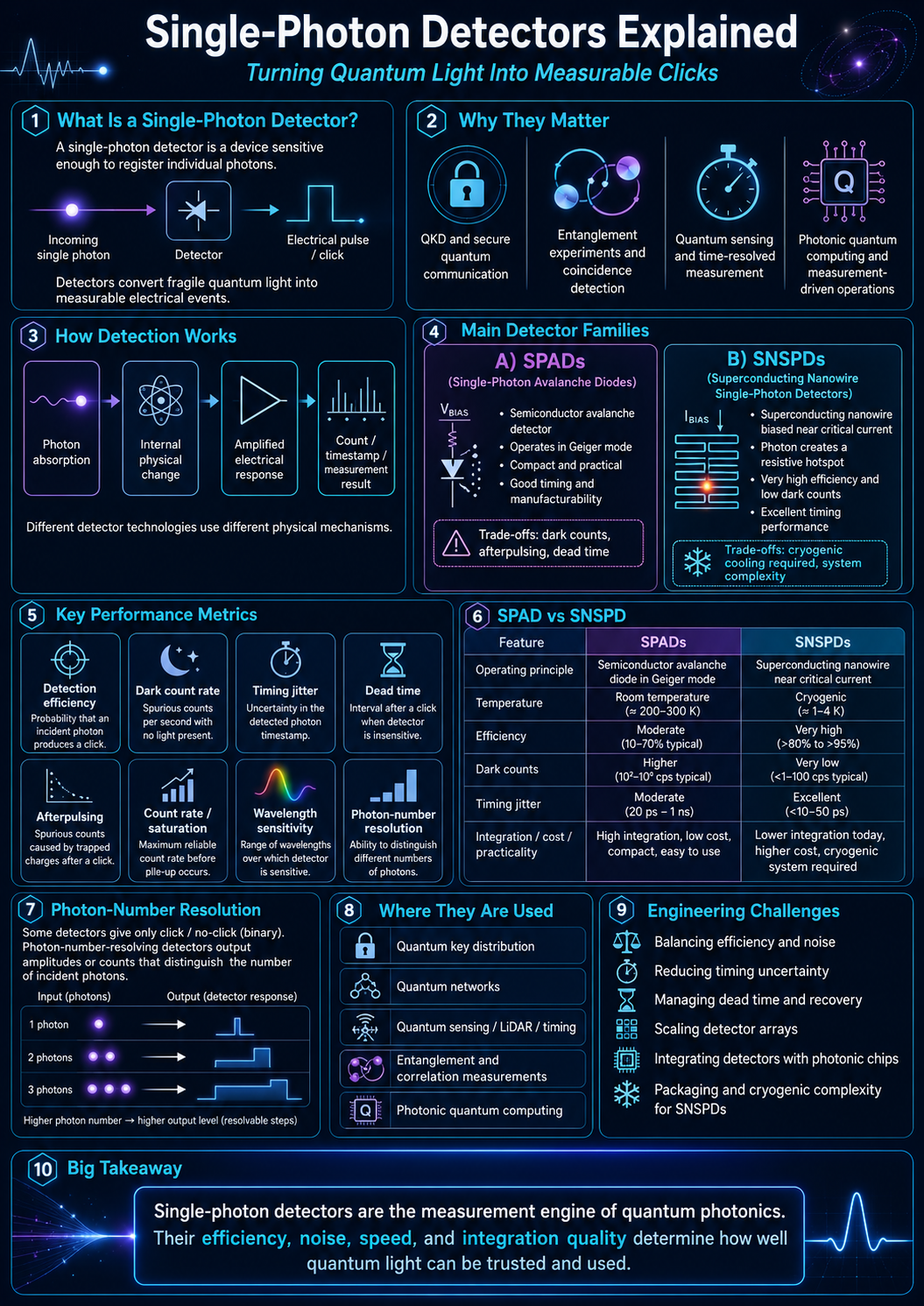
Offer this as a downloadable single-photon-detectors study reference.
Connect this form to your email platform and send visitors the full-size Single-Photon Detectors infographic. This keeps the page educational while turning the visual reference into a useful lead magnet.
Single-photon detectors turn quantum light into measurable events.
A single-photon detector registers individual photons and outputs an electrical signal that can be counted, timestamped, and processed. Detectors are the measurement side of quantum photonics.
Two major detector families dominate many quantum-photonics discussions: single-photon avalanche diodes, or SPADs, and superconducting nanowire single-photon detectors, or SNSPDs. SPADs are semiconductor detectors often used for photon counting and timing. SNSPDs use superconducting nanowires and can offer high efficiency, low dark counts, and excellent timing, but usually require cryogenic operation.
Single-photon sources create quantum light. Single-photon detectors decide whether that quantum light can actually be measured, trusted, and used.
A single-photon detector is sensitive enough to register one photon.
Ordinary optical detectors measure light intensity when many photons arrive. Single-photon detectors operate near the quantum limit, where one photon can trigger a measurable electrical response.
In many quantum systems, the detector does not measure a smooth optical wave. It produces a click: an electrical pulse indicating that a detection event happened. That click can be associated with a time, channel, polarization, path, frequency, or other measurement outcome.
Detector quality controls the reliability of quantum measurement.
If photons are lost, detected late, counted falsely, or confused with noise, the quantum protocol suffers. In QKD, detector imperfections can affect key rates and implementation security. In entanglement experiments, detector efficiency affects coincidence rates. In photonic quantum computing, detector performance shapes scalability.
Security and key rate
Detector efficiency, dark counts, afterpulsing, and timing can affect quantum bit error rates and implementation security.
Coincidence measurement
Entangled photon experiments require reliable detection of correlated events across channels.
Measurement-based operations
Many photonic computing schemes depend on fast, efficient, low-noise detection.
Different detectors turn a photon into an electrical signal in different ways.
Most single-photon detectors work by converting the energy of an absorbed photon into a measurable electronic response. The physical mechanism depends on the detector type.
The photon deposits energy
A photon interacts with a material and creates an electronic or thermal change.
A small event becomes measurable
The device amplifies the photon-triggered event into a detectable pulse.
The system records a click
Electronics count, timestamp, and route detection events into the quantum protocol.
Single-photon avalanche diodes use avalanche gain to detect photons.
A SPAD is a semiconductor avalanche photodiode designed to operate in Geiger mode. When a photon creates an electron-hole pair, the high electric field can trigger an avalanche of carriers, producing a measurable pulse.
SPADs are important because they can be compact, manufacturable, and compatible with imaging, LiDAR, time-resolved measurement, and many quantum-optics setups. Silicon SPADs are common for visible and near-infrared wavelengths, while InGaAs/InP SPADs are often used around telecom wavelengths.
Superconducting nanowire detectors use cryogenic nanowires to detect photons.
An SNSPD uses a thin superconducting nanowire biased near its critical current. When a photon is absorbed, it locally disrupts superconductivity, creating a resistive hotspot and an electrical pulse.
SNSPDs are often favored in demanding quantum photonics because they can offer high system detection efficiency, low dark counts, fast recovery, and excellent timing performance. The trade-off is that they typically require cryogenic cooling.
| Detector Type | Core Mechanism | Major Strength | Major Constraint |
|---|---|---|---|
| SPAD | Photon-triggered avalanche in a semiconductor diode | Compact, practical, scalable semiconductor technology | Dark counts, afterpulsing, dead time, and wavelength/material trade-offs |
| SNSPD | Photon creates a resistive hotspot in a superconducting nanowire | High efficiency, low noise, excellent timing in demanding quantum systems | Usually requires cryogenic operation and specialized packaging |
| Transition-edge sensor | Photon energy changes resistance at a superconducting transition | Can provide photon-number and energy resolution | Slower operation and cryogenic complexity |
Detector performance is measured by more than sensitivity.
A detector must detect useful photons while avoiding false clicks, timing uncertainty, and saturation. The right detector depends on the wavelength, count rate, timing requirement, noise tolerance, and operating environment.
Probability of catching a photon
Higher efficiency improves key rates, coincidence rates, and system throughput.
False clicks without photons
Dark counts add noise and can increase quantum bit error rates.
Uncertainty in event time
Low jitter is critical for time-bin encoding, coincidence measurement, and high-rate systems.
Recovery time after a click
Shorter dead time allows higher count rates and less missed data.
False events after detection
Especially relevant in some avalanche diode systems where trapped carriers can cause later false counts.
Spectral compatibility
The detector must match the photon source, fiber network, chip platform, or quantum memory wavelength.
Some systems need to know how many photons arrived, not just whether one arrived.
Many detectors are click/no-click devices: they indicate that at least one photon was detected. But some quantum photonic protocols benefit from photon-number-resolving detection, where the detector can distinguish one photon from two or more photons.
Photon-number resolution can be achieved through specialized detector physics, detector arrays, multiplexing, or transition-edge sensors, depending on the system requirements.
Click detectors answer: “Did a photon arrive?” Photon-number-resolving detectors ask: “How many photons arrived?”
Single-photon detectors are used wherever quantum light is measured.
Detectors are not just support hardware. They define whether a quantum optical experiment or system can produce reliable data.
Detect encoded photons
Bob’s detector choices and performance affect key generation and error rates.
Measure entanglement events
Entanglement distribution and swapping require precise detection and timing.
Read out optical states
Measurement-based photonic computation depends on efficient, scalable detection.
Detect weak signals
Single-photon counting enables high-sensitivity measurement in specialized systems.
Time-of-flight detection
Photon counting can measure extremely weak reflected optical signals.
Time-resolved imaging
SPAD arrays and timing electronics support fluorescence lifetime and low-light imaging.
Integrated detectors move measurement onto photonic chips.
For scalable quantum photonics, detectors need to be integrated with sources, waveguides, switches, interferometers, filters, and control electronics. Integrated SNSPDs and SPADs are active areas of development because they can reduce coupling loss, improve compactness, and support larger circuits.
The challenge is compatibility. Photonic material platforms, detector materials, cryogenic packaging, electrical readout, heat load, and fabrication processes all need to work together.
Integrated quantum photonics needs detectors that are not just sensitive — they must be scalable, packageable, and compatible with real photonic circuits.
The perfect single-photon detector does not exist yet.
An ideal detector would have 100% efficiency, zero dark counts, zero timing jitter, zero dead time, photon-number resolution, broad wavelength coverage, room-temperature operation, low cost, easy integration, and high reliability. Real detectors involve trade-offs.
Single-photon detectors are moving from lab instruments to integrated system components.
The next generation of quantum photonic systems will require better detector integration, higher efficiency, lower noise, improved timing, scalable arrays, photon-number resolution, and compatibility with practical packaging.
Once sources and detectors are understood, the next QCLS quantum page should move into **Photonic Quantum Computing Explained**, because scalable photonic computing depends on high-quality sources, low-loss circuits, entanglement, interference, and measurement.
Single-photon detectors, explained clearly.
What is a single-photon detector?
A single-photon detector is a device sensitive enough to register individual photons and convert those detections into electrical signals.
What is an SNSPD?
An SNSPD is a superconducting nanowire single-photon detector that uses a cryogenic superconducting nanowire to detect photon absorption events.
What is a SPAD?
A SPAD is a single-photon avalanche diode. It uses avalanche multiplication in a semiconductor diode to turn a photon event into a measurable pulse.
What are dark counts?
Dark counts are false detection events that occur even when no intended photon is present.
Why does timing jitter matter?
Timing jitter is uncertainty in when a photon was detected. Low jitter is important for time-bin encoding, coincidence measurements, and high-speed protocols.
Do detectors affect QKD security?
Yes. Detector efficiency, noise, timing behavior, afterpulsing, and side channels can affect real QKD implementation security.