
Photonics vs Electronics
Electronics uses electrons to compute, store, switch, and control information. Photonics uses photons to transmit, route, sense, measure, and increasingly move information at massive scale. The future is not one replacing the other — it is electronic-photonic systems using each domain where it performs best.
Electronics
Best for logic, memory, control, switching, arithmetic, and dense computation.
Photonics
Best for high-bandwidth data movement, distance, sensing, optical I/O, and quantum links.
Photonics vs Electronics at a Glance
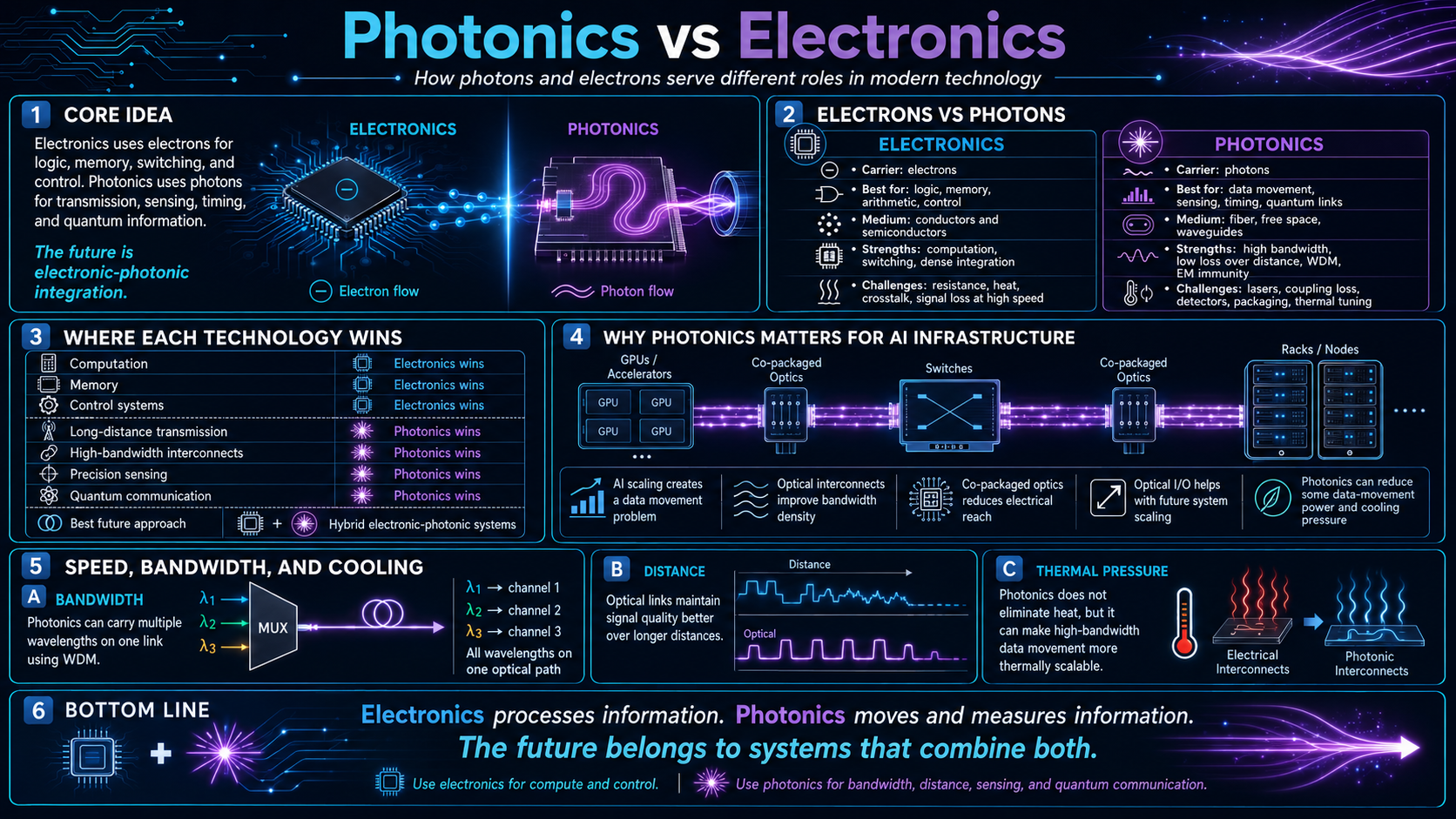
This study graphic summarizes the core lesson of the page: electronics processes and controls information, while photonics moves, measures, and connects information through light.
Offer this as a downloadable study reference.
Connect this form to your email platform and send visitors the full-size Photonics vs Electronics infographic. This gives the page a useful lead magnet while keeping the visual freely visible for trust and SEO.
Electronics processes information. Photonics moves and measures information.
The simplest comparison is accurate but incomplete: electronics uses electrons, and photonics uses photons. The deeper engineering reality is that each technology excels in different parts of a system.
Electronics is unmatched for dense digital logic, memory, control, switching, arithmetic, cache systems, power regulation, and general-purpose computation. It is the foundation of modern processors, memory chips, controllers, sensors, power electronics, and digital systems.
Photonics is strongest when the system problem involves high-bandwidth transmission, long-distance communication, low-loss interconnects, wavelength parallelism, electromagnetic isolation, precision sensing, optical timing, or quantum information transfer.
The future is not photonics replacing electronics everywhere. The future is electronic-photonic integration: electrons for logic and control, photons for movement, sensing, timing, and quantum communication.
Photonics vs electronics: where each one wins.
Good system design does not ask which technology is “better” in the abstract. It asks which physical carrier is better for the function being performed.
| System Function | Electronics | Photonics |
|---|---|---|
| Physical carrier | Electrons and electrical signals | Photons and optical fields |
| Primary strength | Logic, memory, arithmetic, switching, control | High-bandwidth transmission, sensing, timing, quantum links |
| Best distance regime | Very short to moderate distances, especially inside chips and boards | Longer distance and high-bandwidth communication through fiber and waveguides |
| Bandwidth scaling | Higher signaling rates, more lanes, equalization, advanced encoding | High optical carrier frequencies plus wavelength-division multiplexing |
| Power challenge | Resistive loss, capacitance, signal conditioning, equalization, heat | Lasers, modulators, detectors, coupling loss, thermal tuning, packaging |
| Noise and interference | Can suffer from crosstalk and electromagnetic interference | Optical fiber is strongly immune to many electrical interference problems |
| Integration path | CMOS, transistors, memory, digital systems, advanced packaging | Integrated photonics, silicon photonics, photonic integrated circuits, optical I/O |
| Likely future role | Compute, control, memory, logic, local signaling | Optical interconnects, chip-to-chip communication, sensing, quantum networking |
Why electronics remains dominant for computation.
Electronics is the foundation of modern computing because electrons can be controlled extremely well inside semiconductor devices. Transistors can switch, amplify, store, and manipulate electrical signals at enormous density.
Modern processors, memory chips, GPUs, networking ASICs, controllers, and power systems all depend on electronic circuits. Electronics remains superior for dense digital operations because transistors are small, manufacturable, programmable, and deeply integrated with memory and software ecosystems.
Transistors switch efficiently
Digital logic relies on the controlled movement of charge through semiconductor devices.
Electrons store state
Electronic systems can store information in memory cells, registers, caches, and storage devices.
Electronics coordinates systems
Control loops, timing, switching, drivers, firmware, and software interfaces are electronic strengths.
That is why photonics does not simply replace electronics. A photonic system still needs lasers, drivers, modulators, detectors, amplifiers, control electronics, calibration, signal processing, and often digital logic around it.
Why photonics becomes powerful when data movement is the bottleneck.
Photonics uses light as the information carrier. Light can propagate through optical fiber, free space, and waveguides. It can be modulated, routed, filtered, detected, split, combined, interfered, multiplexed, and integrated onto chips.
Photonics is especially powerful when bandwidth, distance, signal integrity, timing, sensing precision, or quantum state transmission becomes more important than dense digital logic.
Photonics is not faster by magic. It is faster in the right architecture.
It is common to say “light is faster,” but serious engineering requires a more careful explanation. System speed depends on the entire link: source, driver, modulator, channel, detector, receiver, packaging, clocking, signal processing, and thermal control.
Photonics gains its advantage from high optical carrier frequencies, wavelength parallelism, low-loss transmission over distance, and reduced electromagnetic interference.
Wavelength-division multiplexing
One of photonics’ strongest advantages is that multiple wavelengths of light can travel through the same fiber or waveguide simultaneously. Each wavelength can carry a separate stream of data.
λ2 → data channel 2
λ3 → data channel 3
λ4 → data channel 4
All wavelengths travel through the same optical path.
This is a unique scaling dimension. Electrical systems can add lanes and increase signaling rates, but photonics can also add optical wavelengths inside the same physical medium.
Photonics helps when electrical data movement becomes too power-hungry.
Electrical interconnects lose energy through resistance, capacitance, high-frequency effects, dielectric loss, equalization, retiming, and signal conditioning. As data rates rise and distances increase, these losses can become a major part of system power.
Photonics can reduce some of that pressure because optical links can move high-bandwidth data with lower distance-related loss in the right regimes. This matters for AI clusters, data centers, switches, optical interconnects, and high-performance computing systems.
Photonics does not mean “no heat.” It means high-bandwidth data movement can become more thermally scalable when optical links are used in the right places.
Photonic systems still consume power. Lasers, drivers, modulators, detectors, receiver electronics, thermal tuning, and packaging all matter. Bad coupling loss or inefficient lasers can erase much of the advantage.
AI makes the photonics vs electronics question urgent.
Artificial intelligence is usually described as a compute revolution. At infrastructure scale, it becomes a data movement problem. GPUs, accelerators, memory, storage, and switches need to move enormous amounts of information continuously.
Electronics still performs the computation. But photonics increasingly helps move the data between components, racks, switches, data centers, and eventually packages or chips.
Moving data with light
Optical links help connect servers, racks, switches, and data-center systems with high bandwidth.
Light closer to silicon
Optical engines move closer to switching or compute chips to reduce high-speed electrical reach.
Beyond the board bottleneck
Future architectures may bring photonic communication closer to processors, accelerators, and chiplets.
The practical conclusion is that AI infrastructure will likely become more electronic-photonic over time: electronic compute plus photonic data movement.
The future is electronic-photonic integration.
Photonics and electronics are not enemies. They are complementary physical technologies. The most powerful future systems will use electrons and photons together.
Compute, memory, logic, and control
Transistors remain the foundation for digital logic, CPUs, GPUs, memory, switching, firmware, and software-controlled systems.
Movement, sensing, timing, and quantum links
Light will increasingly support optical I/O, AI interconnects, sensing networks, quantum communication, and integrated photonic systems.
That is why integrated photonics matters. It brings optical functions closer to electronic systems, enabling chips and packages where electrical and optical domains work together.
Photonics vs electronics, explained clearly.
What is the difference between photonics and electronics?
Electronics uses electrons and electrical signals for logic, memory, switching, and control. Photonics uses photons and optical signals for high-bandwidth communication, sensing, timing, and quantum information.
Will photonics replace electronics?
No. Photonics will not replace electronics everywhere. Electronics remains superior for dense computation and memory. Photonics is strongest for moving and measuring information.
Why is photonics important for AI?
AI systems require massive data movement between accelerators, memory, storage, and switches. Photonics can help improve bandwidth density and reduce data-movement energy in the right links.
Is photonics more energy efficient than electronics?
Photonics can be more efficient for high-bandwidth data movement over certain distances, but it is not energy-free. Lasers, modulators, detectors, drivers, and packaging still consume power.
Why does photonics help with cooling?
Photonics can reduce some heat associated with high-speed electrical data movement and signal conditioning. However, photonic systems still need thermal management.
What is electronic-photonic integration?
Electronic-photonic integration combines electronic circuits with optical components so systems can use electronics for logic and control while using photonics for high-bandwidth data movement and sensing.