
Energy Per Bit Explained
Energy per bit measures how much energy a system spends to move or process one bit of information. In AI infrastructure, this metric matters because modern data centers move staggering amounts of data between accelerators, switches, memory, storage, racks, and optical links.
Energy Per Bit at a Glance
This study graphic summarizes the core energy-per-bit lesson: what the metric means, why AI infrastructure cares, where energy is spent in data movement, how electrical and optical approaches compare, and why photonics can help reduce energy and cooling pressure at scale.
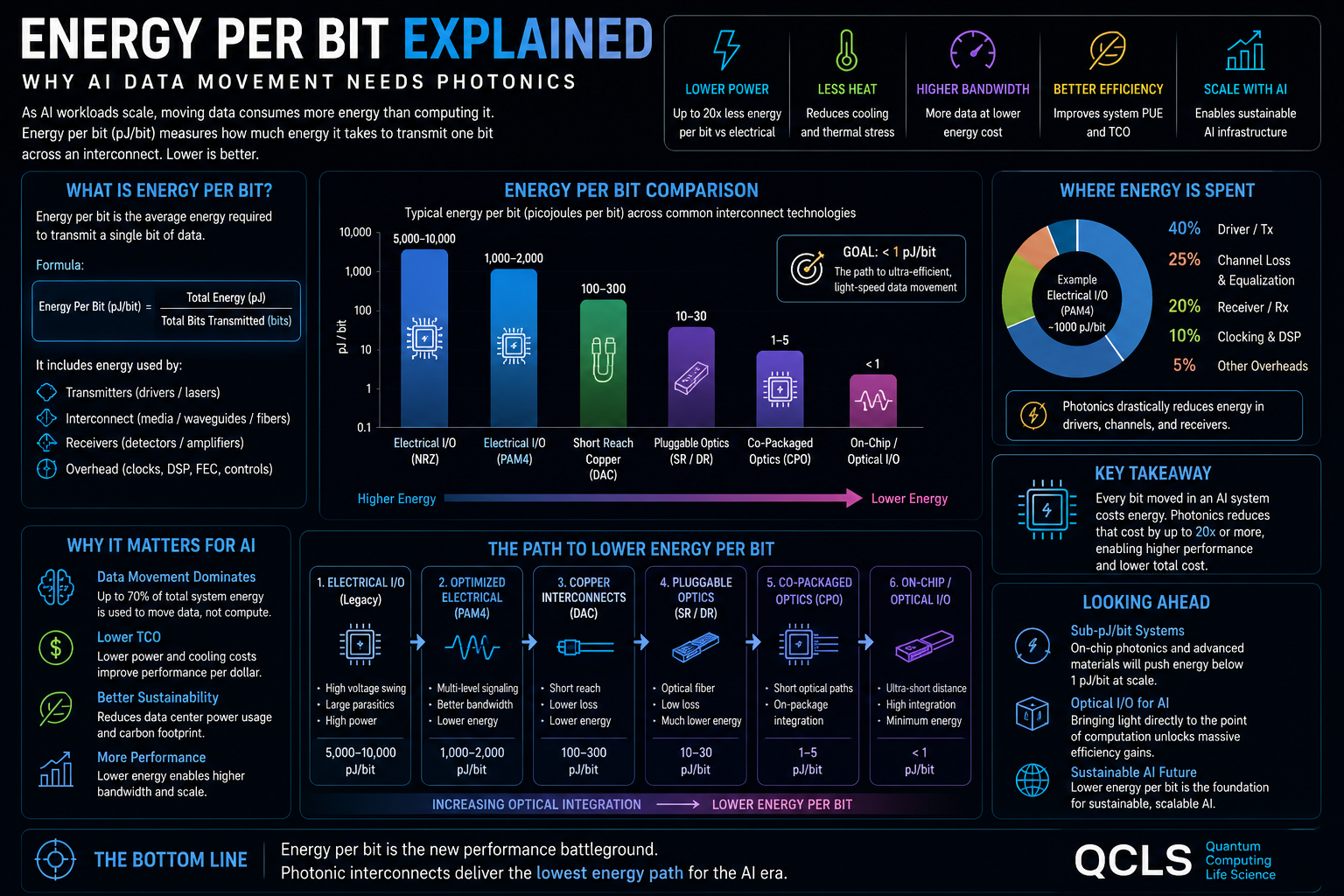
Offer this as a downloadable energy-per-bit study reference.
Connect this form to your email platform and send visitors the full-size Energy Per Bit infographic. This keeps the page educational while turning the visual reference into a useful lead magnet.
Energy per bit is the cost of moving information.
Energy per bit tells you how much energy is spent to transmit, receive, route, or process one bit of data. It is usually expressed in joules per bit, picojoules per bit, or femtojoules per bit.
For AI infrastructure, this metric is critical because the system problem is no longer only computation. It is communication. GPUs, accelerators, switches, memory, storage, and racks exchange massive amounts of data. Even a tiny amount of energy per bit becomes enormous when multiplied across trillions or quadrillions of bits.
AI infrastructure is power-limited because compute is expensive — but data movement is also expensive. Energy per bit makes that cost visible.
Energy per bit measures energy divided by information moved.
The basic idea is simple: take the total energy used by a communication or processing operation and divide it by the number of bits moved or processed.
Common units:
1 pJ/bit = one trillionth of a joule per bit
1 fJ/bit = one quadrillionth of a joule per bit
Lower energy per bit means more efficient data movement. But the metric must be used carefully. A link may look efficient at one distance, speed, temperature, or traffic pattern and less efficient under real deployment conditions.
AI turns small per-bit costs into huge power budgets.
Large AI clusters move data constantly. Model training, inference, memory access, synchronization, checkpointing, and distributed communication all require data movement. If every bit costs too much energy, the data center becomes power-limited and cooling-limited.
AI moves massive data volumes
Huge models and distributed systems multiply the cost of every bit transferred.
Slow links waste compute
If data movement cannot keep up, accelerators can sit idle waiting for communication.
Power becomes heat
Energy spent moving data ultimately adds to the thermal burden of the system.
Electrical data movement becomes harder as speed and distance increase.
Electrical links are essential and will remain essential. But high-speed electrical communication faces resistance, capacitance, crosstalk, reflections, skin effect, dielectric loss, equalization, retiming, and signal-conditioning overhead.
As bandwidth rises, the system often needs stronger drivers, more complex receivers, better materials, shorter reach, tighter packaging, and more power.
Photonics can reduce energy pressure where data movement dominates.
Photonic links use light to carry information. In the right architecture, optical interconnects can improve reach, bandwidth density, and data-movement efficiency compared with long high-speed electrical paths.
The advantage is strongest when the system needs to move huge bandwidth across distances where copper becomes lossy, hot, or physically difficult.
Light travels efficiently through fiber
Optical links can preserve signal quality over longer distances than high-speed copper links.
Multiple wavelengths share one path
Wavelength-division multiplexing lets many channels travel through the same fiber or waveguide.
More data in less physical space
Optical interconnects can increase bandwidth without adding endless copper lanes.
Energy per bit must include the whole link, not just the fiber.
It is misleading to compare “light” against “copper” without counting the full system. A photonic link includes lasers, modulators, drivers, detectors, receivers, control circuits, thermal tuning, coupling, packaging, and sometimes DSP.
| Link Element | Energy Impact | Why It Matters |
|---|---|---|
| Laser source | Can dominate power if inefficient or always on | Laser placement and efficiency are central to optical-link economics. |
| Modulator | Requires electrical drive energy | Low-voltage, high-speed modulators help reduce pJ/bit. |
| Detector + receiver | Consumes power recovering the signal | Noise, sensitivity, and bandwidth affect receiver energy. |
| Coupling loss | Forces more optical power | Bad fiber-to-chip coupling can erase efficiency gains. |
| Thermal tuning | Adds static power | Photonic devices can drift and require active stabilization. |
| DSP / retiming | Adds electronic overhead | Complex signaling can improve reach but increases power. |
Moving optics closer to silicon can reduce electrical reach.
Co-packaged optics, optical I/O, and photonic chiplets all aim to shorten the most difficult high-speed electrical paths. The goal is to convert data into light closer to the ASIC, accelerator, or package that needs bandwidth.
Optics near switch silicon
Co-packaged optics reduces the board-level electrical distance between ASIC and optical engine.
Light near compute
Optical I/O moves photonic data paths closer to processors, accelerators, and packages.
Modular optical tiles
Photonic chiplets can add optical connectivity to advanced multi-die packages.
WDM improves the energy equation by increasing bandwidth per optical path.
Wavelength-division multiplexing lets multiple wavelengths carry separate data streams through the same fiber or waveguide. This can improve bandwidth density and reduce the number of physical links needed for a given aggregate throughput.
λ2 → channel 2
λ3 → channel 3
λ4 → channel 4
More wavelengths = more bandwidth on the same optical path.
WDM is not free. It requires lasers, filters, multiplexers, demultiplexers, thermal stability, and wavelength control. But when engineered well, it gives photonics a powerful scaling dimension.
Every bit of wasted energy becomes heat.
Energy per bit matters because power becomes heat. In AI data centers, cooling is not just a facility problem. It is a system architecture problem. Reducing data-movement energy can reduce thermal pressure across boards, packages, racks, and facilities.
Photonics does not eliminate heat. It can reduce interconnect-related heat pressure when optical links replace the most inefficient high-speed electrical paths.
This is why energy per bit must be evaluated at the full system level: compute power, interconnect power, laser power, cooling load, reliability, serviceability, and utilization all matter.
Low energy per bit is difficult in real systems.
A photonic link can look excellent on a device-level chart but struggle in deployment if packaging, lasers, coupling, control, or reliability are weak.
Light generation can cost power
Laser power must be managed carefully, especially in large-scale systems with many links.
Lost light requires more power
Fiber-to-chip and package-level optical loss can increase total energy per bit.
Stability costs energy
Some photonic devices need active control to maintain wavelength alignment.
Always-on links can waste power
Energy efficiency depends on utilization, sleep states, and whether links scale with demand.
Signal processing is not free
Complex modulation and equalization can add electronic power to optical links.
Efficient must also be durable
AI data centers need links that remain stable under heat, vibration, aging, and service cycles.
The next AI bottleneck is not just FLOPS. It is joules per bit.
AI infrastructure will keep pushing for more compute, more memory bandwidth, more network bandwidth, and more efficient data movement. Energy per bit will become one of the key metrics for evaluating interconnect technologies.
The future likely combines electronic compute with photonic data movement: CPO for switching, optical I/O for packages, photonic chiplets for modular integration, silicon photonics for optical engines, WDM for scaling, and better control systems for energy-proportional operation.
Energy per bit, explained clearly.
What is energy per bit?
Energy per bit is the amount of energy required to move, transmit, receive, or process one bit of information.
Why does energy per bit matter for AI?
AI systems move enormous amounts of data. Even tiny energy costs per bit become large power and cooling burdens when multiplied across massive AI clusters.
Is photonics always lower energy than electronics?
No. Photonics can be lower energy in the right bandwidth and distance regimes, but the full link must include lasers, drivers, detectors, coupling, thermal tuning, and packaging.
How does CPO reduce energy per bit?
CPO can shorten high-speed electrical paths between ASICs and optical engines, reducing signal loss and electrical compensation pressure.
How does WDM affect energy per bit?
WDM increases bandwidth per optical path by sending multiple wavelengths through the same fiber or waveguide, which can improve bandwidth density and link utilization.
What can ruin optical energy efficiency?
Inefficient lasers, high coupling loss, thermal tuning power, receiver overhead, DSP power, poor utilization, and packaging losses can reduce or erase the advantage.