
Co-Packaged Optics Explained
Co-packaged optics moves optical engines closer to high-performance switching or compute silicon. Instead of sending high-speed electrical signals across long board traces to front-panel pluggable modules, CPO shortens the electrical path and converts data to light much closer to the ASIC.
Co-Packaged Optics at a Glance
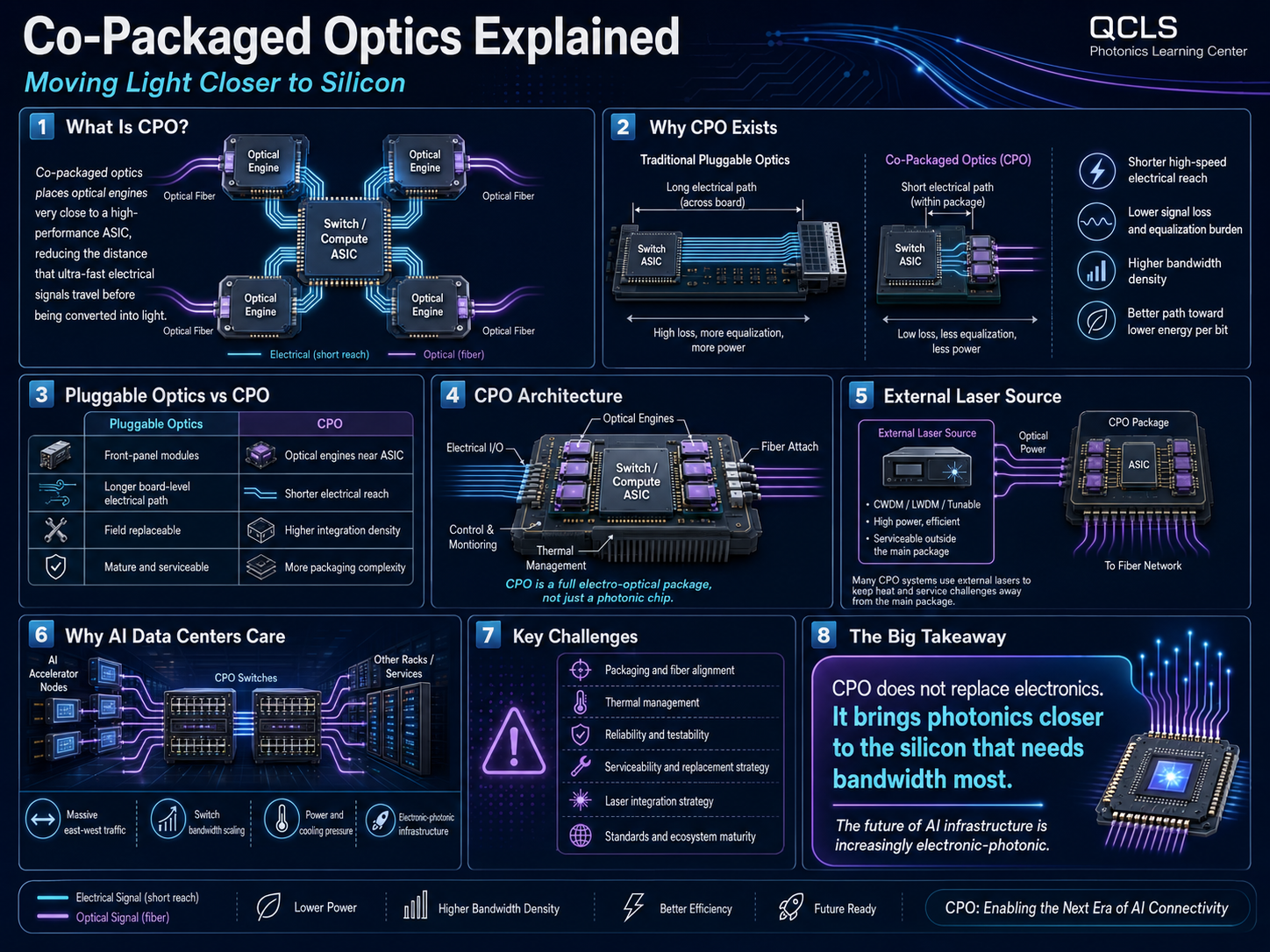
This study graphic summarizes the core CPO lesson: why optics moves closer to the ASIC, how co-packaged optics differs from pluggable optics, what the architecture looks like, why external laser sources matter, and how CPO supports AI data-center bandwidth density and efficiency.
Offer this as a downloadable co-packaged optics study reference.
Connect this form to your email platform and send visitors the full-size Co-Packaged Optics infographic. This keeps the page educational while turning the visual reference into a useful lead magnet.
CPO moves optical conversion closer to the silicon that needs bandwidth.
Co-packaged optics, or CPO, integrates optical engines very close to a high-performance ASIC, most often a switch ASIC in data-center networking. The goal is to reduce the distance that very high-speed electrical signals must travel before they are converted into light.
Traditional pluggable optics place optical modules at the faceplate of a switch. That is serviceable and mature, but the switch ASIC still has to drive high-speed electrical signals across the board to the pluggable module. As link rates and switch bandwidth rise, that electrical reach becomes more power-hungry and difficult.
CPO is not simply a smaller transceiver. It is a packaging architecture that moves the optical engine into the high-performance silicon ecosystem.
Co-packaged optics places optical engines near the ASIC instead of at the front panel.
A co-packaged optics system combines high-performance electronics and photonic devices in a tightly integrated package or module. The optical engine may include photonic integrated circuits, modulators, photodetectors, electronic drivers, receivers, and fiber coupling structures.
The switch ASIC still performs switching and packet processing electronically. The optical engines convert high-speed electrical data into optical signals close to the ASIC, then send the information through fiber.
Instead of:
Switch ASIC → long board trace → front-panel pluggable module → fiber
High-speed electrical reach becomes expensive as bandwidth rises.
At high data rates, electrical channels become harder to drive across distance. Board traces, connectors, packages, and modules introduce loss, reflections, crosstalk, equalization requirements, retiming, and heat.
CPO exists to shorten that electrical path. By moving optical conversion closer to the ASIC, the system can reduce electrical channel loss and shift more of the data movement into the optical domain.
Shorter high-speed paths
CPO reduces the distance very fast electrical signals must travel before becoming optical.
Less signal conditioning pressure
Shorter electrical paths can reduce the need for heavy equalization, retiming, and compensation.
More optical bandwidth near silicon
Optical engines can support dense fiber connectivity close to the switching or compute package.
CPO trades serviceability simplicity for integration density.
Pluggable optics are mature, standardized, field-replaceable, and familiar to data-center operators. CPO is more integrated and potentially more efficient, but harder to package, test, cool, repair, and standardize.
| Design Choice | Pluggable Optics | Co-Packaged Optics |
|---|---|---|
| Optics location | Front-panel module | Near or inside the ASIC package/module ecosystem |
| Electrical reach | Longer path from ASIC to module | Shorter path from ASIC to optical engine |
| Serviceability | Easy field replacement | More difficult because optics are integrated with the system |
| Power potential | Can require more electrical compensation at very high speeds | Can reduce electrical loss and signal-conditioning pressure |
| Packaging difficulty | Lower system integration burden | Higher optical, electrical, thermal, and mechanical complexity |
| Best fit | Mature deployments and modular upgrades | Future high-bandwidth switches, AI fabrics, and dense optical I/O |
A co-packaged system is a full electro-optical package.
CPO is not only a photonic chip. It is a complete integration architecture involving the ASIC, optical engines, fiber attach, lasers, drivers, receivers, thermal control, monitoring, firmware, and system-level service strategy.
The electronic core
The ASIC performs switching, packet processing, buffering, and high-speed electrical I/O.
The conversion layer
Optical engines convert electrical data into optical signals and received light into electrical data.
The optical circuit
PICs may include modulators, detectors, couplers, filters, splitters, and WDM components.
Drivers and receivers
Electrical circuits drive modulators, amplify detector outputs, and condition signals.
The physical interface
Light must enter and exit the package efficiently with low loss and high reliability.
The stability layer
CPO must manage ASIC heat, optical drift, laser stability, and packaging reliability.
Many CPO designs separate laser generation from optical modulation.
One major CPO question is where the laser should live. Placing high-power lasers close to a hot ASIC can create thermal and reliability challenges. External laser source concepts place lasers in a more serviceable and thermally favorable location while feeding continuous-wave optical power to the co-packaged optical engines.
The important idea is that the optical engine does not always need to generate the light itself. It may receive laser light from an external source, then modulate that light with data near the ASIC.
External laser approaches try to preserve one advantage of pluggables — serviceability — while still allowing the optical engines to sit close to the ASIC.
AI infrastructure is one of the strongest reasons CPO matters.
AI clusters need massive bandwidth between accelerators, memory, switches, racks, and data-center fabrics. As clusters scale, the switching layer becomes central. CPO is most often discussed around high-radix, high-bandwidth switches because the switch ASIC must connect enormous amounts of traffic.
CPO is powerful because it is integrated — and difficult for the same reason.
The same integration that gives CPO its potential also creates deployment challenges. A data-center operator needs the system to be reliable, manufacturable, repairable, testable, and economically sensible.
What happens when optics fail?
Pluggables can be swapped at the faceplate. Co-packaged optics require a new strategy for field replacement and repair.
Optics live near hot silicon
ASIC heat can affect optical wavelength stability, laser reliability, and package performance.
Fiber attach is hard
Low-loss optical coupling, mechanical stability, and scalable assembly are major barriers.
Every link must be verified
High-volume CPO systems need electrical, optical, thermal, and mechanical test flows.
Interoperability matters
CPO requires agreement around interfaces, modules, lasers, control, and service models.
Better performance must justify complexity
The system benefit must outweigh the higher integration and deployment burden.
CPO is part of the shift toward electronic-photonic infrastructure.
Co-packaged optics is not just an optical component trend. It is a system architecture trend. It reflects the broader move toward placing photonics closer to the electronic silicon that generates, switches, and consumes data.
The long-term direction includes co-packaged switch optics, optical I/O near compute, photonic chiplets, external laser sources, remote laser architectures, high-bandwidth optical fabrics, and deeper integration between silicon photonics and advanced packaging.
Co-packaged optics, explained clearly.
What is co-packaged optics?
Co-packaged optics places optical engines very close to a high-performance ASIC, reducing the distance that high-speed electrical signals travel before becoming optical.
Why does CPO matter?
CPO matters because high-bandwidth switches and AI data-center fabrics need more bandwidth density and lower power per bit than long electrical paths can easily support.
Does CPO replace pluggable optics?
Not immediately. Pluggables remain mature and serviceable. CPO is more likely to appear where bandwidth density and electrical reach make pluggables increasingly difficult.
What is an optical engine?
An optical engine is the electro-optical module that converts electrical data into optical signals and received light back into electrical signals.
Why use an external laser?
External lasers can improve serviceability and thermal placement by keeping high-power laser sources away from the hottest ASIC region while feeding light to optical engines.
What are the biggest CPO challenges?
The biggest challenges include serviceability, packaging, fiber coupling, laser strategy, thermal management, testing, reliability, standardization, and economics.