
How Photonics Helps Data Center Cooling
AI data centers are power-dense thermal systems. Photonics does not make heat disappear, but it can reduce the energy wasted moving data — and every watt not wasted in interconnects is a watt that does not have to be removed as heat.
AI Rack
Photonics and Data Center Cooling at a Glance
This study graphic summarizes the core lesson: photonics does not cool a data center directly, but it can reduce the energy wasted moving data. That lowers interconnect-related heat, reduces thermal pressure, and helps AI infrastructure scale more efficiently.
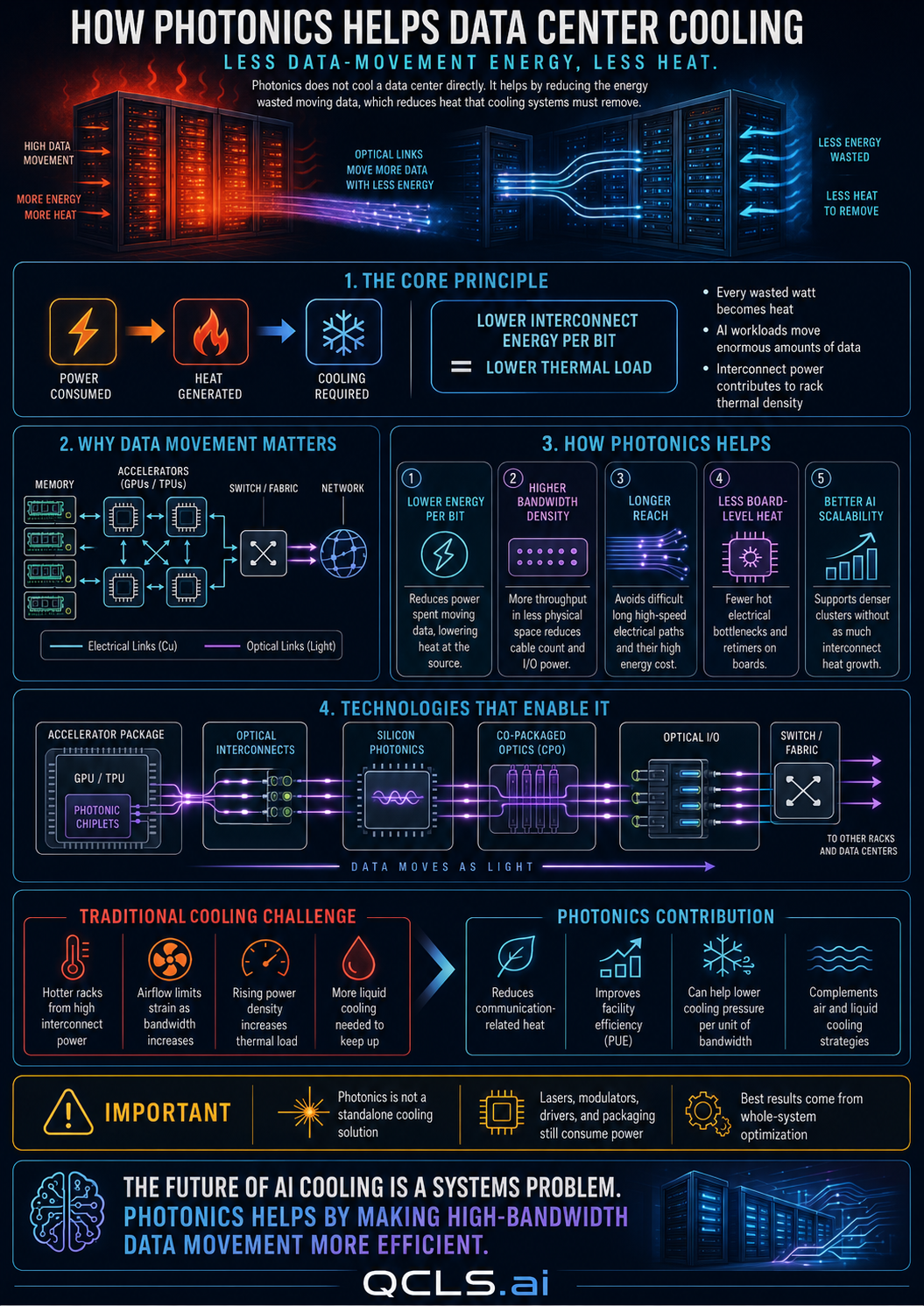
Offer this as a downloadable data-center-cooling study reference.
Connect this form to your email platform and send visitors the full-size Data Center Cooling infographic. This keeps the page educational while turning the visual reference into a useful lead magnet.
Photonics helps cooling by reducing the energy wasted moving data.
Data-center cooling is the process of removing heat generated by compute, networking, memory, power conversion, storage, and infrastructure systems. In AI data centers, cooling becomes harder because accelerators and high-speed interconnects concentrate enormous power into racks and rooms.
Photonics does not cool a data center by itself. It helps by making high-bandwidth data movement more efficient in the right places. Lower interconnect power means lower heat generation. Lower heat generation means less cooling burden, better rack density, improved reliability, and potentially better total cost of ownership.
The most honest way to say it: photonics is not a cooling system. Photonics is a heat-reduction strategy for the data-movement layer.
AI data centers are becoming thermal bottlenecks.
AI systems concentrate high-power GPUs, accelerators, memory, switches, storage, and power conversion into dense infrastructure. As clusters scale, the limiting factor is often not only compute availability. It is power delivery, heat rejection, airflow, liquid cooling, facility capacity, and grid access.
Cooling exists because nearly all electrical power consumed by IT equipment becomes heat. If a data center uses more power, it must reject more heat. That is why reducing the power used for data movement can matter.
Accelerators dominate rack power
AI GPUs and XPUs convert large amounts of electrical power into heat during training and inference.
Interconnects add load
Switches, transceivers, SerDes, retimers, cables, and optical engines all contribute to thermal load.
Cooling consumes infrastructure capacity
Airflow, liquid loops, chillers, pumps, fans, and heat exchangers all become part of the system cost.
Every wasted watt becomes a cooling problem.
For practical data-center engineering, electrical energy consumed inside IT equipment eventually becomes heat that must be removed. This is why energy per bit connects directly to cooling.
More heat inside racks → more cooling capacity required
More cooling capacity → more facility cost, complexity, and operating burden
Reducing interconnect power does not eliminate the heat from computation. But it can reduce the heat associated with moving data between chips, boards, racks, switches, and facilities.
AI cooling is not only about compute. It is also about communication.
AI training and inference involve constant communication between accelerators, memory, storage, and network fabrics. The larger the system, the more important data movement becomes.
Electrical interconnects consume power through drivers, receivers, equalization, retiming, resistance, capacitance, crosstalk control, and signal conditioning. At high speed and longer reach, those overheads can become significant.
Photonics moves high-bandwidth data with less electrical struggle.
Photonics uses light to carry information through fiber or waveguides. In the right bandwidth and distance regimes, optical interconnects can reduce the energy spent fighting electrical channel loss.
Less heat from data movement
More efficient interconnects reduce power consumed by communication, which reduces cooling burden.
Less signal conditioning
Optical links can move high-speed data farther without the same copper reach penalty.
More data in less space
WDM and fiber can move more data through constrained physical paths.
Fewer hot electrical lanes
Optical paths reduce pressure on dense board traces, connectors, cables, and retimers.
More bandwidth per thermal budget
Efficient optical interconnects help AI systems scale without as much interconnect heat.
Lower thermal stress
Lower heat can improve component margin and reduce stress on systems.
Cooling benefits improve as optics moves closer to hot silicon.
Co-packaged optics, optical I/O, and photonic chiplets are all ways to reduce difficult high-speed electrical reach before data becomes light. Shorter electrical reach can mean lower SerDes power, fewer retimers, less equalization, and less board-level heat.
| Architecture | Cooling-Relevant Idea | Why It Matters |
|---|---|---|
| Optical Interconnects | Move high-speed data through fiber | Reduces long-reach electrical channel loss and cable congestion. |
| Co-Packaged Optics | Move optical engines near switch ASICs | Shortens high-speed electrical paths and may reduce switch interconnect power. |
| Optical I/O | Move optical links closer to compute packages | Reduces package and board escape pressure for high-bandwidth communication. |
| Photonic Chiplets | Add modular optical I/O to advanced packages | Can move bandwidth out of AI packages with fewer electrical bottlenecks. |
| WDM | Send many channels through one optical path | Improves bandwidth density without adding endless physical links. |
Photonics complements cooling systems; it does not replace them.
Modern AI data centers increasingly use advanced cooling approaches, including high-airflow designs, rear-door heat exchangers, direct-to-chip liquid cooling, immersion concepts, and facility-level heat rejection systems.
Photonics belongs in a different layer of the problem. Cooling systems remove heat after it is generated. Photonics can reduce some heat before it is generated by lowering the power needed to move data.
Cooling technology asks: “How do we remove this heat?” Photonics asks: “Can we avoid creating some of this heat in the first place?”
Lower interconnect heat can improve the economics of AI infrastructure.
Data-center operators care about more than device-level performance. They care about facility power, cooling capacity, uptime, reliability, serviceability, rack density, deployment speed, and total cost of ownership.
If optical interconnects lower the power needed for communication, that can reduce heat load, improve cooling headroom, increase rack bandwidth density, and support more useful compute per facility constraint.
Facility overhead matters
Cooling and power delivery overhead can shape the effective cost of compute.
More bandwidth per rack
Optical links can help move more data without as much interconnect-related heat.
Efficiency affects economics
Lower power and cooling needs can improve long-term infrastructure economics.
Photonics is not a magic cooling solution.
A serious technical explanation has to include the caveats. Optical systems still consume power and generate heat. Lasers, modulators, detectors, receivers, drivers, thermal tuning, packaging, DSP, and control electronics all matter.
AI cooling will be solved by systems, not one component.
The future of AI cooling will combine better chips, lower-voltage electronics, advanced packaging, liquid cooling, improved facility design, smarter workload placement, optical interconnects, CPO, optical I/O, photonic chiplets, and better energy-aware software.
Photonics becomes important because it attacks the data-movement part of the thermal problem. As AI systems scale, moving data efficiently may be just as important as cooling the compute itself.
Photonics and data-center cooling, explained clearly.
Does photonics cool a data center directly?
No. Photonics is not a cooling system. It can reduce cooling pressure by lowering the energy wasted moving high-bandwidth data.
Why does data movement affect cooling?
Power consumed by interconnects becomes heat. The more energy used to move data, the more heat the data center must remove.
How do optical interconnects help cooling?
Optical interconnects can reduce long-reach electrical loss and signal-conditioning power in the right regimes, lowering interconnect-related heat.
How does CPO help with thermal pressure?
Co-packaged optics moves optical engines close to switch ASICs, shortening high-speed electrical reach and potentially reducing SerDes and board-level interconnect power.
Does photonics replace liquid cooling?
No. Photonics complements cooling systems. Liquid cooling removes heat; photonics can reduce some heat created by data movement.
What can reduce the cooling benefit of photonics?
Inefficient lasers, high coupling loss, thermal tuning, DSP power, poor packaging, and bad utilization can reduce or erase the advantage.